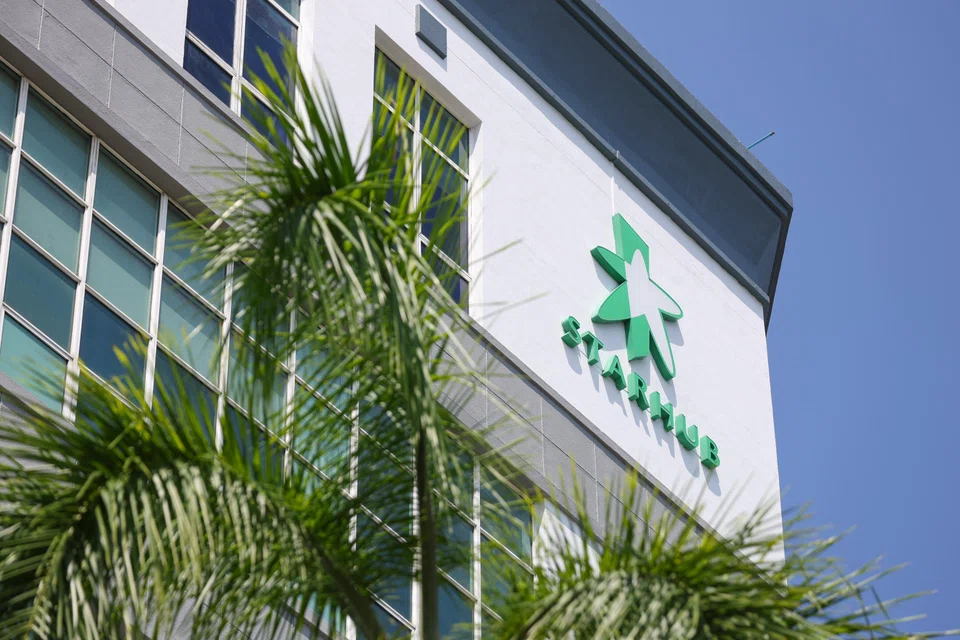
StarHub 5G upgrade may defend market share, but unlikely to reverse underlying earnings slump
Analysts warn that better connectivity may not be enough to persuade customers to pay a premium for mobile plans

[SINGAPORE] StarHub’s latest network upgrade to 5G+ on Sep 1 should help the telco retain customers and defend its market share, but is unlikely to reverse the decline in mobile revenue in Singapore, said analysts.
The 5G upgrade utilises the 700 megahertz (MHz) spectrum to improve underground and indoor coverage, and will take effect for all customers on StarHub 5G mobile plans.
With the upgrade, StarHub becomes only the second telco in Singapore – after Singtel – to offer mass market plans using the low-frequency spectrum.
The upgrade comes at a time when StarHub is experiencing shrinking profits, despite a rise in subscribers.
While StarHub reported net profit of S$255.6 million for the first half of 2026, this was boosted by a one-off gain relating to a reduction in its stake in security business Ensign.
Underlying net profit actually fell 76.1 per cent to S$12.4 million, according to Prem Jearajasingam, analyst at CGS International.
This dip in earnings comes despite a 3.8 per cent year-on-year increase in subscribers to 2.2 million, as at Jun 30. StarHub’s blended average revenue per user (ARPU) remained at S$20.
Despite the pressure on earnings, investing in better coverage remains necessary for the telco to compete, said Sachin Mittal, analyst from DBS Group Research.
But analysts warned that better connectivity may not be enough to persuade customers to pay a premium for mobile plans.
“Better coverage could improve customer experience and reduce premium-customer churn, but we see limited scope for it to drive ARPU,” said Chris Muckensturm, analyst at Bloomberg Intelligence.
Nonetheless, Singapore mobile’s underlying problem “remains structural” – despite premium network options, consumers are still able to access high-quality networks at “value-brand prices”, she said.
The 700 MHz spectrum plans are not exclusive to the telcos’ premium business segments.
“Extending better network quality across all segments and brands helps defend market share, but also weakens pricing power,” she said, citing Singtel Gomo’s 700 MHz spectrum S$11-a-month promotional pricing plan – which rises to around S$22 after three months – as an example.
Singapore’s mobile ARPU level sits about 15 to 40 per cent below that of its developed Asia-Pacific peers, noted a 2025 Maybank Research report.
Testing pricing power
But even if StarHub manages to successfully reduce customer churn and increase its market share, the true test comes following the end of promotional pricing, said analysts.
StarHub’s unlimited upgraded 5G network plan is currently priced at S$39 a month after discount. It will subsequently rise to S$78 a month after six months.
“The key trend to watch will come once the promotions lapse, and see if customers hold onto the higher-tier plans at a non-discounted price,” Muckensturm said.
For the company to compete against Singtel, which leads mobile subscriber share at 43 per cent, StarHub’s S$188 million investment for two lots of 700 MHz spectrum should allow the telco to retain market share, said analysts.
According to Bloomberg Intelligence estimates, StarHub’s mobile market share stood at 21 per cent, slightly behind M1 which has 22 per cent, but still ahead of Simba which has 14 per cent, as at June.
The key catalyst for the telco industry to recover will be through market consolidation, said analysts.
“We maintain the view that industry rationalisation is still necessary for a recovery in mobile service revenue,” said Muckensturm.
Dividend versus network investments
With the timing of consolidation uncertain, StarHub needs to continue to fund the network investments required to remain competitive while sustaining its S$0.06 dividend outlook.
The dividend policy translates to a 5.4 per cent dividend yield. Jearajasingam from CGSI forecasts StarHub’s payout ratio for the 2026 financial year to stand at 279 per cent.
“Even a payout ratio of 100 per cent is too high, if free cash flow is negative,” argued Corporate Monitor, noting that the telco should reduce or even suspend dividends to preserve cash, given the “unfavourable business outlook”.
“StarHub reported negative free cash flow in 2025 and the near-term outlook is unfavourable,” Corporate Monitor told The Business Times.
“Even considering that the spectrum acquisition cost is one-off, operating cash flow continues to deteriorate, and recurring capex as guided by the company is still significant at 13 to 15 per cent of revenue.”
StarHub reported a negative free cash flow of S$171.8 million for H1 FY2025. However, free cash flow has turned positive with the latest H1 FY2026 results, standing at S$40.6 million.
The telco attributed part of the improvement to lower capex, and the absence of the forfeiture amount it had to pay to the regulator after it returned one lot of 700 MHz spectrum. The forfeiture sum was S$14.1 million.
However, Muckensturm noted that StarHub retains some balance sheet flexibility through its potential disposal of its remaining 39 per cent stake in Ensign – which analysts value at between S$266 million and S$322 million.
“Ultimately, if cash generation was to remain below the dividend and capex, StarHub would face a choice between higher leverage or a dividend step-down,” she said.
StarHub management, in its August earnings call, maintained its S$0.06-dividend-per-share outlook.
StarHub shares ended down 0.9 per cent or S$0.01 at S$1.11 on Thursday (Sep 17).
The counter is slightly underwater, also down 0.9 per cent for the year, in contrast to the Straits Times Index, which is up around 22 per cent for the year.
TRENDING NOW
He built the Vingroup empire. Now South-east Asia’s richest man is handing some key roles to his sons
Fed hike throws Singapore banks a margin lifeline; UOB likely to benefit more
Luxury properties seized in S$3 billion money laundering case fail to sell at auction
US stocks: Tech leads Wall Street to higher close as oil eases, Treasury yields dip