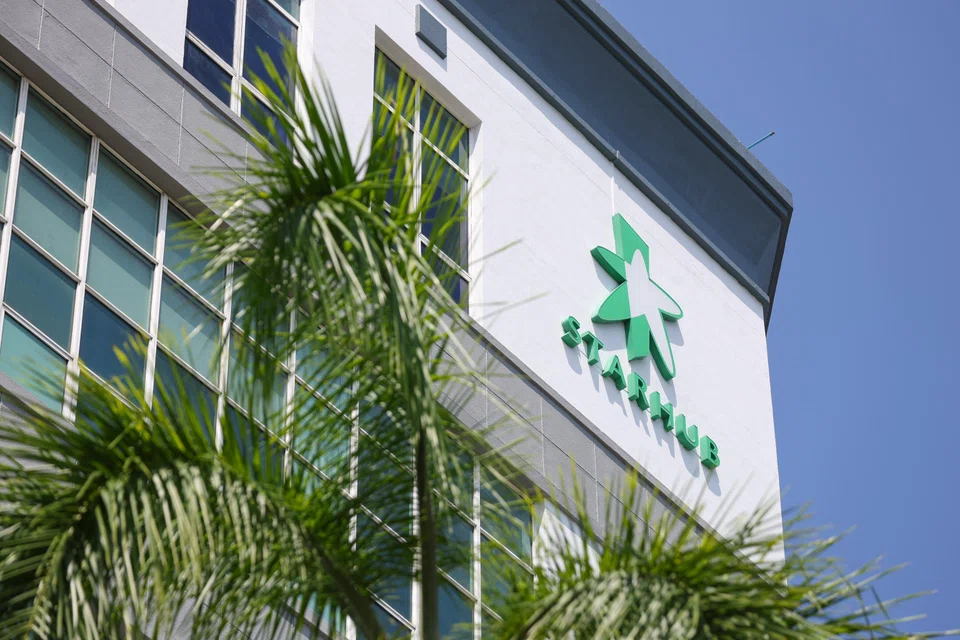
StarHub could buy M1 at below Simba’s bid, but funding poses challenge: analysts
StarHub may need to issue new shares or issue shares directly to Keppel as part of the deal, they suggest

[SINGAPORE] StarHub could acquire M1’s telco business for less than the S$1.43 billion enterprise value agreed with Simba in 2025, but financing the purchase could prove challenging and may require StarHub to raise equity, analysts have said.
Foo Zhiwei, analyst at Macquarie Capital, estimates the enterprise value of M1 to be at between S$1.16 billion and S$1.25 billion; Bloomberg Intelligence analyst Chris Muckensturm puts it at between S$1.1 billion and S$1.2 billion.
Muckensturm said: “We believe StarHub could secure a 16 to 22 per cent discount to Simba’s bid.”
The lower valuation reflects weaker domestic consumer revenue caused by intense competition, as well as the migration of MyRepublic’s 4G wholesale business from M1 to StarHub, she said.
Foo noted that the enterprise value could even fall below his original estimate to around S$1 billion, citing expectations that its earnings before interest, tax depreciation and amortisation (Ebitda) might decline in FY2026.
Based on Acra filings, M1's Ebitda was S$166 million in FY2025. Analysts expect this to fall in FY2026 as competitive pressure in Singapore’s telco market persists.
On Wednesday (Sep 23), StarHub and Keppel confirmed in separate bourse filings that they were in talks over a potential M1 deal. The announcements followed a report by The Business Times, citing sources that both companies were in advanced talks.
Muckensturm believes that the StarHub acquisition would likely target M1’s mobile operations and exclude its information and communications technology service business.
These would be terms similar to those in the Simba-M1 deal, which fell through on the back of a probe into Simba’s unauthorised spectrum use.
Fundraising challenge
Despite the lower enterprise valuation, analysts still raised concerns about the financing of the deal.
As at Jun 30, StarHub had S$515.7 million in cash and bank balances, up from S$487.1 million the year before.
Foo estimated that the telco has debt headroom of S$485 million without merger synergies, rising to as much as S$930 million if the combined company can achieve S$100 million in synergies.
Assuming S$1.16 billion in enterprise value and S$100 million in synergies, StarHub would still need to issue equity for the transaction to remain within its 4.5 times debt covenant.
This could require StarHub to issue new shares equivalent to about 12 per cent of its existing share base, said Foo, noting that the share issuance would dilute its majority shareholder’s stake from 56 to 50 per cent.
Temasek is a controlling shareholder of StarHub, with a 56.1 per cent deemed interest in the telco through Singapore Technologies Telemedia and other portfolio entities.
“We think StarHub would need to either negotiate a lower price or drive higher synergies to make the deal work,” said Foo.
An alternative would be for StarHub to issue shares directly to Keppel as part of the deal, he suggested.
This hypothetical arrangement translates to 209 million new shares issued at S$1.11 apiece, he said.
Cost savings for both StarHub and M1
A potential merger between StarHub and M1 will see a “more modest” cost saving, since both telcos already share 5G infrastructure through its Antina joint venture, Muckensturm told BT.
She estimates S$90 million to S$135 million in annual savings through channels such as IT consolidation, fixed-network optimisation and migrating operations onto StarHub’s comparatively larger operating platform.
Analysts are optimistic that the potential merger between the telcos would ease competitive pressure in Singapore’s mobile market.
“With the merger, there will be an opportunity for mobile price repair,” said Paul Chew, head of research at Phillip Securities Research, referring to recovery in mobile revenue.
Muckensturm described consolidation as a “crucial step” in reducing the intense competition that has weighed on mobile service revenue for both Singtel and StarHub.
StarHub has also been driving consolidation by migrating subscribers from mobile virtual network operators to its network, she added.
“Combined with expectations that Simba will soften its aggressive pricing strategy, this consolidation should foster a gradual recovery in industry average revenue per user from historically depressed levels,” she said.
Shares of StarHub rose 2.7 per cent or S$0.03 to S$1.14, and shares of Keppel rose 0.7 per cent or S$0.08 to S$11.29 on Thursday (Sep 24).
TRENDING NOW
Grab CEO’s wife Chloe Tong on life with Anthony Tan and finding her purpose
Can Mark Shaw bring Singapore back to Orchard Road and the movies?
Ex-Sembcorp Marine CEO Wong Weng Sun acquitted of charges in Brazil corruption case
‘Under human control’: Xi urges AI safeguards at White House summit as Trump resists curbs