

STI closes 2.2% down following global tech stock slides
Key regional indices such as the Hang Seng, Nikkei 225 and Kospi also end lower
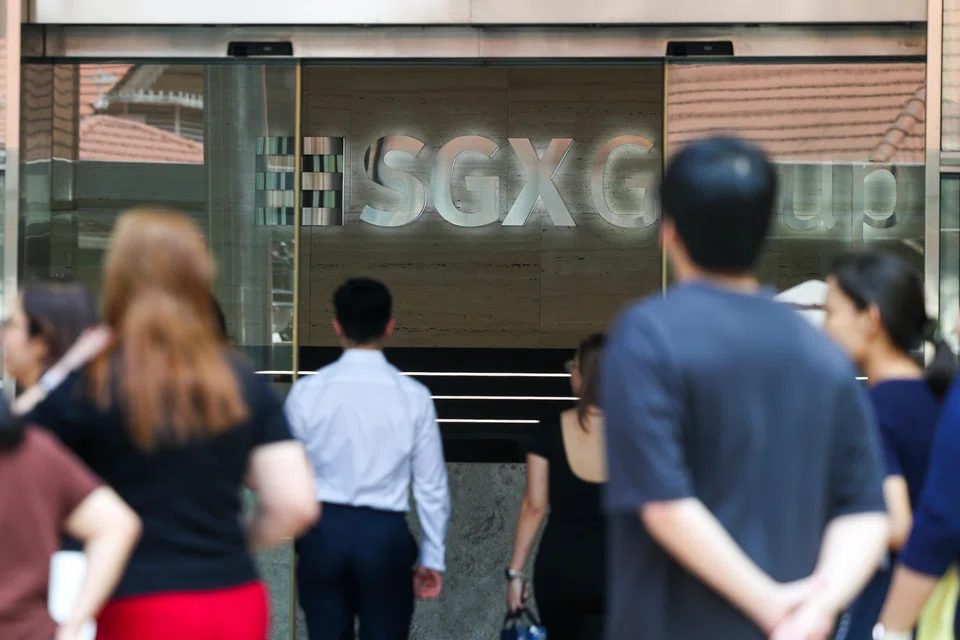
[SINGAPORE] Singapore stocks ended lower on Friday (Nov 6).
The benchmark Straits Times Index (STI) lost 2.2 per cent or 117.08 points to finish lower at 5,179.17.
Sats led the gainers on Singapore’s blue-chip index, rising 0.5 per cent or S$0.02 to S$3.73.
The worst performer among STI constituents was Yangzijiang Shipbuilding, which fell 6.5 per cent or S$0.30 to S$4.35.
The local banks all ended lower. DBS lost 2.1 per cent or S$1.48 to end at S$69.72, OCBC fell 0.7 per cent to S$27.73, and UOB was down 2.5 per cent or S$0.93 at S$36.88.
Within the iEdge Singapore Next 50 Index, CapitaLand China Trust was the top gainer, rising 0.8 per cent or S$0.005 to S$0.625, while CSE Global was the biggest decliner, falling 8.9 per cent or S$0.08 to S$0.82.

Across the broader market, losers beat gainers 472 to 202, after 1.9 billion securities worth S$3.2 billion changed hands.
Oceanus was the most actively traded stock with 167.1 million shares changing hands. DBS was the most actively traded stock in terms of value, with a volume of 9.6 million shares and a value of S$669.5 million.
Key regional indices were negative. Hong Kong’s Hang Seng Index lost 1.3 per cent, Japan’s Nikkei 225 fell 6 per cent, South Korea’s Kospi was down 6 per cent and the FTSE Bursa Malaysia KLCI declined 1.2 per cent.
SEE ALSO





Globally, tech stocks dipped on fears of increased regulation of artificial intelligence after US Democrats’ “blue tsunami” win in the midterm elections. The tech-focused Nasdaq Composite was down 5.5 per cent on Thursday.
Enrico Chinello, an analyst from Next-Generation Research at Julius Baer, said: “We think the market could be misplacing the risk (of Democrat AI regulation). There continues to be bipartisan support on AI as a national strategic topic, and federal AI rules face a presidential veto.”
He added: “The more tangible risk could come from states curbing new data-centre developments, particularly in Texas. We continue to see a base-case scenario where developments are slowed down at the margin, but are not entirely halted. Hence, we remain constructive on the cloud computing and AI theme.”
Christian Gattiker, head of Research at Julius Baer, said of the wider market: “Earnings remained busy but were overshadowed by politics: AMD impressed, Toyota and Sony raised their guidance, and DBS disappointed. Today’s US payrolls may now reveal whether the economy beyond AI is holding up as well as markets hope.”
This article was written with the assistance of AI and reviewed by a reporter
Decoding Asia newsletter: your guide to navigating Asia in a new global order. Sign up here to get Decoding Asia newsletter. Delivered to your inbox. Free.
Share with us your feedback on BT's products and services
TRENDING NOW

Analysts cut DBS target price on lower 2027 earnings, but see buying opportunity after share price slide
China Investment Corp, PGIM’s 50% stake in Nex mall up for sale; asking about S$1.2 billion

Nvidia CEO Jensen Huang drops from world’s top 10 richest after chips sell-off

OCBC wealth clients turn defensive amid market volatility as Q3 profit rises 3%

