

Stirred but not shaken, Singapore’s oil hub status could see opportunities from US tariff poser
The city-state may be able to leverage its robust infrastructure and strategic location to help companies adjust

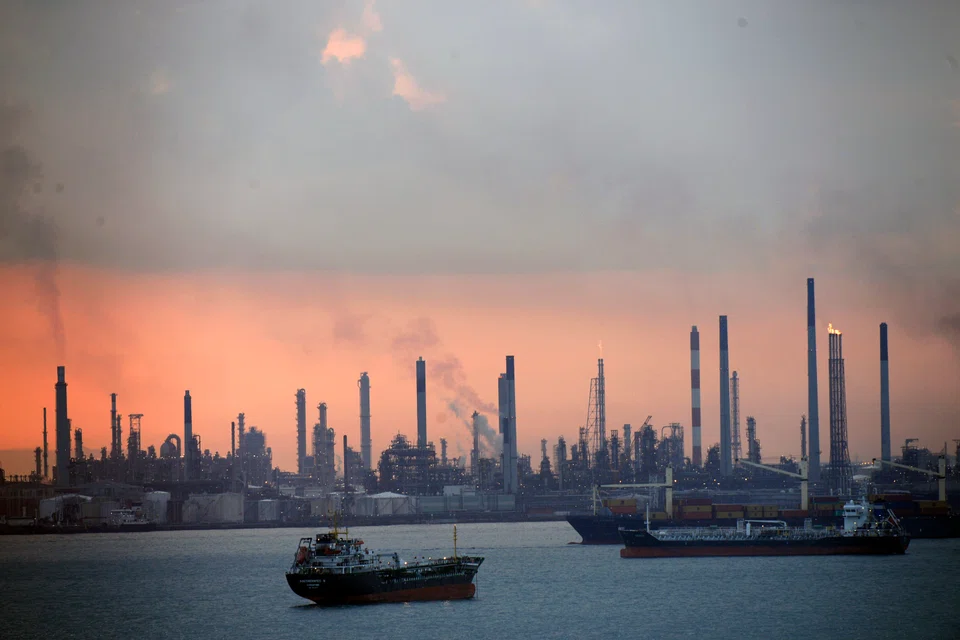
WITH US tariffs shaking up global trade, Singapore could profit by leveraging its position as Asia’s oil trading hub, turning price fluctuations into opportunities and helping companies navigate the turbulence, while securing supply advantages and optimising strategies, say market experts.
“In this evolving landscape, arbitrage opportunities (the practice of taking advantage of a difference in prices in two or more markets) could expand as refiners and traders seek to capitalise on shifting price differentials,” Sam Chua, a principal for Asia-Pacific (Apac) consulting at Rystad Energy, told The Business Times.
He added: “As a regional trading hub, Singapore players could see opportunities to capitalise on these market volatilities to arbitrage, optimise trading strategies, and secure competitive supply advantages amid shifting crude price dynamics.”
US tariffs are expected to disrupt about 4.7 million barrels per day of crude exports from Canada and Mexico, forcing producers to seek alternative markets, though viable options may be limited, said Rystad Energy.
Given US refiners’ reliance on heavy crude from Canada and Mexico, their search for alternative supplies, including from the Middle East, could drive up premiums for Asian crude, intensifying competition for heavy grades across key refining centres, Chua explained.
Opportunities in turbulence
US President Donald Trump ordered 25 per cent tariffs on Mexican energy imports and 10 per cent duty on Canadian energy products on Feb 1, while markets were still digesting his pledge during his inauguration to boost US oil production.
The tariffs were later postponed for a month as the neighbouring countries agreed to heighten border controls.
Experts expect supply-chain disruptions as the trade war intensifies, but Singapore may be able to leverage its robust infrastructure and strategic location to help companies adjust to the impact of tariff shocks, and by doing so, offset some of the pressure.
Sanjeev Gupta, EY Apac oil and gas leader, highlighted that tariffs can create intermediation prospects for Singapore as the country facilitates regional trading.
“Given Singapore’s strategic position as a re-export cum transhipment hub, where goods are imported, processed, and then exported as value-added products, industry players here will benefit from the opportunity to take advantage of varied tariffs,” he said.
He added that the Republic’s financial sector can also help with trade financing and risk management, more so in the current volatile macroeconomic environment.
That is not to say there won’t be challenges. Lim Wen Bin, infrastructure advisory, at KPMG Singapore, acknowledged that tariff-related uncertainty could disrupt global supply chains, exposing Singapore – a key intermediary in the energy market – to market fluctuations.
“For example, tariff-related uncertainties could potentially result in a higher feedstock price for domestic refiners, increasing pressures on end users in terms of energy costs,” he noted. Lim added that shifts in trade flow could reshape Singapore’s trading relationships in both the short and long term.
Lee Chokwai, director of equity research at Morningstar, noted that lower oil prices could spur global demand, increasing Singapore’s need for port services and refining capabilities. However, he warned that if oil prices drop too low in the long term, it could discourage investments and hinder growth in the energy sector.
So much gas, so little clarity
Trump’s policy to increase US gas exports to Asia could also boost Singapore’s position as a liquefied natural gas (LNG) trading hub, said Paul Everingham, chief executive of the Asia Natural Gas and Energy Association (Angea).
As Trump aims to ramp up domestic fossil fuel production, the resulting supply glut could lower oil and gas prices, benefiting Singapore both as an energy trading hub and a natural gas consumer, said EY’s Gupta.
Baldev Bhinder, managing director of law firm Blackstone & Gold, emphasised that the question remains as to whether Trump’s tariffs are just a political flex to bring countries to the negotiating table, or a more permanent feature that will change supply chains.
“In the longer term, a trade war would invariably lead to slower growth and less trade across the world, which would have an impact on a trade-dependent state like Singapore,” he added.
In response to BT queries, Enterprise Singapore and the Economic Development Board replied in a joint statement: “It is too early to determine the direct impact of the changes in US policies on specific sectors in Singapore, including energy.”
Both agencies noted that the Singapore government has been actively monitoring the ongoing changes, with existing measures to help businesses navigate uncertainties.
Potential rerouting
Tariff threats on energy imports from Canada and Mexico, which supply about a quarter of the oil US refiners process, are also unlikely to directly affect Singapore’s oil trading. As Angea’s Everingham pointed out, the Republic’s refineries are not equipped to process the heavy crude from Canada’s oil sands, which makes up the majority of US imports from the country.
“The distance to Canada would be a significant barrier even if Singapore was able to process heavy crude. Meanwhile, the volumes of light crude oil that Singapore currently imports come mostly from the Middle East, and should not be impacted,” he noted.
He said that if tariffs are implemented, seaborne oil imports from Canada and Mexico to the US would be rerouted to other markets, with the US replacing the supply with crudes from the Organization of the Petroleum Exporting Countries and Latin America, as well as refined products from Europe.
This would have minimal impact on Singapore. However, there is a slight possibility that the city-state could see more heavy crude routed through its trading hub if the US shifts its sourcing. “But this would be a small opportunity, and it is far from certain,” he added.
TRENDING NOW

From legacy to launch: Francis Yeoh and Yeoh Pei Xien on family unity and YTL’s next‑gen ventures

Could Japan trigger the next global financial crisis?

Wealthy Indonesians snap up government bonds as yields near 8%: OCBC
‘You buy more picks and shovels because you keep hitting gold’: Why AI spending needs to see results

