

Stretched valuations no barrier to global equity opportunities in 2026: panellists
Investors can still generate returns by being risk-on in a diversified manner, say market watchers

[SINGAPORE] Risk assets will likely continue to perform well globally in 2026, even though valuations in certain sectors may now look increasingly expensive.
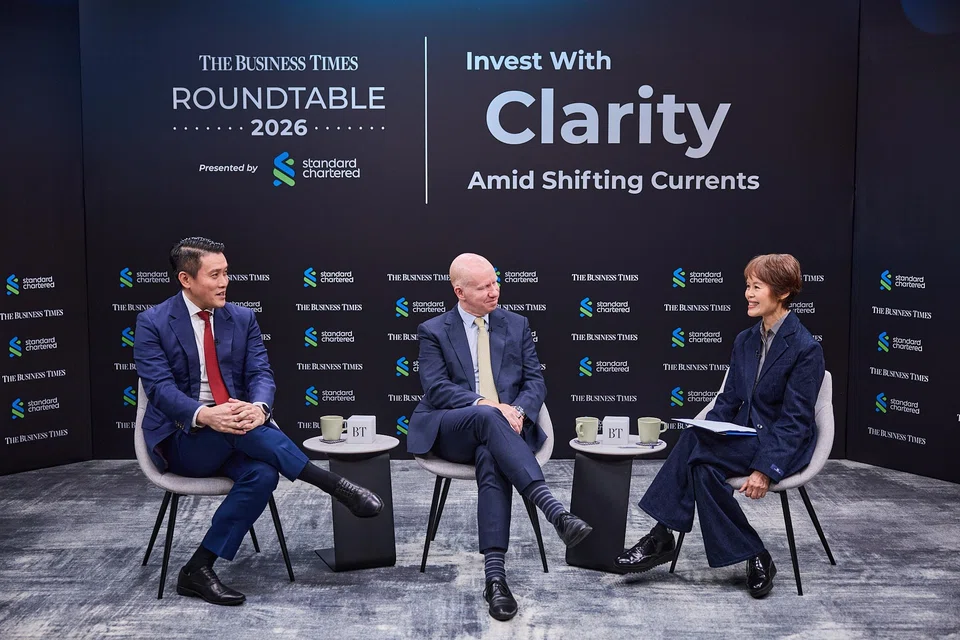
Investors can still generate returns by being risk-on in a diversified manner, said market watchers at a roundtable organised by The Business Times and presented by Standard Chartered (StanChart) on Monday (Jan 19).
Titled “Invest with clarity amid shifting currents”, the roundtable features Steve Brice, global chief investment officer of StanChart, and Albert Tse, chief executive of Amundi South Asia. It was moderated by BT wealth editor Genevieve Cua.
“Valuations, while they’re a little bit stretched, are not going to be an impediment to positive returns for global equities this year,” said Brice.
That said, there are certain countries or sectors that are “well known to be expensive”, including the US tech sector, noted Tse.
Brice and Tse noted ongoing concerns of an artificial intelligence (AI) bubble forming, but said the current conditions do not yet resemble one.
This is mainly because the US tech sector still looks fundamentally sound, with tech earnings outpacing the outperformance of the tech sector on a relative basis, Brice said.
This is unlike the dotcom bubble in the 1990s, in which tech sector earnings did not outperform relative to the US market, he noted.
“Valuations look a little bit more pricey, but we think that’s validated by the strong fundamentals going forward,” Brice said, adding that the bank is overweight on the US market given its strong tech sector.


Tse also expects AI to be more of a structural investment theme than a macroeconomic bubble, pointing out that AI-related capital expenditure in the US is still in its early stages.
But investors who think that certain AI stocks in the US are expensive can look to other markets, such as China, where the tech sector similarly outperformed in 2025, but is still trading at lower valuations.
Investors should also avoid over-concentrating on one or two stocks per country to capture “equally good returns” by not chasing after the same companies, Tse said.
“There are many ways to play the AI theme,” he said. “It’s not a bubble – we just need to broaden our way of assessing the whole ecosystem and the whole AI cycle, then we will be able to generate better risk-adjusted returns.”
Tse encouraged investors to broaden their scope beyond the Magnificent Seven stocks in the US, or beyond US markets to Europe and emerging markets.
Asian markets, in particular, look attractive as valuations look cheaper than those in the US, even after the gap narrowed amid 2025’s outperformance, Brice said.
Earnings growth is expected to remain relatively robust, while a weak US dollar is generally good for emerging market investments, he added.
For US equities, Brice said StanChart is taking a barbell approach by being overweight on tech as well as healthcare.
The bank is also positive on US utilities, given the power generation required for AI investments.
As for Amundi, Tse said the fund manager is focusing on European assets.
The region is seeing improved fundamentals, support from the central bank and renewed interest from investors who are trying to avoid overconcentration in US assets, he said.
Sector-wise, the European defence sector – which includes the whole ecosystem of manufacturing companies – is benefiting from multiple years of focus, he noted.
Meanwhile, the industrial and financial sectors in Europe look attractive as they are offering higher cash flows and dividends compared with many parts of the world.
They should also benefit investors who have been overconcentrated on AI, growth stocks or US assets, and are looking for something more stable and more attractively valued.
Overall, Brice still expects “significant volatility” in 2026, but noted that economic drivers are still positive with central banks easing, while the earnings outlook for global equities remains strong.
Tse added: “We remain cautious about what’s going on in the geopolitical front, so having a risk-on attitude in equities or other risk assets should be well accompanied by exposure to gold or other assets that can help you protect against this risk.”

Decoding Asia newsletter: your guide to navigating Asia in a new global order. Sign up here to get Decoding Asia newsletter. Delivered to your inbox. Free.
Copyright SPH Media. All rights reserved.
TRENDING NOW

Once staunchly pro-China, Malaysian Chinese businesses are now distancing themselves from Beijing

Looking beyond looming CEO succession, should UOB potentially pursue a transformative merger?

Could stablecoins be the future of money?

Grab CEO’s wife Chloe Tong on life with Anthony Tan and finding her purpose

