China robot maker Unitree’s shares slump 45% after fivefold IPO surge, sparking bubble fears in sector
Some analysts say China’s listing mechanism distorts prices
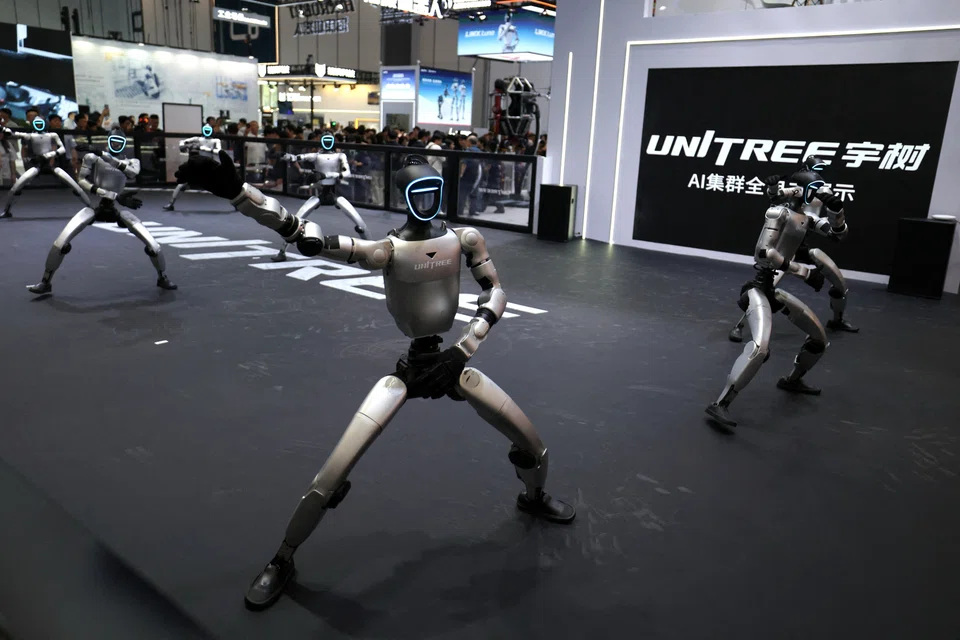
[HONG KONG/SHANGHAI] A roughly 45 per cent slump in the shares of Unitree, China’s best-known humanoid robot maker, since a more than fivefold jump on its Shanghai debut has triggered concerns about bubble risk, retail investor losses and flaws in the IPO system.
The wild swings in Unitree’s valuation - soaring to US$66 billion at one point and later plunging by US$30 billion - have led to questions about whether enthusiasm for AI and robotics has outpaced fundamentals.
The post-listing sell-off in the company, one of the world’s largest producers of quadruped and humanoid robots, has also led to soul-searching over China’s listing mechanism, which some analysts say distorts prices.
Unitree shares steadied on Tuesday (Aug 25) after three consecutive days of decline that took their losses to 45 per cent since their Aug 19 debut.
The sharp reversal could become a cautionary tale for other Chinese tech companies looking to take advantage of Beijing’s “self-sufficiency” drive and IPO opportunities. It also highlights the challenge authorities face in boosting strategic industries without causing a market frenzy.
Unitree’s debut was expected to set the tone for a slew of domestic rivals preparing to come to market.
“Investors were carried away by the technology revolution narrative,” said Dong Baozhen, chairman of Beijing-based asset manager Lingtong Shengtai, cautioning that “all bubbles are doomed to burst.”
Unitree’s debut performance is a sign of market froth, rather than prosperity in China’s tech sector, which has gained prominence over the past year during the country’s intense tech rivalry with the US.
The blockbuster debut came even as Unitree’s first-half profit showed signs of a downshift. The company’s robots have drawn attention for running, dancing and performing martial arts, but Unitree has had little success in broader commercial applications.
SEE ALSO




Its debut performance “was not fuelled by a rosy prospect, but a desire by some to pump up the shares so as to dump them later at lofty prices,” said Abraham Zhang, chairman of venture capital firm China Europe Capital.
Unitree reported adjusted net profit fell 53 per cent to 40 million yuan (US$5.95 million) in the first three months of 2026, according to its prospectus.
Shares of Unitree, which competes with Tesla and Hyundai Motor Group-owned Boston Dynamics, finished up 460 per cent on its debut. That compares with an average first-day gain of 226 per cent for newly listed stocks in China over the past three years.
Retail frenzy
Loopholes in China’s IPO system have allowed major shareholders to cash in and make a fortune, while shifting risks to mom-and-pop investors who get involved in secondary market trades, venture capitalist Zhang said.
The general belief in regulatory paternalism, which refers to government moves to protect small investors from financial harm, and the absence of short-sellers mean overpriced listings face no immediate pushback, bankers said.
Investors were drawn to the Unitree IPO due to perceived state support, as China vies with the US for tech supremacy, analysts said.
Its fast-tracked listing on Shanghai’s tech-focused Star Market, they said, also signalled government blessing as the board is reserved for hard-tech innovators in China’s national strategic industries.
IPOs by companies such as Unitree and DRAM memory chipmaker CXMT were chased in China because “there are not many good companies in China’s stock market,” said Yuan Yuwei, hedge fund manager at Trinity Synergy Investments.
Shares of CXMT soared 466 per cent in their Shanghai debut in July. Due to regulators’ tight scrutiny, however, only 21 companies went public in Shanghai during the first seven months of 2026, compared with 104 in Hong Kong.
Some argue that investors in Chinese robotics should be patient, and take a long-term perspective.
“Many robot makers spend a lot on research, but commercial orders are not yet in sight,” said Gao Xingkun, fund manager of China Southern Asset Management Co.
“It’s not fair if you only look at profit,” he told an online roadshow, drawing a parallel to the early stage of development for China’s now-booming electric vehicle industry.
Small investors were burnt
Chinese stock exchanges not only vet listing hopefuls, but also give guidance on IPO pricing, limiting bankers’ leeway to respond to feverish demand.
Dong said the staggering gap between the IPO price and the debut performance means “either one of them must be wrong,” and he believes the latter was mispriced. “Debut performance is the barometer of market mood, and exuberant mood breeds bubbles.”
Hedge fund manager Yuan said pump-and-dump schemes in new listings in China are possible because of restricted short-selling activities.
“An IPO stock worth 10 yuan can open at 100 yuan, before sliding for years. It’s a rip-off,” he said.
A retail investor who lost money on Unitree said in a blog post that he supports Chinese innovation, but “the rapid concentration of wealth cannot be built on the pains of retail investors.”
Those who won the IPO shares “walked away with smiles,” leaving many small investors in tears, said Zhang, the venture capitalist.
“The capital drama seen in the Unitree listing is not the first in China, and will not be the last.” REUTERS
Decoding Asia newsletter: your guide to navigating Asia in a new global order. Sign up here to get Decoding Asia newsletter. Delivered to your inbox. Free.
Share with us your feedback on BT's products and services