Info-Tech Systems wants to leverage customers’ overseas expansion for future growth
It wants to follow its customers to expand into Indonesia, the Philippines, Vietnam as this will improve customer stickiness

[SINGAPORE] Info-Tech Systems , a software as a service (SaaS) player, sees future growth coming from customers’ overseas expansion. As well, it aims to add to its suite of software products while growing in its existing markets.
The pure-play software provider targeted at small and medium enterprises (SMEs) operates a recurring subscription revenue model for human resource management system (HRMS), accounting and customer relationship management software services.
It was started in Singapore and has now replicated its business model in Malaysia, Hong Kong, and India. Nearly all markets generated double-digit improvement in revenue in 2025.
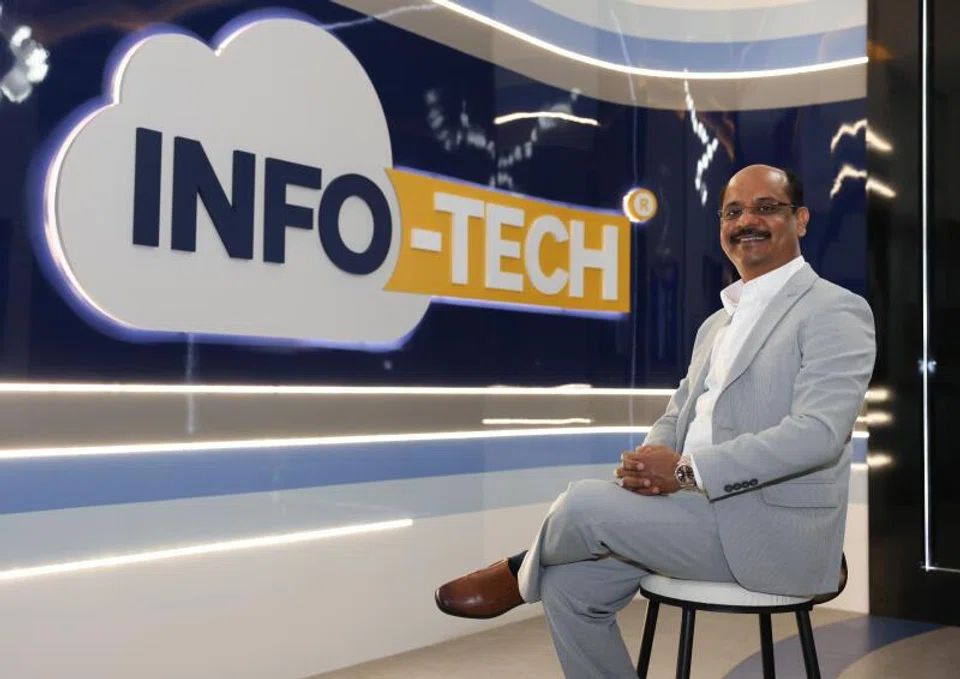
Babu Dilip, the CEO of Info-Tech Systems, said it wants to follow its customers to expand into Indonesia, the Philippines, Vietnam and other countries instead of setting up offices in the markets where the customers go.
This will improve customer stickiness and also ensure Info-Tech Systems does not have to price its subscriptions lower because the market where the customer expands to might have a lower cost of living.
“They are paying in (their own) currencies. When they (expand overseas), they don’t mind paying the same price. They’re not expecting local price because they want one (integrated) solution. They can manage the entire workforce. That’s our future strategy,” he said.
This strategy aligns with Info-Tech Systems principle of not sacrificing profit margins for revenue.
Singapore and Dubai, hence, are premium markets for the software provider, which collects all subscription fees a year ahead.
It incorporated a company in Dubai before the Middle East war started but has not commenced business activities there due to the geopolitical conflicts.
Bullish about Singapore
Singapore now rakes in 75 per cent of revenue for the mainboard-listed Info-Tech Systems that was listed in July in 2025. Malaysia contributes less than 20 per cent, while India and Hong Kong make up the balance.
Despite the high contribution from the city-state, Babu is bullish about this market as there are nearly 370,000 SMEs in Singapore and the government is continuing its digitalisation drive. These present vast potential for Info-Tech Systems to tap.
It was estimated to have a 9.8 per cent share of the Singapore market for cloud-based HRMS and accounting SaaS in 2024, indicated an independent study.
In Singapore, the company also runs the Info-Tech Academy, set up two years ago to offer mainly artificial intelligence courses as it foresaw demand for training in the field.
“We already anticipated how to (tap) the potential from AI. We are not chip manufacturers... but we need to capitalise (on) AI. As I said, we always have a philosophy, that is, to move towards the market, don’t go against it, follow the market.”
The academy offers cross-selling opportunities for Info-Tech Systems software services, too. It is also contemplating extending the academy to other markets.
Support from the government of Singapore for individuals and enterprises to adopt technology in the form of subsidies bodes well for Info-Tech Systems, be it for its software or training.
For example, the company benefitted from a surge in demand for training in late 2025 as Singaporeans and permanent residents rushed to use the SkillsFuture credits provided by the government before they expired. Revenue, as a consequence, jumped nearly threefold to S$12.7 million for its training services for the second half of FY2025 to December.
Babu turned his CEO office into a temporary classroom to capture the red-hot demand. “My room doesn’t matter,” said the shareholder with a 42 per cent stake.
The asset-light company does not own properties but leases additional premises according to demand, thereby retaining flexibility to scale up or down.
Babu is not concerned about the possibility of the government ending such subsidies as he has seen in the past 15 years various types of grants being handed out to help enterprises and individuals.
The company has done well in past recessions, benefitting from the government’s assistance to help everyone upskill or digitalise to prepare for the economic turnaround, he said.
AI, a double-edged sword
AI presents opportunities and challenges for Info-Tech Systems, but the helmsman believes the company he co-founded will ride the boom and emerge ahead of the competition.
Info-Tech Systems commenced incorporating AI into its software in 2025, enabling customers to perform analyses using the technology.
AI also sped up its development of new systems. Babu said the company is exploring a few solutions to add to its suite of software, including a point-of-sale system targeted at the retail and F&B industries.
With more solutions, the rising adoption of AI and vast market potential, Babu is confident that Info-Tech Systems will be able to boost its revenue.
He dismissed concerns that AI will replace software services, saying that technology changes job nature but does not eliminate all roles. As long as companies have workers on their payroll, there will be a need for HRMS, for example.
But AI equips competitors or new entrants to the industry with capabilities that Info-Tech Systems also has access to, Babu pointed out.
He is unfazed, however, as he believes it is able to beat rivals with its business model, execution of strategies, customer services and up-to-date solutions.
Info-Tech Systems’ business model entails locating IT and backend employees – more than 300 of its 600-strong staff – in India, paying them in rupees but billing customers in strong currencies such as the Singapore dollar. Manpower topped its cost expenses.
Babu also hailed from India, arriving jobless in Singapore in 2000 – when the dotcom bubble burst (as Internet companies’ share prices plunged) and recession ensued.
“When I came, it was the worst time," said the naturalised Singaporean. Now he owns a 41.4 per cent stake in Info-Tech Systems with a market value of about S$238 million, and has no plans of paring this down.