S&P upgrades Singtel to ‘A+’ on asset monetisation, balance sheet strength
Rating agency expects telco to realise the remaining S$2.2 billion of its asset recycling programme by end-FY2028

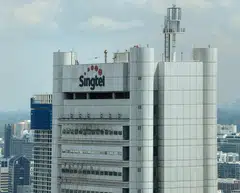
[SINGAPORE] S&P Global Ratings on Wednesday (Aug 19) upgraded Singtel to “A+/A-1” from “A/A-1”, citing the telco’s improved balance sheet and robust financial flexibility driven by its aggressive asset recycling programme.
The credit rating agency also raised its issue rating on the company’s senior unsecured notes to “A+” from “A”, and on its guaranteed subordinated perpetual securities to “BBB+” from “BBB”. The outlook is stable.
S&P noted that regular asset monetisation and an anticipated earnings recovery will allow Singtel to sustain its balance sheet strength, even as the company manages elevated capital expenditure (capex) and increased shareholder distributions over the next 12 to 24 months.
“This marks the first rating upgrade by S&P Global Ratings since Singtel was first rated by the agency,” said the telco on Wednesday. “We are committed to maintaining Singtel’s strong investment-grade credit ratings.”
Singtel’s adjusted debt fell to S$7.5 billion at the end of FY2026, which concluded in March. This was down sharply from a peak of S$12.3 billion at the end of FY2021.
Correspondingly, its adjusted debt-to-Ebitda (earnings before interest, taxes, depreciation and amortisation) ratio improved to 1.7 times from 2.5 times over the same period. S&P expects this leverage metric to remain below two times over the next 24 months.
Since FY2022, Singtel has reaped more than S$12 billion through asset monetisation, including divestments of minority stakes in India’s Bharti Airtel and Thailand’s Gulf Development, telecom towers, loss-making businesses and its Comcentre office properties.
The rating agency expects Singtel to realise the remaining S$2.2 billion of its current S$9 billion asset recycling programme by the end of FY2028.
Earnings rebound, higher capex
S&P forecasts a rebound in Singtel’s adjusted Ebitda to between S$5.5 billion and S$5.7 billion in FY2027, up from S$4.5 billion in FY2026.
SEE ALSO
This projection factors in reduced regulatory and remediation costs at its Australian subsidiary Optus, as well as about S$700 million in special dividends from Thai associates Advanced Info Service and Gulf Development.
The improved cash flow will support Singtel’s “value realisation” initiative. Shareholder distributions are expected to increase to between S$4.1 billion and S$4.3 billion annually in FY2027 and FY2028, up from S$3.3 billion in FY2026, buoyed by dividends and a S$2 billion share buyback programme.
Capex is also slated to rise to between S$2.9 billion and S$3.1 billion in FY2027, up from S$2.5 billion in FY2026. The bulk of this will be channelled into network investments in Singapore and Australia, alongside accelerated growth initiatives in data centres, satellite infrastructure and artificial intelligence cloud services such as GPU-as-a-Service.
Operational headwinds
While Singtel’s core business fundamentals are expected to improve, driven largely by its Digital InfraCo and NCS units, operations in Singapore face persistent pricing pressures due to stalled industry consolidation, following the terminated merger between Simba Telecom and M1.
Average revenue per user in Singapore has declined to S$23 in FY2026 from S$30 in FY2020, noted S&P.
In Australia, Optus continues to face headwinds from competitor TPG Telecom and lingering costs from its 2025 network outage, though these are expected to be offset by industry-wide price hikes and cost-reduction efforts.
Singtel’s portfolio offers further latent financial flexibility. A potential monetisation of a minority stake in Optus, or further equalisation of its Bharti Airtel shareholding – where a three percentage point gap represents over S$5 billion in value – could provide massive future cash injections.
S&P warned that the ratings could be lowered if Singtel’s debt-to-Ebitda ratio exceeds two times on a sustained basis. This could be triggered by aggressive shareholder distributions or growth spending without corresponding increases in operating cash generation and asset monetisation.
Conversely, an upgrade could materialise if the company commits to a financial policy that keeps its leverage ratio below 1.5 times.
Shares of Singtel fell 0.5 per cent or S$0.02 to S$4.44 on Tuesday.
Decoding Asia newsletter: your guide to navigating Asia in a new global order. Sign up here to get Decoding Asia newsletter. Delivered to your inbox. Free.
Copyright SPH Media. All rights reserved.