

US House to weigh penalties on AI model copying by Chinese firms
Known as the Deterring American AI Model Theft Act, the bill is set to be considered by the House Foreign Affairs Committee next week
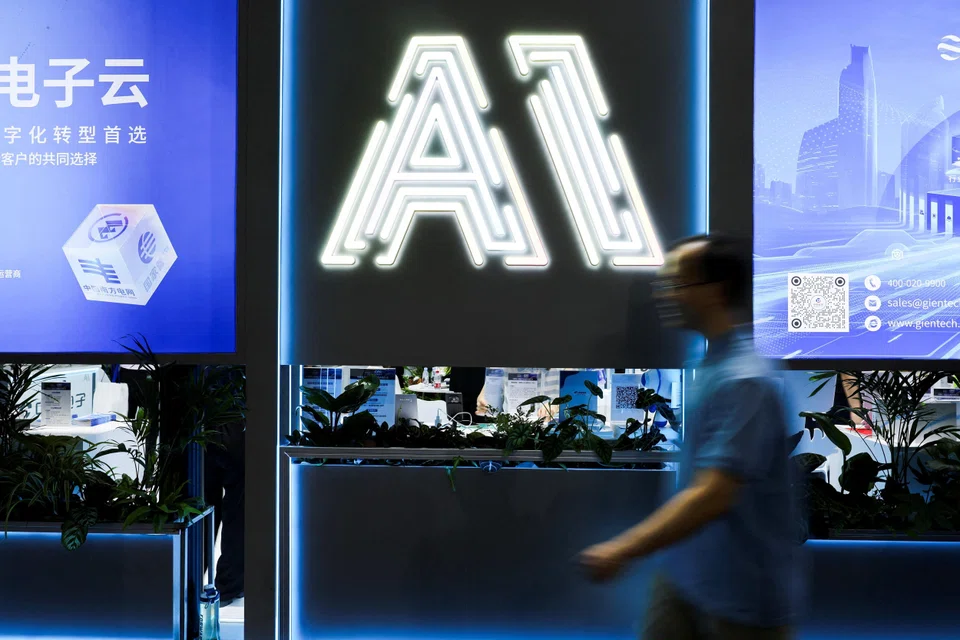
[WASHINGTON] House Republicans are calling for US sanctions against Chinese entities that improperly extract results from leading US artificial intelligence models to develop their own competing systems, part of a widening effort by Congress to counter China in the global AI race.
Legislation proposed by Representative Bill Huizenga would direct the government to identify entities in China and Russia that use improper query-and-copy techniques on American models, according to a draft seen by Bloomberg News. It would prompt consideration of sanctions on offenders via the Commerce Department’s blacklist and through presidential emergency economic powers established under a 1977 law.
Potential targets of the law could include companies that have faced accusations of extracting capabilities from US AI models, including Chinese AI labs – DeepSeek, Moonshot, and MiniMax – as well as larger companies. The Chinese AI industry is currently led by far bigger rivals such as Alibaba Group Holding and ByteDance.
The proposal marks the first significant step by Congress to address a growing concern for OpenAI, Anthropic PBC and Alphabet’s Google that some users, especially in China, are creating less safe imitation versions of their products that could undercut them on price and syphon away customers.
Known as the Deterring American AI Model Theft Act, the bill is set to be considered by the House Foreign Affairs Committee next week, along with more than a dozen other export-control initiatives also aimed at curtailing China’s rise in the emerging technology. It’s co-sponsored by Representative John Moolenaar, the Republican chair of the House Select Committee on China.
“Model extraction attacks are the latest frontier of Chinese economic coercion and theft of US intellectual property,” said Huizenga, a member of the House Foreign Affairs Committee. Referring to Anthropic’s breakthrough Mythos system, he added that “American AI models are demonstrating transformative cyber capabilities and it is critical we prevent China from stealing these technological advancements.”
OpenAI, Anthropic and Google recently began sharing information to detect so-called adversarial distillation. In distillation, an older “teacher” AI model is used to train a newer, “student”, model that replicates the capabilities of the earlier system – often at a much lower cost. While tolerated for training smaller, less-advanced systems, distillation violates AI companies’ terms of use when it’s used to replicate a leading AI model without authorisation.
The House China Committee plans separately to issue a report singling out some of the Chinese startups, including DeepSeek, that have been accused of using the technique. It also calls on Congress to ask the Commerce Department to “treat model extraction as industrial espionage, and impose penalties severe enough to deter Beijing’s theft of American innovation”.
“Rather than replicating the massive, hardware-intensive systems of US firms such as OpenAI and Google, Chinese companies such as DeepSeek, MiniMax, and Moonshot have prioritised lightweight, compute-efficient models,” the report says, according to a copy reviewed by Bloomberg News.


Both the draft bill and the House China committee report encourage the formation of a US government-facilitated information sharing centre to better detect distillation threats, akin to what the leading American developers have just started.
The committee’s report also recommends that cases of adversarial distillation be referred to the Justice Department for possible prosecution. It also calls on lawmakers to instruct the Commerce Department to evaluate DeepSeek, Moonshot AI and MiniMax for an entity list designation, a goal that may be indirectly accomplished if the draft legislation moves ahead.
Earlier this year, OpenAI told the House China committee that DeepSeek had improperly used ChatGPT results to create a knock-off model that lacked safety guardrails. OpenAI said that the activity continued and evolved when it tried to enact counter measures. Google and Anthropic have also released public reports with similar conclusions, citing activity they have observed on their software access portals as evidence of unauthorised techniques.
American AI labs have warned that distilled models are vulnerable to censorship on topics that are sensitive for the Chinese government, such as Tiananmen Square, and may not stop users from conducting dangerous activities like creating a bioweapon. There’s also a financial risk for US developers, as the nearly free open-weight models made by Chinese startups undercut revenue needed to offset investments US firms have made in AI data centres and personnel.
In its report, the House China committee found that Chinese entities are using a “sophisticated access infrastructure designed to obfuscate request sources, distribute traffic across thousands of fraudulent accounts, and maintain connectivity despite provider restrictions”.
The panel specifically identified two public code tools and three intermediary operators that offer Chinese tech firms, including Alibaba, Tencent Holdings, and Baidu, as well as Chinese research universities Tsinghua University and Peking University, access to closed-source US AI models. BLOOMBERG
Decoding Asia newsletter: your guide to navigating Asia in a new global order. Sign up here to get Decoding Asia newsletter. Delivered to your inbox. Free.
Share with us your feedback on BT's products and services
TRENDING NOW

LTA proposes combining car COE categories, adding rebate-surcharge system
StarHub to acquire MyRepublic’s mobile business amid ongoing telco consolidation

DBS, OCBC, UOB rout lops billions off STI as inflation, rate concerns spook investors

Grab CEO’s wife Chloe Tong on life with Anthony Tan and finding her purpose

