

Tiger Brokers, Moomoo, Longbridge Singapore units ‘financially independent’ amid China crackdown: MAS
But market observers note that the separation between customers’ funds and a company’s assets ‘is not completely airtight’

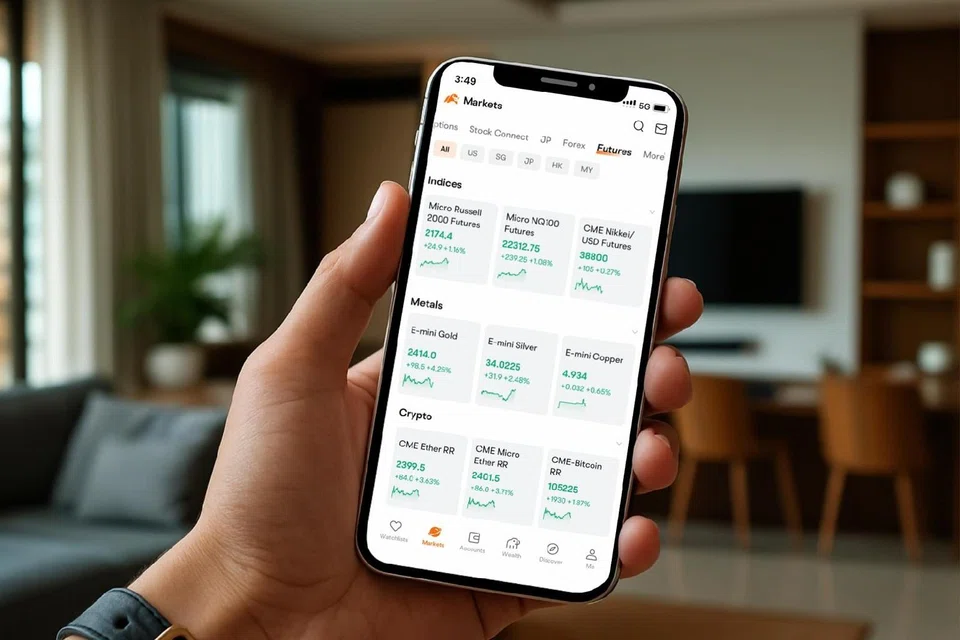
[SINGAPORE] The Singapore entities of three foreign brokerages targeted by Chinese regulators are “financially independent” from related group entities in Hong Kong and other jurisdictions that have come under regulatory action, said the Monetary Authority of Singapore (MAS) on Thursday (May 28).
Chinese regulators mounted a crackdown on illicit cross-border stock trading on May 22 under Beijing’s drive to prevent capital outflows.
The three companies targeted – New Zealand-registered Tiger Brokers, Hong Kong-registered Longbridge Securities and Futu (the parent of Moomoo Financial Singapore) – were fined a combined total of more than US$330 million for operating in China without a licence. (*see amendment note)
Sharnie Wong, senior analyst at Bloomberg Intelligence, estimated that the penalties amounted to about 13 and 30 per cent of pre-tax profit for Futu and UP Fintech (the parent of Tiger Brokers), respectively.
Responding to queries by The Business Times, MAS said that the Singapore-incorporated entities of the three brokerages are holders of capital markets services (CMS) licences in the Republic.
The Singapore-incorporated entities – Tiger Brokers (Singapore), Long Bridge Securities and Moomoo Financial Singapore – are subject to ongoing financial requirements and supervision, including minimum base capital and risk-based capital requirements, said MAS.
CMS licensees are required to deposit customers’ money or assets into a trust or custody account, which must be segregated from the licensee’s own funds and assets.
“This means that customers’ monies and assets are kept safe and separate from the licensee’s own funds, and cannot be used to meet the licensee’s own liabilities,” said an MAS spokesperson.
Ryan Lin, director of Bayfront Law, said that under Singapore corporate law, subsidiaries are treated as distinct legal entities, even when they are wholly owned.

Consequently, liabilities or regulatory penalties imposed on a parent company would not automatically attach to the Singapore subsidiary or its customer assets.
He added that in a typical insolvency scenario, assets properly held on trust for clients would generally not form part of the insolvent estate available to the parent company’s creditors.
“The principle of segregation is designed to ring-fence client assets from corporate liabilities,” he said.
Segregation not ‘airtight’
However, Emir Hrnjic, senior lecturer in the Department of Finance at the National University of Singapore Business School, pointed out that the separation between the customer’s money and company’s assets “is not completely airtight”.
Lin concurred, noting that in a cross-border insolvency situation, the outcome will still depend on factors such as how the custody structure was implemented.
Other factors such as whether segregation was properly maintained in practice, the governing contractual terms, and whether there are allegations of commingling, fraud, or breaches of fiduciary duty would also be considered.
“If the parent company were to face major financial or operational issues, there could still be some indirect risks, depending on the group structure and custody arrangements,” said Dr Emir.
This is why lawyers would rarely describe the protections as “absolute”, said Lin.
Responding to queries from BT, Longbridge said: “Client accounts and all services are operating normally.”
Singapore clients may continue to trade, deposit, withdraw and manage their accounts “as usual”, it added.
The Singapore-headquartered brokerage elaborated that the Chinese regulatory requirements in question pertain strictly to cross-border transactions originating from the mainland, and are unrelated to securities business conducted within Singapore.
BT has also reached out to Tiger Brokers and Moomoo for comments.
MAS said that it is following up with the three entities to reinforce its expectations of conduct and compliance.
More brokerage competition across Asia-Pacific
Following the crackdown in China, market observers believe that the brokerages could double down on the Asia-Pacific as its next expansion site.
“These firms may increasingly focus on markets where they are already established and have licensed operations, including Singapore and other parts of South-east Asia and the Asia-Pacific,” said Dr Emir.
Bloomberg Intelligence estimates that the US, Singapore, Australia, Japan and Malaysia accounted for 56 per cent of Futu’s paying clients in 2025.
Singapore accounted for 41 per cent of paying clients at UP Fintech in 2025.
Beyond leving lower fees, Dr Emir expects brokerages to try and grow through better products, stronger user experience, investor education and partnerships.
Lin said he has observed an uptick in Chinese companies applying for broker dealer licences in Singapore, and is currently advising several applicants amid an uptick in market demand.
Interactive Brokers, among the brokerages contacted by BT, said that it has controls to ensure that it complies with regulatory requirements in the jurisdictions in which it operates, and the jurisdictions include China.
Other brokerages declined to comment.
Regulatory scrutiny in focus
Dr Emir added that while the regulatory framework is robust, the immediate hurdle for all the brokerages is to manage retail sentiment.
“Much will depend on how clearly the firms communicate with customers to reassure them about asset protection and regulatory safeguards,” he said.
Lin noted that the heightened attention on cross-border brokerage models highlights the growing importance of jurisdictional certainty, operational substance and properly structured custody arrangements.
“For many private wealth clients, these considerations are increasingly becoming as important as investment performance itself,” he said.
*Amendment note: Article has been updated to accurately represent the entities involved.
Decoding Asia newsletter: your guide to navigating Asia in a new global order. Sign up here to get Decoding Asia newsletter. Delivered to your inbox. Free.
Copyright SPH Media. All rights reserved.
TRENDING NOW

LTA proposes combining car COE categories, adding rebate-surcharge system

StarHub to acquire MyRepublic’s mobile business amid ongoing telco consolidation

DBS, OCBC, UOB rout lops billions off STI as inflation, rate concerns spook investors

Grab CEO’s wife Chloe Tong on life with Anthony Tan and finding her purpose

