

Tiong Woon’s next heavy lift: S$200 million revenue by FY2030, as it expands beyond crane rental
CEO Michael Ang says the group is keeping gearing low as it explores overseas M&A opportunities

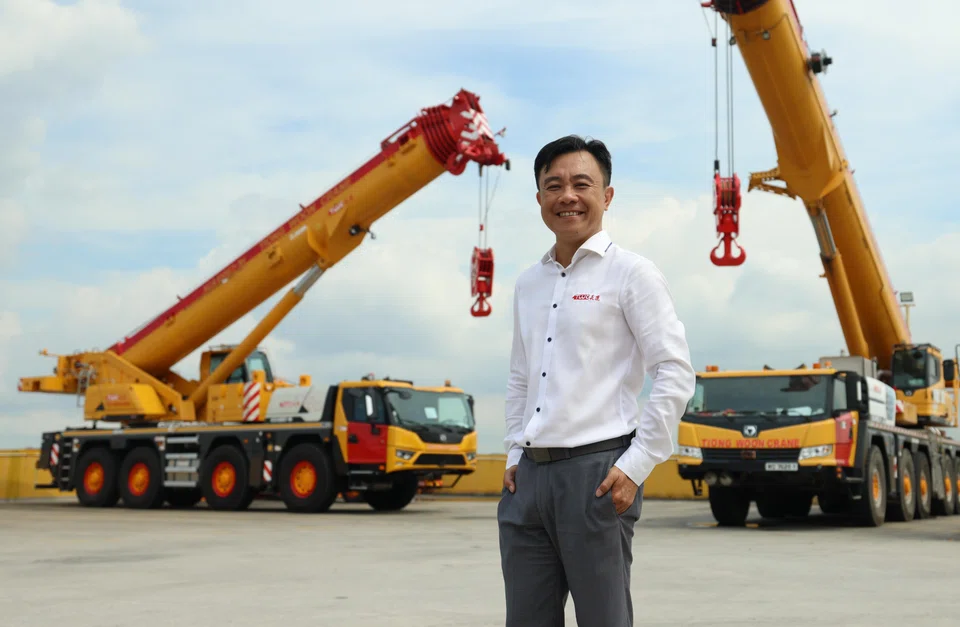
[SINGAPORE] Mainboard-listed Tiong Woon has spent the past few years lifting more than just heavy loads.
The heavy-lift and haulage specialist has grown its earnings base and drawn greater market interest while repositioning itself beyond its traditional crane rental business.
It is now targeting annual revenue of more than S$200 million by FY2030, as it builds its regional footprint and moves deeper into integrated engineering work.
“The market has always taken us as a crane rental company,” CEO Michael Ang told The Business Times. “But we have actually been… doubling down on the integrated supply of related engineering services.”
In February, the group secured three major projects worth over S$40 million across the semiconductor, public infrastructure and biopharmaceutical sectors. The contracts involve a blend of services, from crane deployment to lifting engineering and project support.
This strategic shift has also been reflected in its financial performance.
Revenue rose from S$112.9 million in FY2021 to S$163.5 million in FY2025. Net asset value per share likewise climbed from S$1.17 to S$1.39, and earnings per share from S$0.0425 to S$0.0829.
Net profit also grew to S$19.2 million in FY2025, up from FY2021’s S$9.9 million.
In H1 FY2026, revenue and net profit came in at S$89.7 million and S$13.6 million, respectively – already more than half of FY2025 levels.
Ang declined to provide earnings guidance ahead of its FY2026 results expected in August, but said with a chuckle that business was “looking okay”.
Rental remains Tiong Woon’s “bread and butter”, but Ang said the group sees stronger differentiation in integrated projects and engineering solutions, especially as competition stiffens in Singapore’s crane rental market.
That means leaning on its scale and technical track record to stay a preferred contractor in sectors such as semiconductors, data centres, and oil and gas, as well as increasing both equipment capacity and capability for integrated projects.
“Some of the clients (want) more fast-track work, they need high reliability and high safety, and they want a variety of services – this is actually where the group shines,” he added.
One of the group’s strengths is also its ability to engineer alternative solutions for the same lifting challenge, giving clients greater flexibility, he said. “We’re quite proud to say that we always try to think out of the box for the client.”
Recent work includes a load-out project in Thailand involving a module of more than 4,500 tonnes – a record for Tiong Woon.
The group has also moved up the global heavy-lift rankings. In the latest IC100 list of the world’s largest crane-owning companies, Tiong Woon ranked 15th globally in combined lifting capability, up from 23rd in 2022 – making it the top-ranked Singapore-based company.
But strong demand has not come without margin pressure. Some analysts noted that Tiong Woon’s gross margins moderated in FY2025, with more cross-hiring of equipment on the back of stronger project activity.
Ang said such cross-hiring arises when client-side delays cause project timelines to overlap.
“We map out all our projects in the pipeline, but unfortunately, things will not always happen as planned… because of the supply chains (in the current) global landscape,” he said. “In that case, we would just lease the equipment to continue managing the project.”
Whether the group chooses to cross-hire equipment, invest in new assets, or engineer an alternative solution from its existing fleet depends on factors such as cost, production lead time and whether demand is expected to be sustained, Ang said. “We will almost never walk away (from a project).”
Growing regional presence
Tiong Woon remains focused on expanding its regional footprint in key markets such as Thailand, India and Saudi Arabia.
Thailand is an important growth market, where the group is seeing more work across data centres, infrastructure, shipbuilding and offshore logistics, Ang said.
In India, the focus is on a niche market for critical heavy-lift work. In Saudi Arabia, much of Tiong Woon’s business remains rental-led as the group builds recognition and awareness of its broad capabilities in the Middle East.
While geopolitical uncertainties have made the group more cautious on the wider Middle East, he said the region “still looks interesting” over the longer term and that Tiong Woon was “still exploring opportunities” there. In Saudi Arabia, he added, business was also seeing a gradual recovery after slowing earlier.
Closer to home, Malaysia has been a market where Tiong Woon has operated “on and off” for many years, depending on the flow of projects – although activity there is now “slowly coming up”.
Indonesia is another market the group is eyeing, though Ang sees it as a more medium-term opportunity. “A few big projects are being announced, but they won’t start until around 2029 or 2030,” he said. For now, the group has been engaging clients on preliminary feasibility studies.
To support its regional push, Tiong Woon is keeping its balance sheet deliberately conservative.
Net gearing stood at 11.5 per cent as at Dec 31, 2025.
Though the group does not have a fixed gearing target, Ang said it remains disciplined in capital deployment. “If the opportunity comes along, we can deploy our reserves quite fast because sometimes the market moves quickly.”
He pointed to a previous opportunity in Thailand, when its European counterpart was looking to divest various assets from its Thailand fleet. Tiong Woon moved quickly to acquire key assets, a yard and key personnel, strengthening its capabilities in the market.
“We need certain partners to grow,” Ang said.
Tiong Woon is therefore “constantly exploring” overseas mergers and acquisitions (M&A), which would help it gain local market access, complementary capabilities and partners with on-the-ground knowledge.
Even as Tiong Woon pursues its regional ambitions, Ang said the group has to balance expansion needs with shareholder returns.
Over the past five years, dividends rose from S$0.004 per share in FY2021 to S$0.0175 in FY2025. Dividend payout ratio also grew from 9.4 per cent to 21.1 per cent over the same period.
The group does not have a formal dividend policy, he said, but recognises the need to “give back” to shareholders.
Tiong Woon will “definitely” try to keep to the upward trend, while being prudent in preserving its reserves for potential growth opportunities, he added.
The stronger performance has put Tiong Woon on more investor and analyst radars, though Ang said this has not changed how the group runs the business. “For us, it is business as usual.”
Still, the greater interest has prompted the once “media-shy” group to be more open in communicating its strategy.
“Now that people are interested in us, we are happy to share,” he added.
TRENDING NOW

LTA proposes combining car COE categories, adding rebate-surcharge system

StarHub to acquire MyRepublic’s mobile business amid ongoing telco consolidation

DBS, OCBC, UOB rout lops billions off STI as inflation, rate concerns spook investors

Grab CEO’s wife Chloe Tong on life with Anthony Tan and finding her purpose

