

Can SIA achieve soft touchdown after its surprise S$76 million loss?
Analysts are divided as the Iran war boosts the group’s top line while oil prices hurt operating costs

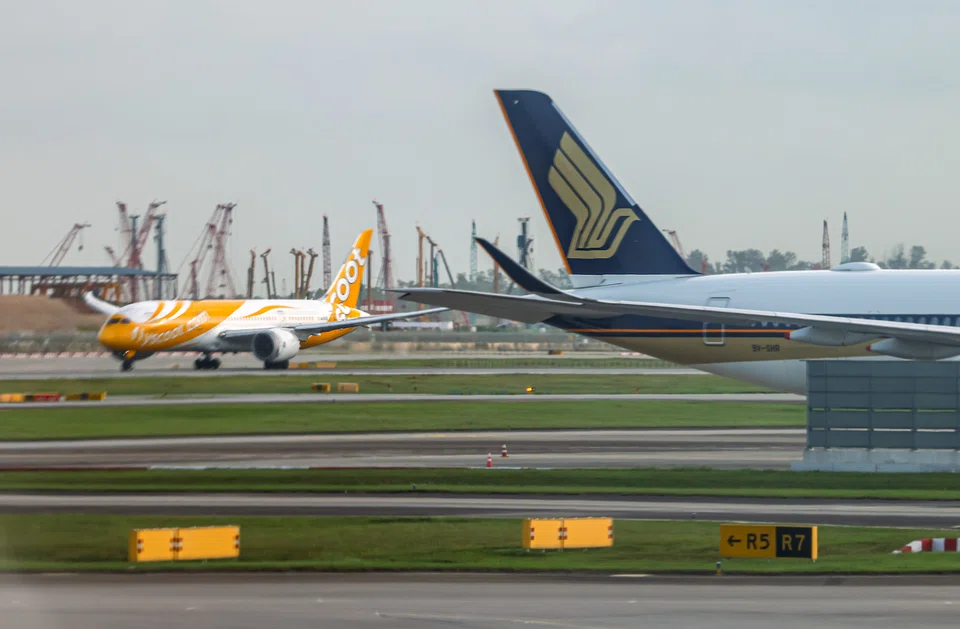
[SINGAPORE] There is no consensus among analysts as to whether the sharp jump in fuel costs and losses from Air India will continue to weigh on Singapore Airlines (SIA) following its S$76 million first-quarter net loss.
The carrier this week announced its first quarterly loss since 2022 – dragged down by an almost S$1 billion jump in its fuel bill and share of losses by its associate in the sub-continent.
SIA raked in record revenues of S$5.7 billion as Gulf air hubs closed amid continuing hostilities in the region. But the same conflict also pushed oil prices up around the world.
Consequently, SIA’s earnings were wiped out by a S$2.5 billion fuel tab, up S$991 million from the prior quarter.
DBS Group Research was critical on Wednesday (Jul 29), noting in a report that the group’s Q1 results fell well below expectations.
SIA’s operating profit came in at S$106 million, plunging 73.8 per cent year on year, significantly missing DBS’ estimate of S$244 million and consensus estimates of around S$282 million.
The research house said that before the results, positive profit guidance from close regional peers such as Cathay Pacific and Korean Air had pointed to a resilient operating backdrop.
DBS expects a negative share price reaction, arguing the stock had already priced in a stronger operating performance.
The brokerage maintained a “hold” call and a S$6.50 target price, against SIA’s closing price of S$7.53 on Wednesday.
SEE ALSO


Still outperforming regional rivals
Citi on Thursday echoed a cautious tone on growth, noting that while demand remained robust, passenger and cargo unit-revenue growth were unlikely to accelerate from the respective 12.4 per cent and 32.5 per cent year-on-year increases recorded during the quarter.
Morningstar director Lorraine Tan on Wednesday said the net loss was not surprising given previous industry guidance on the difficulty of fully offsetting fuel cost jumps.
However, she noted SIA benefited from traffic being diverted away from Middle East competitors, which helped keep its load factor at a decent 87 per cent despite capacity expansions.
Tan expects earnings to improve in the fiscal second half fuel costs ease amid continuing efforts to resolve the Middle East conflict, though she cautioned that passenger yields may also begin to soften.
Independent aviation analyst Brendan Sobie on Wednesday said that comparing SIA’s performance to North Asian peers such as Cathay Pacific and Korean Air was not entirely appropriate, given their very different operating environments.
Sobie noted that March was an anomaly for SIA, echoing Tan’s sentiment that the airline benefited significantly from the complete closure of Gulf hubs.
This drove strong load factors and yields on long-haul routes before the lagged impact of fuel price increases fully materialised. He added that market indicators had suggested for months that the second calendar quarter would be challenging.
Though many of its regional rivals have yet to release their June results, Sobie said that SIA excluding Scoot may have been the sole South-east Asian airline to achieve operating profitability in the June quarter, having generated a S$128 million operating profit.
Additionally, while budget arm Scoot posted an operating loss of S$32 million, Sobie noted this figure was marginal within the context of the overall “dismal performance” of the region’s low-cost carrier sector.
Given that Scoot had already reported a S$16.5 million loss in the corresponding period last year, Sobie said it was demonstrating relative resilience under the circumstances.
SIA to better handle Iran impact
OCBC Group Research, which raised its fair value estimate to S$6.95 from S$6.65 while retaining a “hold” rating, on Thursday noted that SIA was in a relatively stronger position than its peers to withstand the impact of the Iran conflict.
This was aided by an effective hedging programme partially pegged to the Mean of Platts Singapore – the average of a set of Singapore-based oil product price assessments published by Platts.
Sobie said the scale of this protection, noting that without hedging, the higher fuel costs would have come in at S$1.46 billion.
He also echoed SIA management’s sentiment that it was impossible for the airline to fully pass on the increase in fuel costs to consumers.
Losses from associated companies, predominantly Air India, increased by S$42 million year on year.
While this continued to draw market attention, Citi noted that near-term funding risks appeared contained, with no capital requests received to date, and SIA making it clear it did not intend to guarantee Air India’s external borrowings.
As for SIA’s share price, brokerages kept their targets relatively steady, though they cautioned against stretched valuations.
OCBC said SIA’s share price had outpaced fundamentals, trading at a forward price-to-book ratio well above its historical average. However, the research house maintained that the airline continued to hold long-term value due to its robust balance sheet.
Morningstar similarly viewed SIA shares as overvalued in light of rising competition, maintaining a fair value estimate of S$6.30.
While noting that investors appear to be ignoring the near-term impact of the Iran conflict on earnings, Morningstar added that the airline’s net cash position will still allow it to pay out a decent dividend.
Citi maintained a S$7.58 target price, citing successful commercial collaborations and the stickiness of a rising trend towards premium quality that could divert hub traffic away from the Middle East.
Decoding Asia newsletter: your guide to navigating Asia in a new global order. Sign up here to get Decoding Asia newsletter. Delivered to your inbox. Free.
Copyright SPH Media. All rights reserved.






