

Grab gets first Singapore-Johor ride-hail licence as ‘anywhere’ drop-off rules kick in May 4
Passengers gain the convenience of unrestricted drop-offs across Singapore and key districts in greater Johor

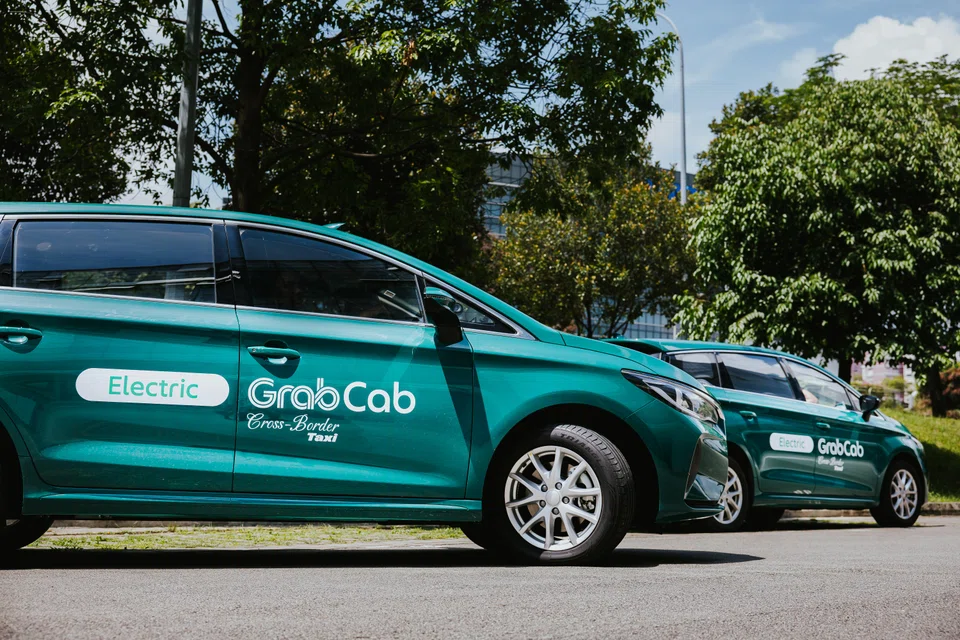
[SINGAPORE] Grab has secured the first regulatory licence to operate cross-border ride-hailing services between Singapore and Malaysia, opening up new income streams for its platform workers.
The Land Transport Authority (LTA) on Thursday (Apr 30) awarded GrabCar the inaugural Cross-border Ride-hail Service Operator Licence, a three-year permit effective immediately. It enables passengers to book cross-border taxi services via Grab’s platform.
The licence is expected to provide “greater convenience and more transport options for commuters between Singapore and Malaysia”, LTA said in a press release.
Under the enhanced Cross-Border Taxi Scheme, which begins on May 4, licensed operators – including Grab and future recipients – can offer such services through their platforms. Cross-border taxis will be allowed to drop off passengers anywhere in Singapore, and in Johor Bahru, Iskandar Puteri, Forest City, Kulai and Senai. Home country pickups will be without restrictions.
Taxis granted the licence must ensure that their cross-border vehicles are easily identifiable. They are required to have prominent roof-top signs, distinct cross-border taxi identification decals and specific licence plate prefixes.
Grab said on Thursday that passengers can book door-to-door rides between Singapore and Malaysia in advance through a new booking service on its mobile app.
The booking service, called the Cross-Border SG-JB (beta) pilot, will allow passengers to book door-to-door rides in advance from Singapore to the designated areas in Malaysia. Passengers from both cities will be able to book rides through the Grab app between 12 hours and up to seven days in advance.
Grab said that a number of GrabCab drivers are licensed to support cross-border journeys, and that it is in the midst of onboarding licensed cross-border taxis from GrabCab and other taxi operators.
A shield for gig workers
The new form of cross-border transport is being closely watched by labour advocates, who see the new digital framework as a shield for domestic gig workers.
SEE ALSO


Local drivers have faced pressure from illegal, unregulated cross-border transport operators in the past years. Yeo Wan Ling, NTUC assistant secretary-general and adviser to the National Taxi Association (NTA), welcomed Grab’s licence and the broader framework as protection for platform workers’ livelihoods.
Digital and visual enforcement – including a mandate for Malaysian taxis to install Singapore’s ERP 2.0 on-board units and a strict 10-year age limit on vehicles – will root out grey-market competition.
Crucially, the integration of ride-hailing platforms will reshape how drivers earn. Under the May 4 roll-out, foreign-registered taxis will be barred from street-hailing. Instead, they will rely entirely on ride-hail and e-hailing bookings to secure return fares at three new designated hubs in each country.
For Malaysia-registered taxis operating in Singapore, these new pickup zones are located near VivoCity, near Century Square and at Joo Koon MRT. Singapore-registered taxis in Malaysia will service pickups at Toppen Shopping Centre, Mid Valley Southkey Mall and Angsana Mall.
Far from viewing these restricted hubs as a limitation, Yeo noted that funnelling pre-booked trips through specific holding areas will ensure orderly operations and actively widen earning opportunities on the ground. Operators are barred from waiting at the pickup points and must wait at designated holding areas until they receive a trip assignment.
Expanding fleets and fares
To service this newly digitised market, regulators are expanding the cross-border fleet. Both nations will inject an initial 100 taxis into the system, raising the cap from 200 to 300 vehicles per country, with a long-term target of 500.
This fresh quota is dedicated to larger “standard 6-seater” and “premium 6-seater” vehicles. For Grab drivers, this means access to higher-yielding fares from catering to families and corporate groups.
The baseline economics of the route have also been officially structured to support sustainable driver earnings. While passengers will benefit from liberalised drop-off rules, allowing them to alight anywhere in Singapore and across key Johor economic zones such as Iskandar Puteri and Forest City, the underlying fares are built to protect driver margins.
A trip from Singapore’s Ban San Street to Larkin will start at S$80 for a standard four-seater vehicle and scale to S$180 for a premium six-seater.
Regulators are also maintaining strict bans on vacant carriage entries to maximise fleet efficiency. To enter the foreign country, taxis must carry at least one passenger, except during exemption periods: 12 pm to 12 am on Fridays for Malaysia taxis entering Singapore; and 12 pm to 12 am on Sundays for Singapore taxis entering Malaysia.
Decoding Asia newsletter: your guide to navigating Asia in a new global order. Sign up here to get Decoding Asia newsletter. Delivered to your inbox. Free.
Copyright SPH Media. All rights reserved.
TRENDING NOW

DBS, OCBC, UOB rout lops billions off STI as inflation, rate concerns spook investors

Grab CEO’s wife Chloe Tong on life with Anthony Tan and finding her purpose

OCBC sheds S$8 billion in value as shares close nearly 6% down; analysts cautious on banks

Deal between tycoon friends sparks scrutiny of Philippine power sector

