

Luxury brands and used cars defy the worst car market in 8 years
Scarce COEs mean the car market is on track for a miserable year, but not everyone is feeling the pain
NEW car sales haven’t been this bad in nearly a decade, but not everyone in the industry here is feeling the pain.
Land Transport Authority (LTA) figures show that 21,470 new cars were registered in the first eight months of this year. With an estimated 12,000 or so Certificates Of Entitlement (COEs) for passenger cars still to be deployed in the final four months of 2022, the year’s final tally of new cars sold could end up at less than 34,000 — down significantly from 2021, when 45,422 new cars rolled onto roads here.
That will make 2022 the worst year for new car sales since 2014, when the industry sold 28,932 units.
New car numbers are down because COEs, which are issued by the LTA to replace cars that are scrapped or re-exported, have become scarce and are getting scarcer. A car can only be registered here if its buyer has a COE for it.
Only 2,352 certificates that can be used to register cars are available every month on average. In October 2017, car buyers could duke it out among themselves for 7,296 COEs, more than three times as many.
But not every corner of the car trade is feeling the pain. While overall industry sales look set to shrink 25 per cent this year, the motoring world’s elite nameplates are bucking the downturn.
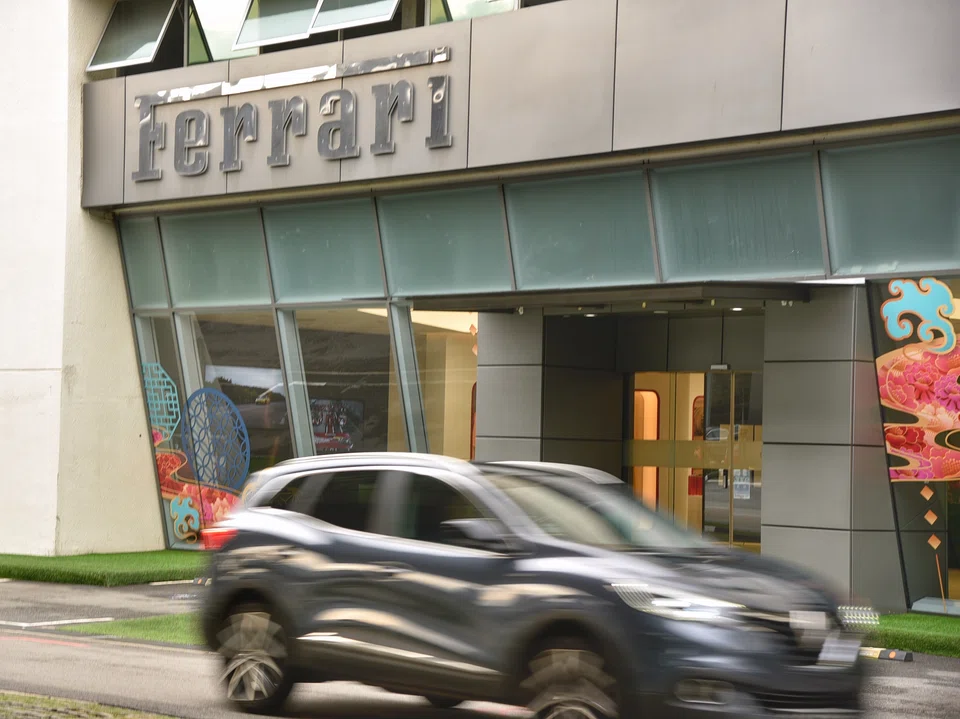
After booking record sales last year, Bentley, Ferrari and Rolls-Royce look on track to surpass 2021’s numbers with 74, 58 and 67 registrations respectively in the first eight months of this year.
“The luxury space is still a very, very good one to be in,” the managing director for a multi-brand dealership told The Business Times.
Things also look rosy in a less glamorous corner of the car market. While the LTA doesn’t release explicit used car data, the number of times that cars have changed owners (which happens each time a used car finds a new owner) has held up this year.
Some 62,500 such ownership transfers took place between January and August this year. That’s 7,813 a month on average, compared with 8,004 last year, which suggests that the used car market has been more resilient than the one for new cars.
One used car dealer said the current climate of high COE premiums have made new cars so expensive that some buyers have been pushed to the second-hand market. “Those people who need a car no matter what may not be able to afford something new, but used cars are still within reach,” he said.
The premium for a Category A certificate (for combustion cars with up to 1.6 litres under the bonnet and no more than 130 horsepower, or electric vehicles with up to 110 kilowatts of power) landed at S$80,501 at the end of this week’s COE auction. The cost of a Category B COE (for combustion cars with more than 1.6 litres or 130 hp, or electric cars with more than 110 kW) ended up at S$95,856.
Both had come down from lofty levels, including an all-time high of S$113,000 for Category B last month, but car prices remain high.
The latest Volkswagen Golf has a retail price of S$164,900 with COE, for example. One used car dealer has an older version with two-and-a-half-years under its wheels for sale at S$120,800, a good $44,100 less.
“There’s also the question of the loan quantum. The deposit for a new car nowadays can be pretty steep,” he said.
Vehicle financing rules can disadvantage new cars. Current limits on car loans require buyers to place a deposit of at least 40 per cent if a car’s import value is above S$20,000, or 30 per cent if the value is below that.
But the Monetary Authority of Singapore (MAS) allows the import value to be depreciated with age. A new VW Golf, which is taxed on a value of S$25,000, would need the buyer to foot a 40 per cent deposit, but after two years the MAS would deem the same car’s import value to have depreciated to S$20,000, making its down payment a more affordable 30 per cent.
For the Volkswagens listed above, that means an upfront payment of S$64,960 for the new one, versus S$36,240 for the used car.
Yet, some claim the used car market is less robust than the number of ownership transfers suggest. “You have to take into account what happens when some digital dealers buy in cars to resell to (the used car) industry,” one former car dealer who is now working at a digital car trading platform said.
Such digital dealers often buy cars from consumers and flip them to buyers, or wholesale them to used car dealers who go on to sell them in the open market. “One car can change owners three times on paper, but it’s effectively just one deal,” he said.
Carro, a digital vehicle trader, currently lists 2,259 used cars for sale on its website. That is seemingly enough to make it a sizeable player here, but its listings still include cars that have already been sold. “I’m not sure what impact they have on the market,” the former dealer said.
As for whether the used car business is as healthy as the ownership transfer numbers suggest, the last place to find out could be in the market itself. “I think used car dealers are still doing okay, but one thing’s for sure, you will never hear them say they are doing well,” he said. “They will always complain that business is bad.”
TRENDING NOW

Higher rates, weaker spending: Is the Philippines entering stagflation?

China recruited exec at Singapore data centre firm to spy on Nvidia CEO Jensen Huang: US intelligence

Could Japan trigger the next global financial crisis?

Philippines’ FDI slowdown exposes uneven investment prospects across S-E Asia

