

PARF headache looms down the road for car dealers
Inured to the pain of rising taxes, dealers have something new to grapple with after Budget Day
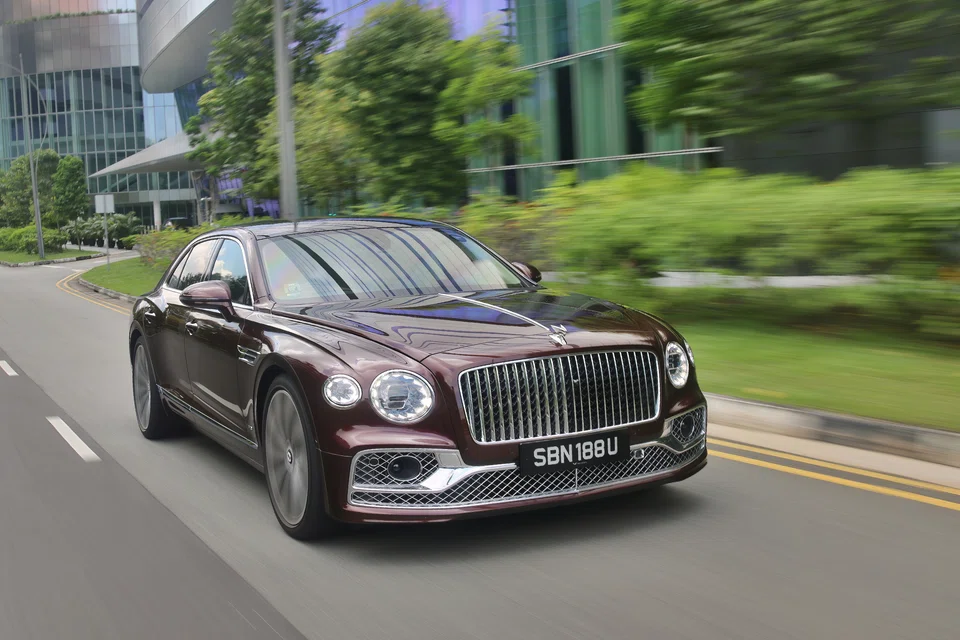
WITH certificates of entitlement (COEs) so scarce and expensive these days, the Leng Kee automotive belt has been a gloomy place lately. But after Budget Day on Feb 14 brought steep new Additional Registration Fees (ARF) aimed at making car taxation more progressive, the atmosphere has turned positively funereal in some quarters.
“It’s like being stabbed with a sword,” one senior manager for a luxury brand’s dealership groaned. “Not just cut, but stabbed. And with the blade twisted over and over,” he added, moving an imaginary sabre through the air.
The new taxes raise prices at the executive car level and above, and apply to cars registered with a COE from February’s second tender exercise onwards. Most cars are lightly affected. Taxes for a Tesla Model Y or Audi e-tron 50 quattro, two glamorous electric cars, are set to rise by S$20,000.
But things get properly eye-watering in the luxury world. A Bentley Flying Spur’s ARF climbs from S$600,000 to S$840,000. With spectacular timing, the Aston Martin Valhalla, a supercar inspired by Formula 1 racing, made its debut here the day after Budget Day with its price tag freshly raised by a cool S$1 million to S$4.8 million.
Car companies are used to rough treatment by the tax man. 2013’s introduction of a new tiered ARF brought tears by raising taxes from a flat 100 per cent to as much as 180 per cent on a portion of Open Market Value (OMV), which is what dealers pay to buy a car from the factory, ship it here and insure it in transit.
Only last year, a new ARF tier raised taxes to as high as 220 per cent on the portion of OMV above S$80,000. You can forgive some dealers for taking it personally when ARF was raised yet again this year, this time to a maximum of 320 per cent for the highest tier. After rising S$60,000 a year ago, the Bentley Flying Spur’s price is up another S$240,000.
Yet, dealers have simply become inured to the pain. The director-level executives that The Business Times spoke to responded with resignation. “It is what it is,” sighed one. “I’ve been overusing that phrase all day.”
In truth, it is customers rather than dealers who ultimately bear the sting. Higher prices may demand extra suaveness from a smooth-talking car salesman, but it is still the buyer who pays the taxes, after all.
Here, there is the feeling that the government has been skilful at inflicting just the right amount of pain. “What will be enough to make a Rolls-Royce customer downgrade to ‘only’ a Mercedes S-Class?” mused the CEO of a dealership group. “I don’t think we’re there yet.”
While higher taxes are easy to calculate and pass on, dealers are now pondering the second-order effects of the new ARF regime.
Luxury used cars will be repriced, for example, as some buyers are pushed down to the pre-owned market. “I think prestige used cars will go up (in price) by 10 to 15 per cent,” said one general manager for a multi-franchise dealership. “But I’m not sure.”
Dealers are even less certain about what will happen to luxury cars’ residual values down the road. That’s because Budget Day also saw a new cap of S$60,000 for Preferential Additional Registration Fees (PARF) rebates, the tax refund that owners get for deregistering a car. That will make it much harder to properly value used cars for trade-in deals.
Residual value is based on the “body” value of a car (or how much it could fetch as a used car in another country) and its “paper” value (the remaining value of a car’s COE and its PARF rebate).
The new cap puts a serious dent in how much dealers can confidently offer customers for some trade-ins. After five years a current Porsche 911 Carrera’s PARF rebate would be S$285,000, for example. With the S$60,000 cap in place, the same car’s paper value is a painful S$225,000 less.
Knowing how to price trade-ins is vital to a dealership because taking a used car off a customer’s hands helps to unlock a new car sale. Asked how his dealership group would handle such cars a few years from now, the CEO that BT spoke to said he had no clue. “When you figure it out, let us know,” he added.
An informal poll of more car executives produced the same befuddlement. For the moment, no one seems to know how the new PARF rebate cap will ripple across the business, except that customers will probably have to get used to being offered less money when trading in posh cars.
The feeling is that this is a looming headache for the trade. “The PARF rebate cap is actually way more significant than the higher ARF,” fumed a dealership group’s director. “Seriously, it’s impossible for us to plan anything with all these changes.”
Having likened the higher new taxes to being stabbed, many in the car industry now have the aftermath of the PARF rebate cap hanging over them like the Sword of Damocles.
TRENDING NOW

Things to know about DBS’ incoming chairman Anthony Lim
DBS eyes prime brokerage business as Q3 profit falls 5% on weaker trading income

Royal Group and Sunset Hospitality abandon plans to open Casa Mett hotel off Orchard Road

George Yeo adds 100,000 Wilmar shares at S$2.97 apiece, taking stake to over 1 million shares

