Singapore sells modestly more marine fuel in July, reflecting strength in shipping activity
Sales are up 1.3% on the month to slightly more than 4.5 million tonnes

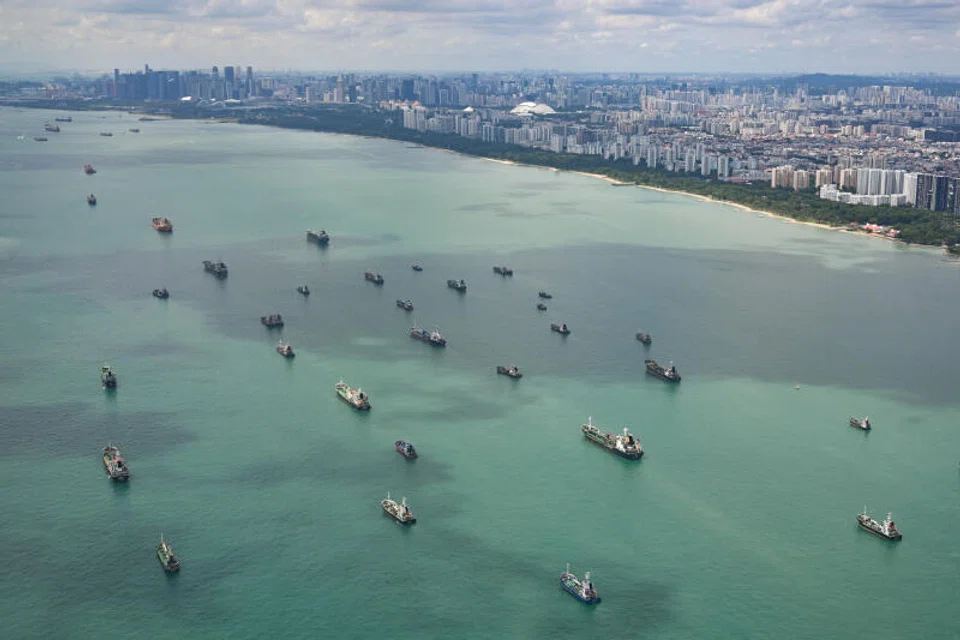
[SINGAPORE] Sales of marine fuel in Singapore, the world’s largest bunkering hub, continued to rise for the third consecutive month in July, but logged a year-on-year decline.
Sales of bunker or marine fuel inched up 1.3 per cent on the month to 4.7 million tonnes in July.
However, it was 3.8 per cent lower than in July 2025, statistics from the Maritime and Port Authority of Singapore published on Friday (Aug 14) showed.
The sales performance was achieved as despite 23 fewer oil tankers calling at Singapore during the month, their total gross tonnage, which measures the total internal volume, was 4.8 per cent more than that of June.
However, compared to the year-ago period, there were 114 fewer oil tankers arriving and the total gross tonnage was 6.6 per cent lower in July.
Mahua Mitra, head of marine fuels pricing for the Asia-Pacific at energy and commodity market intelligence-provider Argus, said the July bunker sales reflected the underlying strength in shipping activity.
However, higher bunker prices, elevated premiums and supply concerns prompted many shipowners to limit purchases to immediate requirements, weighing on year-on-year demand despite a modest month-on-month recovery.
Prices for Singapore’s very low sulphur fuel oil, otherwise known as VLSFO, the primary marine bunker fuel used by the global shipping industry, averaged US$702 a tonne in July.
The prices were also up 2.6 per cent month on month and 37 per cent year on year.
Meanwhile, high-sulfur fuel oil prices rallied sharply, as Middle East tensions raised concerns over regional fuel supply availability.
Reduced blendstock availability, fewer cargo arrivals and longer delivery lead times pushed VLSFO premiums – the extra costs charged above baseline crude or cargo benchmark prices to supply marine bunker fuel – back to US$35 to US$40 a tonne by end-July, Mitra noted.
She commented: “Prompt deliveries attracted even higher premiums, encouraging buyers to defer purchases.”
Prices of bunkers delivered in Singapore spiked for key grades shortly after the US-Israel attacks against Iran on Feb 28, as the supply of crude oil flowing through the Strait of Hormuz was reduced to a trickle after Iran closed the waterway.
One-fifth of global crude oil volume would have normally flowed through this passage.
A key thing to note, she said, is that the decline in biofuel blend sales as regulatory drivers weakened, following the deferment of the International Maritime Organization Net Zero Framework, reducing urgency for some shipowners to purchase biofuels.
However, Singapore is still drawing interest in liquefied natural gas (LNG) bunkering, with LNG bunker sales rising 41 per cent year on year to 58,700 tonnes, supported by the growing dual-fuel fleet in Asia.
Record container throughput
Meanwhile, container throughput was a monthly record high of nearly four million 20-foot-equivalent units (TEUs) in July, beating the earlier record of 3.9 million TEUs in May.
The container throughput also registered a 4.2 per cent increase month on month and a 3.1 per cent improvement year on year.
Tan Hua Joo, analyst at container shipping intelligence provider Linerlytica, pointed out that container volumes have globally remained very strong this year, powered by exports from Asia.
The higher volumes in July were driven by peak season cargo demand in the US and Europe, as well as strong cargo demand in the emerging markets in Africa, Latin America and the Indian sub-continent.
“Singapore’s higher volumes in July were also boosted by spillover cargo that were diverted from China due to typhoons in North China over the past month,” he said.