Singapore’s ‘mild’ green jet fuel levy lags global targets but provides clarity to industry: observers

Derryn Wong
Derryn Wong

Published Mon, Feb 26, 2024 · 05:00 AM
    • Aviation industry observers say the proposed levy by Singapore to fund sustainable jet fuel use will have only a minor effect on ticket prices.
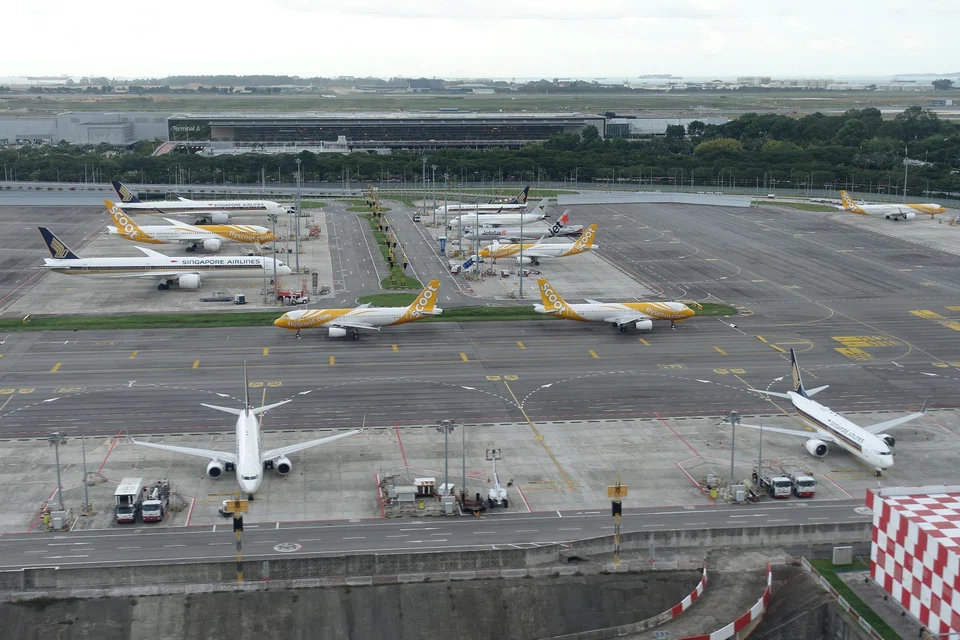
    • Aviation industry observers say the proposed levy by Singapore to fund sustainable jet fuel use will have only a minor effect on ticket prices. PHOTO: BT FILE

    SINGAPORE’S proposed levy on flights to fund sustainable aviation fuel lags international targets, said observers. Even so, it still provides some much-needed clarity to the aviation industry, with only a minor impact on air ticket prices, they said.

    The levy, which was announced on Feb 19 and is to be applied from 2026, will be paid by passengers on all flights leaving Singapore.

    The revenue collected will be used to buy sustainable aviation fuel. The levy quantum will be set so as to cover 1 per cent of all jet fuel used by departing flights, to be increased to 3 to 5 per cent by 2030.

    The Civil Aviation Authority of Singapore (CAAS) estimates the levy for a direct economy-class flight to Bangkok, Tokyo and London to be S$3, S$6 and S$16, respectively.

    Observers said that these are relatively minor price increases compared with the effects of oil prices and overall market demand.

    “If you look at how ticket prices have changed, and how oil prices have changed, (the levy) will not change how people fly,” said Sami Jauhiainen, the vice-president of renewable aviation, Asia-Pacific, at Neste.

    Subhas Menon, director-general of the Association of Asia-Pacific Airlines (Aapa), noted that oil and jet fuel prices have been volatile since the Russian invasion of Ukraine, with the jet fuel price having risen to US$110 from US$80 per barrel in 2019.

    Volodymyr Bilotkach, associate professor in aviation management at Purdue University, does not expect sustainable fuel to add more than 2 to 3 per cent to ticket prices in 2026.

    Market demand is a larger factor, he said.

    “Higher ticket prices in Asean are a result of a mismatch between demand and supply recovery, as supply tends to lag behind demand,” said Dr Bilotkach.

    He added that the levies may not necessarily be passed to consumers, as keen competition between airlines in South-east Asia could cause some to absorb the cost.

    Mild start

    Apart from having only a minor impact on airfares, Singapore’s sustainable fuel levy is also modest by international standards.

    Dr Bilotkach noted that Singapore’s targets lag those of the International Air Transport Association, of 2 per cent by 2025 and 5.4 per cent by 2030, as well as the European Union’s mandate of 2 per cent by 2025 and 6 per cent by 2030.

    “I would say that Singapore is trying to find a balance between competitiveness and decarbonisation of aviation,” he said.

    Singapore needs to be careful not to be too ambitious, he added, as – unlike in Europe – competing airports in South-east Asia are less likely to introduce similar targets.

    Christian Scherer, chief executive officer of the commercial aircraft business of Airbus, agreed that the levy “qualified as a rather mild measure”.

    Still, “it goes in the right direction”, he said, noting that Singapore has been one of the strongest advocates for sustainable fuel.

    Clear direction

    Aapa’s Menon said that the move provides needed clarity to both consumers and airlines. For consumers, Singapore’s approach shows exactly what the cost difference will be, he said.

    As the levy will be used by the government for centralised purchasing of sustainable fuel, it also provides certainty for airlines.

    It differs from sustainable fuel mandates in the EU, for example, where airlines must use a certain percentage of such fuel and are responsible for securing their own supply.

    Singapore’s centralised approach could be a competitive advantage, noted Menon, as it sends a message to airlines that they can obtain sustainable fuel in Singapore. As airlines face increasing requirements to use such fuel, they could choose to fly here to secure their supply.

    On the production side, the levy could help boost the supply of sustainable fuel, which is the largest barrier to widespread adoption. In 2023, sustainable aviation fuel comprised 0.2 per cent of global jet fuel consumption.

    Neste’s Jauhiainen said that the levy helps address the issue of demand uncertainty and the high capital expenditure needed to ramp up production.

    Neste spent S$2.3 billion in 2023 to expand its Singapore refinery’s annual capacity to 1 million tonnes of sustainable aviation fuel, making it the largest such production facility in the world.

    “To build this capacity, we need to put a lot of capital upfront, and we need to believe that there is going to be a market, years down the road, so that we can sell the product and make the investment worthwhile,” he said.

    As a sustainable fuel producer, what Neste needs is not grants, but a long-term framework for sustainable fuel usage, he added.

    “The European mandates have been a proven tool for this, and I think the Singapore approach delivers the same thing. It’s the start of a snowball that we need to drive the global movement towards sustainable jet fuel use.”

    Aapa’s Menon added that, given Singapore’s high standing in the aviation industry, the move could be a model for regional regulators to follow.

    “When it comes to air transport, Singapore is not small,” he said.