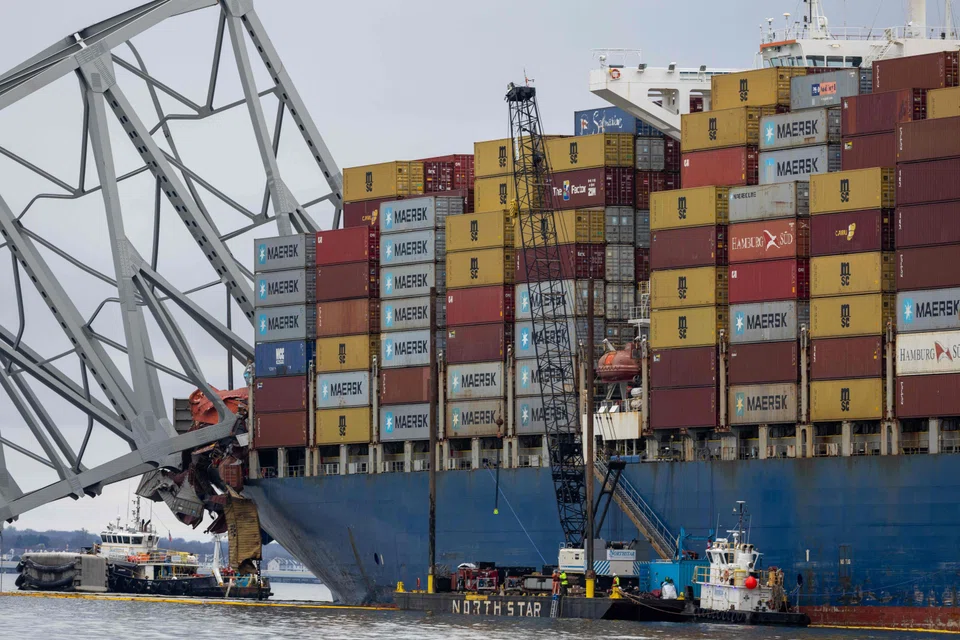
Dali’s Singapore owner seeking share of salvage costs from cargo owners as Baltimore takes legal action

Baltimore to take legal action against those accountable

Tay Peck Gek
Published Mon, Apr 15, 2024 · 10:22 PM
    • The Dali was carrying a total of 4,679 containers when it lost power and slammed into Francis Scott Key Bridge, less than an hour after it left the Port of Baltimore.
    • The Dali was carrying a total of 4,679 containers when it lost power and slammed into Francis Scott Key Bridge, less than an hour after it left the Port of Baltimore. PHOTO: AFP

    OWNERS of cargo onboard the Singapore-flagged vessel Dali that hit and caused a Baltimore bridge to tumble have been asked by the shipowner to share the salvage costs, which are expected to be “extraordinary”.

    Maersk, which chartered the ship when it slammed into the Francis Scott Key Bridge on Mar 26, has confirmed to The Business Times that the Singapore-based shipowner Grace Ocean has declared General Average.

    This is a maritime principle where all parties involved in a sea voyage shoulder the costs of acts undertaken for the preservation of the ship and cargo from the peril, with the quantum shippers have to pay proportional to their share of the cargo.


    In the correspondence from the shipowner’s director Anthony Heng dated Apr 12, Maersk was told that cargo owners would get their shipments only after providing a General Average security.

    “General Average is a long-established procedure in the maritime industry, and is included in our terms and conditions of carriage. The owners of the vessel have control of whether to invoke this procedure, and have done so, ” Maersk said.

    The Danish carrier has told its customers to inform their cargo insurer of the declaration as swiftly as they can.

    Mediterranean Shipping Company (MSC) has also informed its customers whose shipments were also on the Dali that the shipowner is seeking a share of the salvage costs from shippers.

    “No indication is communicated so far as (to) when and where their vessel will be berthed and discharged, but this decision indicates that the (ship)owners expect the salvage operations to result in high extraordinary costs for which they expect contribution from all salvaged parties under General Average,” said MSC’s customer advisory.

    Chinese cargo owners could be among those affected as Dali was ultimately bound for the North Asian country.

    Professor Martin Davies of Tulane University Law School told BT that the shipowner might be able to claim General Average for the salvage expenses, but not for its liability to those who died, nor for the cost of the bridge. Paying compensation for damage caused by the ship is not a General Average expenditure and cannot be shared with cargo.

    Meanwhile, the city where the incident took place has engaged law firms to take legal action “to hold the wrongdoers responsible and to mitigate the immediate and long-term harm caused” to residents, the mayor of Baltimore, Brandon Scott, announced on Monday (Apr 15).

    The parties the city is looking to hold accountable include the owner, charterer, manager/operator, and the manufacturer of Dali.

    The vessel was carrying a total of 4,679 containers when it lost power and slammed into the bridge, less than an hour after it left the Port of Baltimore, bound for Colombo, Sri Lanka, with Yantian, China as its final destination.

    The impact caused the structure to tumble, and six road maintenance workers on the bridge died as a result.

    As at Apr 11, approximately 38 containers have been removed from Dali.

    The declaration by the shipowner of General Average came 11 days after it and Synergy Marine, the manager of Dali, applied to the District Court in Maryland on Apr 1 to seek to exonerate themselves or limit the damages that could arise from the collapse of the bridge to about US$43.6 million.

    The shipowner and manager are also seeking consolidation of claims against them in the same court, where industry watchers expect “sizeable” claims to the tune of billions of dollars, given the extent of the damage to the infrastructure, its surrounding area and any loss of life.