

Vital bulk carrier route from Ukraine reopens
 Add BT as a preferred source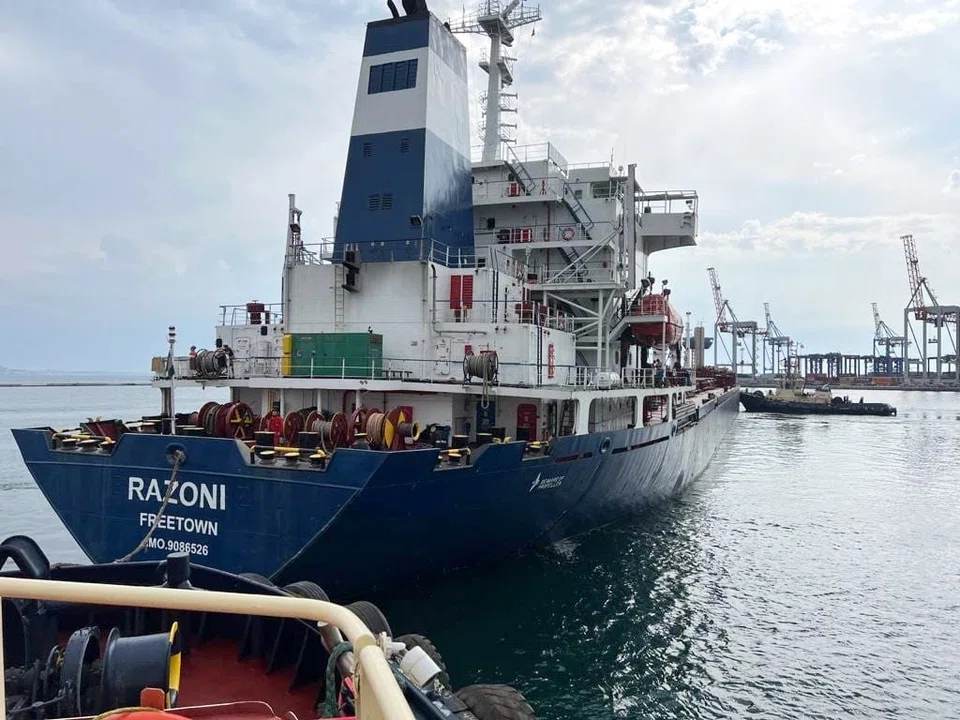
WHEN the large container ship Ever Given blocked the Suez Canal last year, albeit for just a few days, the world was reminded how much it relied on sea transport – or at least how much the supply of consumer goods relies on the smooth operation of container ships.
Until much more recently, however, few outside the shipping or global food production industries would have realised just how vital a role bulk carriers play. When container ships get held up, the general public in the US and Europe complain about not getting their iPads or fridges on time. The Ukraine war has reminded everybody that bulk carriers carry desperately-needed foodstuffs around the world. If they can’t do that, people starve to death.
Widely quoted figures indicate that about 30 per cent of the global supply of wheat, as well as 55 per cent of sunflower oil and 20 per cent of maize and fertilisers, comes from Ukraine and Russia.
The invasion of Ukraine and the turning of the Black Sea into a war zone effectively stopped most of those commodities coming out of Ukraine. There, vast amounts of grain have piled up in silos waiting to be exported, mainly to developing countries whose populations depend on this basic food supply. Russian grain shipments were also stopped.
Not surprisingly, a huge amount of effort went into trying to arrange a deal to allow the flow of grain shipments to restart. What is surprising or even astounding, is that a deal, in which Turkey played a key role, has actually been struck and appears to be holding.
As I write this, the International Maritime Organization (IMO) has issued a statement saying: “IMO secretary-general Kitack Lim has welcomed the departure from Odesa of the first commercial ship to leave the port under the United Nations-supported Black Sea Grain Initiative to establish a humanitarian maritime corridor for the safe passage of ships from Ukraine.”
The bulk carrier Razoni is the first commercial ship to leave Ukraine’s port of Odesa since Feb 26, 2022. The ship is bound for the port of Tripoli, Lebanon, carrying a cargo of 26,527 tonnes of grain.
“I am pleased to see the first departure. The immense work by the United Nations (UN) and the relevant parties has now come to fruition. IMO will continue to do everything to support safe and secure shipping and ensure the safety of seafarers,” added Lim.
It is difficult to think of any similar arrangement between 2 warring countries, but the fact that it has been agreed to at all underlines just how crucial these grain shipments are and how interdependent the world has become.
When news of a deal broke the week before last, the global shipping industry body International Chamber of Shipping (ICS) issued a statement saying that it fully supported the work being undertaken by the UN, the IMO, and others to restart the movement of grain ships from Ukraine and Russia. It added: “We stand ready to work with all parties to ensure this important initiative becomes a reality.”
“This is a long-needed breakthrough for the millions of people who rely on the safe passage of grain to survive. But although this is an important step, lots of work remains to be done. Ensuring crew safety will be crucial if we are to get this agreement moving quickly. Questions remain over how ships will navigate heavily mined waters, and how we can effectively crew the ships in the region to meet the suggested deadline.”
Lloyd’s of London was also quick to pledge its support. Its chief executive John Neal was reported by UK newspaper The Telegraph as saying insurance market was “the first cab off the rank” when it came to providing cornerstone insurance that will unlock shipments. He added: “There is no lack of willingness on our part to provide cover. Is that more expensive than it would normally be? Yes, a bit, but not a lot, actually. Realistically, you are talking in the order of 15-20 per cent.”
Until now, there had been few further comments about the nuts and bolts of how this is all working. It not even clear whether the Razoni was already in Odesa, though reports seem to imply that she had been. It is not surprising that everybody involved has been metaphorically walking on eggshells. The deal has seemed very shaky at times.
What is certain is that, as ICS noted, getting ships manned and reactivated inside what is still a war zone is going to be a complex and difficult operation.
This agreement is a long way from a peace deal and it could easily fall apart at any time. Nevertheless, it is a quite remarkable piece of good news in these otherwise awful times in Eastern Europe.
Decoding Asia newsletter: your guide to navigating Asia in a new global order. Sign up here to get Decoding Asia newsletter. Delivered to your inbox. Free.
Share with us your feedback on BT's products and services
TRENDING NOW

The S$1 million National Day paradox: ‘money dysmorphia’ amid a wealth surge

Singapore at 61: How we can ensure opportunity, security and ownership for the next generation

Why Asean matters more than ever to the UK and Singapore

Too little, too late? Manila’s billion-dollar bid to ignite its sputtering EV industry

