

‘Boring’ is the new black: The stars are aligning for a Singapore stock market revival
The benchmark Straits Times Index has outperformed the S&P 500 – in both USD and SGD terms – in recent years

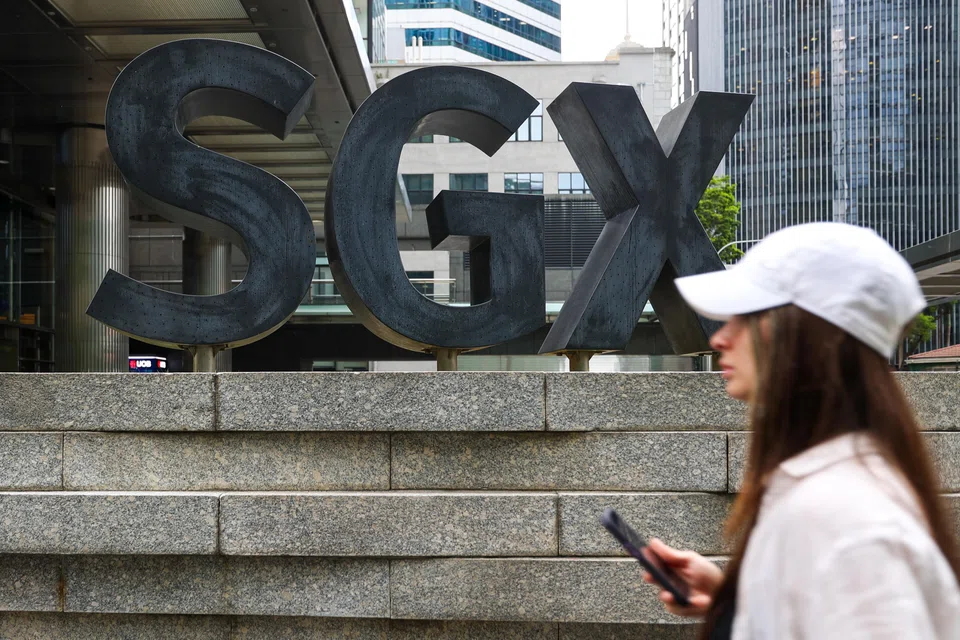
[SINGAPORE] For the longest time, selling Singapore equities felt like trying to spark a fire with wet wood. But for investors like Terence Wong, founder and CEO of Azure Capital, the blaze is finally catching.
The veteran fund manager has spent years championing local small and mid-cap stocks. Now, he is seeing a flurry of dealmaking he has not witnessed in nearly a decade.
”I’ve done more placements in the last six months or so – or from the latter half of 2025 – compared to since the inception of my fund, which is almost nine years old,” Wong told The Business Times.
“When I first started, I even had to inspire the analysts and tell them: ‘Don’t worry, one day the market will come back’,” he added. “But now, it’s a different story.”
Wong is not just talking up his book; he is putting fresh capital to work.
Convinced the local bourse is entering a golden window, Wong is launching a new vehicle to invest specifically in Singapore equities. He is now eagerly waiting for his bank accounts to clear so he can deploy the cash.
Why the sudden rush? It is not just a sugar rush from government liquidity. We are seeing a structural shift in global capital flows, driven by a multipolar world and rising geopolitical tensions.
Global markets are navigating a messy landscape. The threat of renewed US trade tariffs and endless conflicts in the Middle East, among other things, have changed the global cost of risk.
Yet, amid this storm, the Singapore stock market is emerging as more than a defensive shelter. It is a compelling growth play.
SEE ALSO

For nearly a decade, younger retail investors ignored local equities. They chased high-flying US tech stocks and crypto instead.
But a mix of global pivots, cheap valuations, and an aggressive regulatory push is turning the tide – and the narrative for the Singapore Exchange (SGX) is changing.
Market veterans, who have survived the long drought of local liquidity, can feel the tectonic plates shifting.
Now, defying the broader global panic, there is a revived demand for local assets. Just look at the dealmakers on the ground, like Azure’s Wong.
But his optimism is grounded in reality. For too long, Singapore’s smaller counters were punished as “value traps” and traded at depressed price-to-earnings (P/E) multiples.
Their underlying profits and steady dividends did not matter – they simply stayed cheap.
But the trap is fast becoming a playground.
Instead of comparing these companies to their depressed five-year P/E averages, investors should look at them against regional peers.
The way Wong sees it, many of these cash-generating businesses offer deeply discounted entry points.
Furthermore, while investors used to hate Singaporean managers for being famously conservative, that is now a highly prized asset in today’s era of global uncertainty.
A refuge in a fractured world
This local revival is deeply tied to a rotting global macroeconomic environment, where the shift to a multipolar world has effectively damaged the economic premise of globalisation.
With traditional supply chains proving vulnerable and international alliances becoming purely transactional, Singapore’s longstanding political neutrality is suddenly worth its weight in gold.
When you add fiscal discipline and a strong rule of law to the mix, you get a massive “structural premium”.
Thilan Wickramasinghe, Maybank Securities’ head of research for Singapore, has been shouting about this from the rooftops as capital flees high-risk areas in search of proven safe havens.
”I am still bullish,” Wickramasinghe said in an interview with BT. “Out of this whole war and uncertainty, if any market that is holding up relatively better, it is Singapore.”
Maybank recently unpacked this resilience in a strategy report looking at the fallout from the Middle East, noting that while escalating conflicts and swinging oil prices inject massive volatility into global equities, the local market’s DNA offers a unique buffer.
“Historically, oil price shocks have had limited impact on valuations,” Wickramasinghe noted, adding that Singapore’s “certainty premium” and domestic-resilience-led themes should continue to attract flows amid the volatility.
This premium is already bringing in real money as wealth management and family office capital look to reroute from the Middle East and North Asia to land in Singapore, providing a rock-solid base of liquidity.
It is not just about playing defence, though, because these domestic-resilience themes point to sectors primed for multiyear growth.
The global rearming cycle is a perfect example; as nations hike defence budgets from 2 per cent of gross domestic product to 3 or 4 per cent, the growth assumptions for local defence proxies such as ST Engineering need a serious upgrade.
At the same time, as global firms move manufacturing out of China, Singapore is cementing its place as the crucial logistical and financial node for the broader South-east Asian supply chain pivot.
While macro defence and structural growth make for a good story, the bedrock of the SGX has always been income. Yet, a stubborn myth persisted for years among retail investors who believed that buying Singapore meant sacrificing total returns for stagnant dividends, assuming the real money was made passively indexing the US markets.
The data, however, completely shatters this illusion.
The dividend engine
Chen Weiheng, global investment strategist at JP Morgan Private Bank, believes that the local market carries hidden strength.
The way he sees it, the Singapore equity market presents a compelling combination of stable dividend income, attractive value, and secular growth opportunities.
Tackling the performance gap head-on, Chen pointed out that, surprisingly to many investors, the Singapore equity market has demonstrated outperformance even against the S&P 500 in both USD and SGD terms in recent years – and with lower volatility.
This outperformance comes from the relentless compounding of dividend yields, which historically drive about half of long-term total returns in Asian markets. In this dynamic, Singapore reigns as the absolute king.
Take the local banks, DBS, OCBC, and UOB, which are biased towards a short-war scenario as the Middle East conflict plays out. Boasting strong capital positions, soaking up massive wealth inflows, and offering dividend yields of 5 to 6 per cent, their main risk remains a drawn-out global conflict where elevated oil prices could spark broader credit stress and force them to delay capital management programmes.
Then there are the S-Reits, which are highly sensitive to interest rates but are finally looking lean after two painful years of restructuring. While their dividend spreads are attractive and offer real upside if the rate-cut trajectory holds, they could remain sitting ducks if the US Federal Reserve freezes and keeps rates higher for longer.
Meanwhile, offshore and energy giants Sembcorp and Keppel offer an all-weather play deeply tied to the green transition. They are perfectly placed to grab a massive slice of global spending as capital pours into both renewable infrastructure and transitional fossil fuels.
Even telcos Singtel and StarHub are finding new life by pivoting to data centres, tapping directly into the multiyear AI infrastructure boom to transform from cyclical spenders into structural winners.
Anchored by these heavyweights, the Straits Times Index offered dividend yields close to 5 per cent in the last two years, ranking among the highest in the developed world.
These defensive champions generate highly predictable cash flows backed by a deep-rooted culture of capital discipline, creating a phenomenal margin of safety for those looking to lock in a near 5 per cent yield in a volatile rate environment.
This yield is further sweetened by a remarkably strong local currency, as the Singapore dollar is one of the few global currencies to consistently appreciate against the greenback over the past fifty years.
Thanks to the Monetary Authority of Singapore (MAS) running a tight ship with its exchange-rate-centred policy, foreign investors do not lose their equity gains to FX depreciation, adding a carry advantage that elevates the whole return profile.
But markets do not break out of decade-long ruts on fundamentals alone; they need a spark. And for the SGX, that spark is a very intentional and wide-ranging intervention, with ecosystem-wide measures aimed at tackling market challenges.
To deepen liquidity, boost trading, and revive the IPO pipeline, MAS answered with the Equities Market Development Programme (EQDP); its funding was recently bumped up to S$6.5 billion.
The programme is designed to fix the market’s blind spots by handing capital to asset managers to actively invest in Singapore-listed equities, focusing squarely on the small and mid-cap companies that institutions have ignored for years.
By investing billions into the exact segments fund managers such as Azure’s Wong are hunting in, it ensures fundamentally sound companies will finally get the price discovery they deserve.
This cash injection comes paired with a much-needed regulatory overhaul that replaces punishing, inflexible listing rules with a full-disclosure-based regime, trusting companies to explain their business to the market rather than choking them with rigid rules.
Add to this the SGX-Nasdaq dual-listing bridge slated for mid-2026, which will streamline prospectus requirements and let companies tap Asian and US liquidity pools at the same time. This effectively positions the city-state as a leading capital-raising hub for ambitious firms across the Asia-Pacific.
Indeed, we are standing at a rare inflection point.
As geopolitical instability drives up the global cost of risk and the reality of inflated US valuations starts to bite, the fundamental laws of financial gravity are firmly returning.
Capital is inherently pragmatic, flowing back to tangible assets, visible cash flows, and unshakeable macro stability.
Throw in aggressive ecosystem-wide measures, solid corporate governance, and cheap regional valuations, and the picture becomes incredibly clear: the smartest bets in this economy are no longer sitting an ocean away, but are waiting right here at home.
Decoding Asia newsletter: your guide to navigating Asia in a new global order. Sign up here to get Decoding Asia newsletter. Delivered to your inbox. Free.
Copyright SPH Media. All rights reserved.
TRENDING NOW

DBS, OCBC, UOB rout lops billions off STI as inflation, rate concerns spook investors

Grab CEO’s wife Chloe Tong on life with Anthony Tan and finding her purpose

OCBC sheds S$8 billion in value as shares close nearly 6% down; analysts cautious on banks

Deal between tycoon friends sparks scrutiny of Philippine power sector

