

UOB upbeat on Asean trade despite fresh US tariffs, trims 2026 fee guidance after Q4 profit slips
Fourth-quarter earnings decline 7% to S$1.4 billion; lender declares H2 dividend of S$0.71 a share

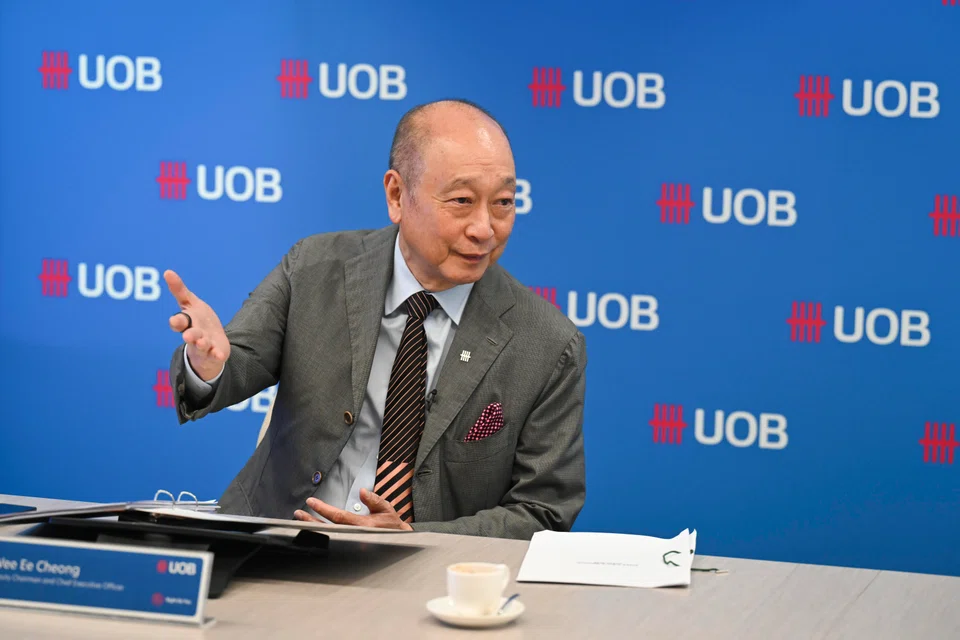
[SINGAPORE] As fresh tariffs cloud the global trade outlook, UOB said that Asean’s intra-regional momentum remains intact, positioning the region as a relative bright spot amid rising volatility.
While businesses may adopt a cautious stance in the near term as they assess shifting tariff rules, the bank pointed to firm growth in trade financing and steady cross-border activity over the past year as evidence that regional connectivity remains robust.
“If you look at trade, capital flows and cross-border investments – (they) continue to expand, reinforcing the region’s role as a key growth engine,” said UOB deputy chairman and chief executive officer Wee Ee Cheong on Tuesday (Feb 24).
He was speaking at the bank’s fourth-quarter results briefing for the three months ended Dec 31, 2025. UOB reported a 7 per cent fall in net profit to S$1.4 billion, as margin pressures from lower benchmark rates weighed on earnings, with the result narrowly missing analysts’ consensus estimates.
The lender trimmed its 2026 fee income growth outlook to high single digits, from an earlier high single to double-digit target, citing more conservative loan growth targets and macroeconomic uncertainty.
For the full year, net profit fell 23 per cent to S$4.7 billion in FY2025, from S$6 billion a year earlier, largely due to the lender’s decision to set aside nearly S$1 billion in allowance provisions in Q3.
A dividend of S$0.71 per share was declared for the half-year, bringing the total net dividend for FY2025 to S$1.56 per share. This represents a 50 per cent payout ratio – meaning about half of the bank’s net profit is returned to shareholders as dividends. The total payout was lower than the S$1.80 distributed in FY2024.
In determining the final dividend for FY2025, the pre-emptive general provision set aside in Q3 was excluded from the calculation, said Wee.
Asean resilience
Part of Wee’s optimism regarding Asean stems from stronger contributions from the region.
SEE ALSO



Across UOB’s four core Asean markets outside Singapore – Indonesia, Malaysia, Thailand and Vietnam – total income rose 5 per cent for the full year, compared with a 3 per cent decline at the group level.
“Asean is actually trending up,” Wee pointed out.
The growth was largely led by Malaysia, where total income climbed 10 per cent year on year (yoy) to a record S$1.7 billion in FY2025.
At the group level, total income fell to S$13.8 billion in FY2025, from S$14.3 billion previously. In Q4, total income declined 5 per cent to S$3.3 billion, mainly due to a moderation in net interest income.
Asked how the Trump administration’s latest tariff measures – including a higher global base rate of 15 per cent after the US Supreme Court struck down parts of earlier tariffs – could affect Asean’s outlook for 2026, Wee said that intra-Asean trade and trade with China remain robust.
“In Asean, we have no choice – we have to support each other given the situation,” he added.
Leong Yung Chee, UOB’s group chief financial officer, noted that when tariffs were first introduced during US President Donald Trump’s “Liberation Day” announcement in April 2025, customers initially paused to reassess their plans. However, subsequent supply chain shifts supported trade financing activity.
“Loan growth did dampen, but, by and large, the activities continued, trade continued,” said Leong. “I think there will be some time required for the system to absorb, comprehend and react to (the latest tariffs).”
One by-product of tariff-driven supply chain adjustments has been stronger demand for trade loans, as companies reconfigured operations across Asean and sought financing support.
As at Dec 31, 2025, UOB’s trade loans stood at S$45 billion, up 25 per cent from S$36 billion a year earlier. This outpaced the 5 per cent increase in total gross wholesale banking loans, which rose to S$251 billion over the same period.
Although trade loans account for a relatively small share of the overall loan book, they reflect the “active realignment” of supply chains and the resilience of Asean’s trading ecosystem, said Leong.
The expansion in trade activity has also created opportunities to cross-sell foreign exchange, interest rate hedging and cash management services.
“The broader wallet associated with trade isn’t just because of trade, but it also has implications on how we shape the business,” he added.
The bank stressed that it remains focused on the “long term” rather than short-term volatility, maintaining that Asean remains attractive.
Indonesia, where UOB’s loan exposure represents roughly 3 per cent of its total portfolio, continues to offer opportunities given its population size and expanding middle class, noted Wee.
Thailand, which accounts for about 8 per cent of loans, could benefit from improved political stability and rising foreign direct investment, he added. Vietnam remains one of the region’s fastest-growing economies.
2026 guidance intact
On Tuesday, UOB kept its 2026 guidance on key metrics mostly unchanged. It continues to expect low single-digit loan growth, a full-year net interest margin (NIM) of between 1.75 and 1.8 per cent, low single-digit operating cost growth, and total credit costs of 25 to 30 basis points (bps).
In Q4, NIM came in at 1.84 per cent, compared with a full-year FY2025 margin of 1.89 per cent, as lower benchmark rates continued to exert pressure.
As at end-January, UOB’s exit NIM stood at 1.82 per cent, said Leong, “giving us some confidence” in terms of what margins could look like in 2026.
Wee noted that interest rates in Singapore, including the Singapore Overnight Rate Average, have stabilised. He added that the bank has also factored in expected rate cuts by the US Federal Reserve.
For FY2025, a 14 bps decline in NIM led to a 3 per cent drop in net interest income to S$9.4 billion, from S$9.7 billion previously.
Net fee income rose 7 per cent to a record S$2.6 billion, driven by new highs in wealth management and loan-related fees. Other non-interest income fell 15 per cent to S$1.9 billion, as trading income and liquidity management normalised after a strong 2024.
Total expenses eased 2 per cent yoy to S$6.2 billion, although the cost-to-income ratio rose to 44.6 per cent from 44.1 per cent due to lower overall income.
The non-performing loan ratio was unchanged at 1.5 per cent. UOB set aside S$2 billion in allowances in FY2025, more than double the S$926 million recorded in the previous year.
Separately, UOB said that it will grant its junior employees a one-off, additional half-month of base salary, “in recognition of their contributions amid a challenging external environment”.
The supplementary payout, to be disbursed in the second quarter of this year, will benefit about 6,000 employees across the group and amount to around S$4 million in total.
UOB is the second of Singapore’s three local banks to report full-year results, after DBS released its numbers on Feb 9. OCBC is due to report on Wednesday.
Shares of UOB fell following the results announcement. The counter closed S$1.60 or 4.1 per cent lower at S$37.20 on Tuesday.
Decoding Asia newsletter: your guide to navigating Asia in a new global order. Sign up here to get Decoding Asia newsletter. Delivered to your inbox. Free.
Copyright SPH Media. All rights reserved.
TRENDING NOW

DBS, OCBC, UOB rout lops billions off STI as inflation, rate concerns spook investors

Grab CEO’s wife Chloe Tong on life with Anthony Tan and finding her purpose

OCBC sheds S$8 billion in value as shares close nearly 6% down; analysts cautious on banks

Deal between tycoon friends sparks scrutiny of Philippine power sector

