

‘We were born very privileged. What do we do with that?’: Next-gen heirs want more say in family offices
Forum panellists agree that wealthy families need to give their younger members space to make decisions

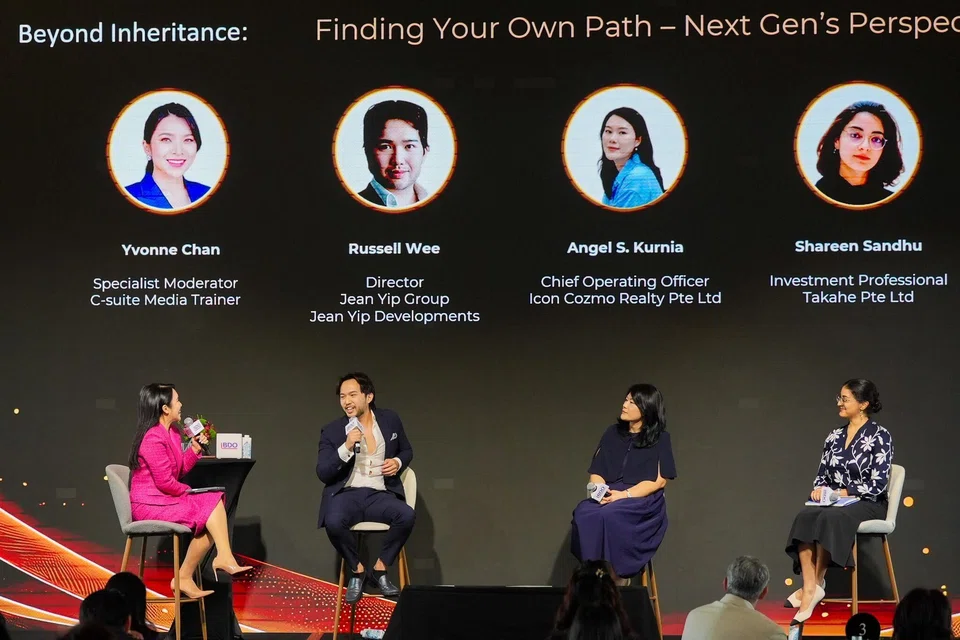
[SINGAPORE] Wealthy families need to give the next generation room to make decisions and chart their own course, as they seek to uphold the values on which their fortunes were built, said panellists at a family-office forum.
While inter-generational conflict is inevitable, it is important for families to be clear about their vision and trust that the next generation can carry it forward, the panellists added.
Russell Wee, director at Jean Yip Group and a second-generation member of the family, said: “Preserving family values and family law is the whole point of a family office.
“Of course, there are different perspectives, but that doesn’t mean the goal is different.”
With US$12 trillion set to change hands in Asia in the next 15 years, the issues of succession, governance and what gets passed down were being re-examined at the BDO Global Private Client Symposium held at the Andaz on Thursday (Oct 15).
A recent study by the Wealth Management Institute (WMI) found that seven in 10 high-net-worth families are set to transfer wealth to later generations, but only about half think the next generation is prepared to engage with the family office.
At the panel discussion on the role of the next-gen in family offices, Shareen Sandhu, an investment professional at Takahe, a Singapore-based family office, said younger family members should be treated as stewards of wealth rather than passive beneficiaries.
Speaking as a member of the second gen herself, she said: “It takes into consideration the white elephant in the room – which is that we were born very privileged. What do we do with that? And how do we learn more about that position that we hold just by virtue of birth?”
Once the family’s values are entrenched, members of the next gen can also grow and experiment, she added.
Many members of the next-gen also bring skills from outside careers as they move into the family business or office.
Fellow panellist Angel S Kurnia, chief operating officer of Icon Cozmo Realty, started a wellness-fitness venture prior to joining the family office.
For her, the overriding goal of the family office is to pass down values, not just wealth.
Jean Yip’s Wee said that having worked in an institution before joining the family gave him an understanding of “the bigger picture”.
“When you work with your kids in the future or in the family office, I would say treat them as professionals, not as just as your kids,” he said, stressing the need to manage expectations.
Bridging the gap between generations
Multi-generation family offices often have to balance legacy rules against what the next-gen wants to bring to the table.
Kurnia said bridging that gap can be challenging, as each generation operates from a different playbook.
In a separate panel, Richard Mak, principal and chief executive officer of Highland Family Office, said that his family office had a family charter drafted in 1992, and the document has since been updated and revised.
It sets out principles such as liquidity requirements, minimum investment size and ethical guidelines, which he, as a third-generation member, has to follow.
One strict clause bars the family from using leverage.
“(When) we look at the current market situation, we are stepping away from a lot of the things that I see some of the other family offices are doing because of the family-office charter, and we will miss a lot of opportunities,” he said.
“But… we value sleep at night and capital preservation.”
Impact investing and patient capital
Families should ensure that their governance systems allow for “patient capital” and long-term investing, whether in companies or communities, speakers on a third panel said.
For companies, families provide entrepreneurial experience and networks instead of just capital, noted Koh Jin Hoe, head of capital markets, global sales and origination at the Singapore Exchange (SGX).
Private capital is also best-placed to support system-changing efforts as they tend to be more patient and flexible, noted Kenneth Goh, associate professor at the Singapore Management University (SMU).
He said those with greater capacity and interest in solving long-term existential problems tend to be the next gen as “they have the most to lose”.
The issue is, returns on such investments tend to pan out only in the long run, which may be counterintuitive for next-gen members who have to prove their credibility by showing results in the short term.
The solution is to alter governance systems to allow for such risks, he said.
“Allowing for cheque book philanthropy, I think, is important; but also give some space for more catalytic investments in which you see the results only in the long term,” he said.
Singapore’s stability remains a draw
Overall, Singapore stands out as a symbol of stability amid rising global uncertainty, the panellists agreed.
Said Teo Kai Xiang, head of the Banking Development Division at the Monetary Authority of Singapore (MAS): “Resilience today is not just about how the family office itself is being structured, but also where it is being anchored.
“That is one reason why Singapore continues to attract family offices in a world where certainty is increasingly scarce.”
Teo acknowledged competition with Hong Kong, but said that it is healthy as it ensures that the financial hubs keep innovating.
In fact, both hubs are complementary, given that they each open doors to different markets, with most family offices now operating in both Hong Kong and Singapore, he noted.
Such a one-plus-one strategy can support the continued growth of both markets, he added.
Decoding Asia newsletter: your guide to navigating Asia in a new global order. Sign up here to get Decoding Asia newsletter. Delivered to your inbox. Free.
Copyright SPH Media. All rights reserved.
TRENDING NOW

Two Singapore-listed palm oil firms named in Greenpeace report on Indonesian plantation fires

Singapore Airlines flight returns to San Francisco after ‘unruly’ passenger incident

Singapore looking into which companies responsible for haze-causing fires: PM Wong

Deluge IPO 3.86 times subscribed ahead of SGX debut

