

Zoom looks beyond video calls as Singapore workers return to office
Video meetings now sit within a broader portfolio that includes phone calls, face-to-face meetings and even hybrid meetings, says Carlos Quaderi

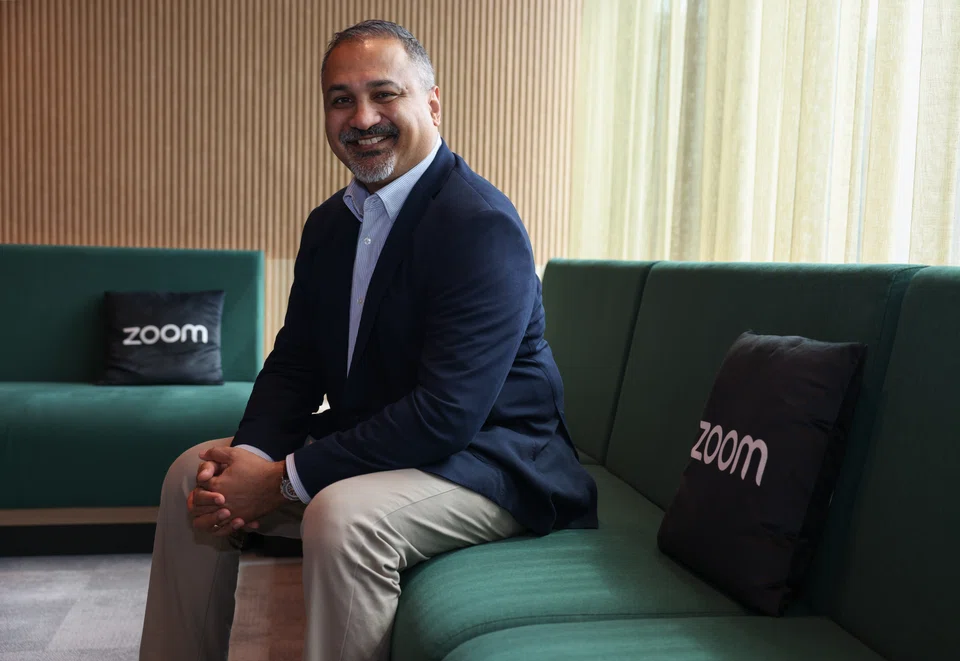
[SINGAPORE] As more workers return to the office, Zoom wants to follow them as part of its wider push to grow beyond a video-conferencing platform in the Asia-Pacific.
Instead of positioning itself solely around virtual meetings, Zoom is expanding into artificial intelligence-powered workplace software – including meeting room systems and office management tools – as it seeks to redefine itself.
A 2025 JLL survey of 500 Singapore employees found that 69 per cent faced policies requiring them to work from office for a certain number of days.
“We are no longer a (video) meetings company alone,” Carlos Quaderi, head of Apac at Zoom, told The Business Times.
Previously, he was Zoom’s head of Asia. He took on the role of Apac head on Aug 1, and now oversees the broader region as well as works more closely with the global leadership team.
He elaborated that video meetings now sit within a broader portfolio that includes phone calls, face-to-face meetings and even hybrid meetings.
“The portfolio we are actually building is designed to meet the organisation where they are,” he added.
“Over-indexed” in Singapore
“We have actually over-indexed in Singapore,” he said, noting Zoom’s various investments in the likes of infrastructure, data centres and customer service over the past few years.
One of the group’s most significant recent investments is a new 7,500 square foot (sq ft) office at IOI Central Boulevard Towers in Singapore, opened last year.
Within the office stands a 2,000 sq ft experience hub, which showcases Zoom’s wider range of products to current and potential customers. It is one of the company’s two experience hubs globally; the other is in Japan.
That product shift is also shaping the next phase of Zoom’s plans for Singapore, which Quaderi said would play “an instrumental part” in the overall Apac strategy.
In his view, the coming chapter of regional growth will be driven by cultivating more Singapore-based integrators, AI companies, resellers and channel partners.
“The future is about cultivating and growing the partner ecosystem, specifically in Singapore,” he said, noting that the group will focus on the geographic and organisational needs in the Republic.
Zoom has around 2,800 partners across Apac, but Quaderi did not disclose how many are based in Singapore.
This strategy could help the group deepen adoption among Singapore customers while extending its reach across South-east Asia.
Quaderi highlighted that many of the Singapore-based partner ecosystems are already servicing companies in the region, allowing Zoom to use the Republic as a springboard to South-east Asia.
For the first quarter of its 2027 financial year, Zoom posted revenue growth of 6.2 per cent for Apac. This outpaced the 5.4 per cent revenue expansion seen in the Americas, as well as the 5.2 per cent rise in the Europe, Middle East and Africa region.
Apac revenue stood at US$150.5 million, accounting for 12.1 per cent of the group’s total revenue of US$1.2 billion.
Zoom was unable to provide a breakdown of the figures by country. Its Q2 results will be released on Aug 26.
When asked about the company’s AI strategy, Quaderi framed its expansion in Singapore not as a response to work-from-office trends, but instead as part of a calculated push that began three years ago to integrate AI across its product portfolio.
“AI has to be embedded across all of it,” he said.
“Amalgamation of models”
This push comes as AI developers move away from chatbots and towards agentic AI tools.
Zoom’s AI strategy differs from such tools as it seeks to build around the conversational data generated by its communications products, including meeting transcripts and follow-up tasks.
The way Quaderi sees it, Zoom does not regard model developers such as OpenAI and Anthropic as direct competitors.
Instead, the company uses an “amalgamation of models” in its back-end, alongside its proprietary AI models, to enhance its offerings related to the technology, he said.
He added that the group routes tasks to specific AI models depending on capabilities and costs, before using the context from conversations to carry out jobs such as PowerPoint generation and meeting follow-ups.
With the additional conversational context, Quaderi said the AI models are less likely to hallucinate. “There is nothing better than human conversation to provide real-time contextual awareness.”
Not just infrastructure investments
But as Zoom looks to embed more AI into its products, cybersecurity and computational power demand are also rising.
“We’ve actually just... invested in (another) data centre to service our customer-experience customers in this part of the world with dedicated investments in Singapore,” said Quaderi. He did not share further information on the size and investment cost.
The move builds on Zoom’s 2020 investment to open its first data centre in South-east Asia in Singapore. That same year, the company announced that it intended to double its data-centre capacity in the Republic.
Through its latest infrastructure investment, Zoom aims to improve contact-centre experience and also enhance its AI capabilities via its AI agent, said Quaderi.
But he also noted that the next phase of Zoom’s growth in Singapore does not lie in additional infrastructure investment.
“Any company is going to be limited by infrastructure investments in Singapore,” he said, citing size and power constraints within the nation.
“The value is actually sitting above the infrastructure layer,” he added, referring to software.
TRENDING NOW

First Resources blames El Nino, outside fires for Kalimantan hotspots amid haze scrutiny

High Court rules against Julius Baer’s Singapore trust arm in US$50 million family trust dispute

Singapore key exports jump by higher-than-expected 68.4% in September, led by non-electronics

MSCI proposes downgrading Indonesia to standalone market status

