5G wireless network will be fork in road for Singapore telcos
They will need to be efficient provider of connectivity or must evolve to be digital and service platform provider

Annabeth Leow
Singapore
LICENCES for Singapore's planned 5G wireless networks are hailed by observers as a game-changing catalyst, amid a consumer mobile market battered by a price war.
Since winning bidders can roll out services only from 2021 on, uplift may still be more sentiment than reality in the new year, with consumer competition set to stay intense.
"Telcos in Singapore are at a fork in the road," Oliver Wilkinson, a partner at PwC Singapore, told The Business Times, citing pressure on their earnings before interest, tax, depreciation and amortisation (Ebitda).
"They will either need to be an efficient, asset-heavy provider of connectivity with the need to upgrade to 5G and newer technologies to stay relevant, or they must evolve towards a more digital and service platform provider business model."
As Singtel group chief executive Chua Sock Koong put it: "The paradox for the telco industry has been that mobile revenue growth has stagnated even as data growth has taken off." Still, she projected that 5G, Internet of Things (IoT) and artificial intelligence (AI) technologies "will fundamentally change where value is created".
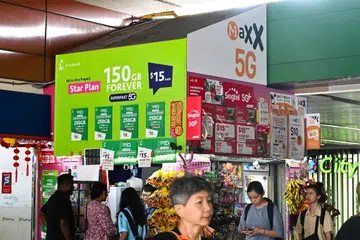
The three incumbent mobile network operators (MNOs) have been hit by intense consumer market competition, which is fuelled not just by new MNO entrant TPG Telecom, but also a continued rise in the mobile virtual network operators (MVNOs) - or digital telcos - that lease their network.
TPG started mobile services on a trial basis in end-2018 and is expected to introduce them commercially in 2020. While the telco told BT that the timeline and price point are not yet determined, it has opened its first physical store at Orchard Central.
Singapore now hosts 12 telcos - four MNOs and eight MVNOs. Manjot Singh Mann, CEO of recently privatised Keppel Corp subsidiary M1, cited the "highly competitive" nature of the mobile market as a top concern for the coming year. Mainboard-listed StarHub estimated that Singapore's mobile industry lost as much as S$180 million in revenue in 2019 from free trials, according to its CEO, Peter Kaliaropoulos.
"We welcome TPG officially launching, because if I have 300,000 or 400,000 free customers, that's revenue coming out of the industry," Mr Kaliaropoulos told BT. "Tomorrow, these customers will have to pay."
That is even as one MVNO became the first to blink in the years since Circles.Life shook up the market with its debut on M1's network in 2016.
Zero Mobile, which leases from Singtel, called a time-out on its mobile services in December. CEO Glenn Mohammed has held that the hiatus is temporary and told BT that "we have decided to make further investments and continue our operations in Singapore".
While Zero SG used to have two mobile products - an unlimited-data and an "unlimited everything" plan - it signalled that it will switch to a "modular" pricing model in early 2020. But Mr Mohammed also pointed to market competition that he said "has intensified very significantly . . . and at a breakneck speed".
In a landscape of scarce options, the MVNOs' modus operandi has pushed incumbents to also offer simpler SIM-only, no-contract products.
Mr Mann cited how M1 has boiled its 19 mobile plans down - to one SIM-only and one handset product - as a key achievement in 2019. And if you can't beat 'em, join 'em. Two MNOs rolled out all-digital "sub-brands": StarHub's Giga and Singtel's Gomo.
But there may be little respite in 2020. Mr Kaliaropoulos expects the consumer market to face "even more competition than we've seen in the last 12 months" in the year ahead, based on discussions with interested parties for its wholesale operations.
Mr Mann, noting that revenue contribution from Circles.Life "is driving positive results to our bottom line", similarly told BT that M1 is "well positioned to host more MVNOs".
Credit Suisse analyst Johnson Loh argued that the surge in MVNOs in 2019 - three threw their hats into the ring this year - was "one of the surprising developments".
Amid the pressure, Foong Choong Chen, an analyst at CGS-CIMB, said in a report that industry mobile service revenues could fall by 6.9 per cent in 2020, easing just a tad from this year's estimated 7.6 per cent drop.
But will MVNOs last? Said Mr Loh: "The smaller mobile revenue pool, which has declined by about 28 per cent since 2015, coupled with an uncertain operating environment as we move into 5G, are likely to prove more challenging for the MVNOs to make a good return on capital."
That assessment matches Mr Kaliaropoulos' guess that MVNOs have a combined market share of between 6 and 8 per cent, but "we don't even believe they're close to 5 per cent" of mobile revenue.
Otherwise, Singtel and StarHub will double down on the enterprise front, where they have worked to grow their footprints, while M1 - backed by new owner Keppel's heft - is making a swing for that field.
Noting that roughly one-quarter of Singtel revenue now comes from non-carriage services, Ms Chua named infocomm technology, cloud and cyber security services as the areas of focus.
Amid the forecasted global growth in IoT devices, she added that the industry must shift to what she dubbed "intelligent connectivity". "Competition cannot simply be on the basis of connectivity alone, as connectivity revenues will shrink further," she said.
M1's Mr Mann is also looking at synergies with the Keppel conglomerate for growth - in areas such as smart cities and shipyards here and abroad, as well as regional data centres and hybrid cloud opportunities.
But TPG is opting for a different tack. Despite an enterprise trial for 5G services at CapitaLand's Science Park, it told BT that its priority in Singapore will be consumer mobile services.
"We are very confident of the quality of our network," said country general manager Richard Tan. "TPG is excited to bring continuous competition to the Singapore market."
READ MORE: 5G roll-out high on telecom industry's agenda in 2020