5G roll-out high on telecom industry's agenda in 2020

Annabeth Leow
Singapore
SINGAPORE'S unprecedented bidding exercise for 5G network licences will be the hottest development for telcos in 2020 - even if it is unclear what hand each company plans to reveal.
With up to four permits on the table, the four mobile network operators (MNOs) have played it close to the chest so far. But all have worked to gin up end-demand interest in what 5G can offer consumers and industry.
Joongshik Wang, a strategy and operations partner at Ernst & Young, told The Business Times that a 5G roll-out ought to be high on the Singapore telecom industry's agenda in 2020.
But there will be cost challenges for 5G as well, he warned, adding: "Operators will be looking to leverage existing network investments . . . before making significant investments in 5G."
Or, as StarHub chief executive Peter Kaliaropoulos put it in an interview with BT: "We think 5G is relevant, but we're more worried about the right return on investment for 5G."
After a two-month consultation, the Infocomm Media Development Authority (IMDA) decided in October to have not just two nationwide 5G licences, but as many as two smaller-scale licences as well, with a requirement for wholesale access.
And, unlike a conventional auction that looks at bid price alone, the IMDA will rank - among other criteria - the design, resilience, roll-out and performance of the proposed networks.
When asked for one strategic decision that she looks forward to executing in 2020, Singtel group CEO Chua Sock Koong pointed to the opportunities from 5G, calling the new technology "a game-changer for many industries, including maritime, manufacturing and gaming".
Singtel's 5G projects so far have included a pilot network in one-north, a model factory and a cloud gaming trial. Ms Chua told BT that the group hopes to keep rolling out 5G in Singapore and Australia next year.
The authorities are pumping in good money to spur research and development for 5G - notably, a S$40 million fund rolled out in June, as well as industry grants for businesses to explore use cases and applications.
Yet, while the initial proposal deadline of Jan 21, 2020 inches closer, the MNOs have given little insight into their planned bids and partnerships.
To be sure, Ms Chua told an earnings briefing that "we would have to go for a nationwide licence", just as StarHub's Mr Kaliaropoulos teased on a November call that "we're in discussions with all MNOs to find the right partnership to submit a bid".
But "it's the what and how" that is the sticking point, Mr Kaliaropoulos has since told BT. "We want to play in both (licence) segments, but the arrangement of how do you share with another party, how do you co-invest, what are the boundaries of investment to create a new company. . . all of that takes a longer time to agree on."
Meanwhile, M1 CEO Manjot Singh Mann told BT that the telco is still reviewing plans and options, but he hinted that "5G will also provide a huge opportunity for us to increase our presence in the enterprise market".
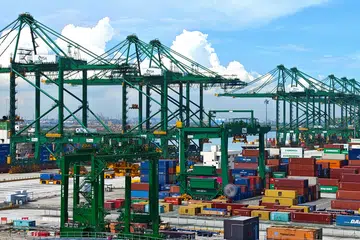
A smart port, a remote robotics trial and a vehicle testbed at Nanyang Technological University are some 5G projects that M1 has begun.
All in all, PwC partner Oliver Wilkinson, who focuses on entertainment and media, noted that the call for proposals has "interesting deviations from a typical auction approach".
"This sophisticated approach will shape the telco landscape in 2020 and the decade ahead," he said. "Game theorists are having fun thinking about all the possible permutations for winners and losers."
READ MORE: 5G wireless network will be fork in road for Singapore telcos