

Asean leaders should focus on energy transition, not US-China rivalry: Al Gore
The former US vice-president sees Beijing taking a bigger role in climate governance

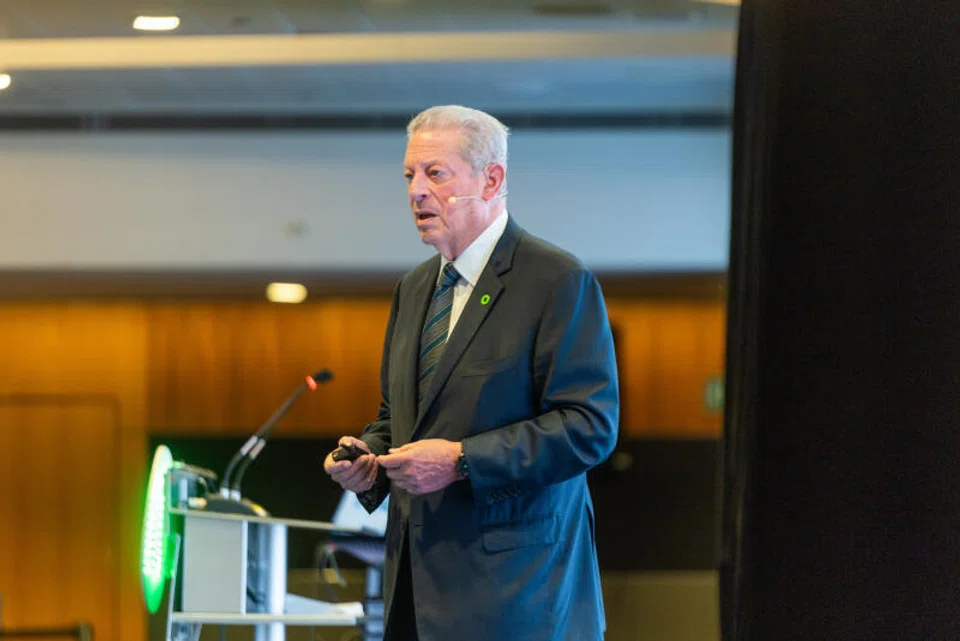
[SINGAPORE] Asean governments should focus on accelerating the transition to a low-carbon economy as this would best serve the interests of their people, rather than worry about how to navigate escalating tensions between the US and China, said former US vice-president Al Gore.
Gore was speaking to Singapore media on Tuesday (Sep 8) on the sidelines of a climate leadership training programme organised by The Climate Reality project, a non-profit climate organisation he founded in 2006 after leaving politics.
“I think what they should focus on is not how China will react to what they’re doing or how the US will react to what they’re doing, but what will best serve the interests of the people in their nations, and I think it’s becoming increasingly clear that the best interests of their people is obviously served by speeding up this transition,” he said.
He was responding to a question on how Asean should navigate geopolitical tensions in a possible future where China might take on the role of the world’s next climate leader, filling the vacuum left by the US’ retreat from its climate ambitions.
Gore said that there are three compelling factors for South-east Asia to move away from fossil fuels:
- The price volatility and supply disruptions of critical fossil-fuel resources as seen in the outbreak of the Iran war;
- The decline in costs of installing solar and wind power with battery storage; and
- The growing rate of extreme climate events that would facilitate public support for sustainability.
He highlighted the latest flash floods in Nepal and China that have killed more than 1,400 people as an example of the frequency and severity of extreme weather events arising from climate change.
Gore also weighed in on the likelihood of China stepping into a bigger diplomatic role in the world stage on climate governance, saying that he is “optimistic that China will significantly reduce its greenhouse gas emissions in the years ahead, and help to provide leadership for the world toward genuine solutions for the climate crisis”.
US, the EU and China have typically been the three major negotiating blocs at international climate negotiations. However, the US left the Paris Agreement – the global treaty on addressing climate change – after Donald Trump became president in 2024.
The country did not send a delegation to the annual United Nations climate summit last year, which was held in Belem, Brazil. It is expected to remain absent for this year’s COP31 talks in Antalya, Turkey.
SEE ALSO





There have been two developments signalling China’s shifting stance on global climate advocacy.
First, it was reported in July this year that the country plans to take a more important role in steering the global campaign to tackle climate change, according to the latest five-year plan released by the Ministry of Ecology and Environment, the National Development and Reform Commission.
Second, reports have emerged that China is mulling a bid to host COP33 in 2028.
“China has been in transition, and I believe that that transition is moving powerfully toward advocacy for renewables,” said Gore.
The world’s second-largest economy already dominates the global clean energy supply chain. It produces most of the world’s solar panels and batteries for storage, electric vehicles, as well as the processing of rare-earth elements, which are critical for the energy transition.
This has helped cushion the impact of supply disruptions and rising energy prices stemming from the Iran war, compared with the experience of other Asian markets.
Carbon-tracking tools have indicated that China’s carbon emissions have been plateauing over the last year, and have even started declining.
“The net result is they have, over a period of many years, achieved a dominant position in the manufacture and supply of solar panels, of windmills, of batteries, of fast trains, of other sustainability technologies,” said Gore, adding that this has put China “in a position to dominate the transition into sustainable energy”.
“And I suspect,” he added, “that if they move forward with this plan to provide global leadership in the diplomatic sphere, they will be in a position to enhance their leadership role in the world.”
Decoding Asia newsletter: your guide to navigating Asia in a new global order. Sign up here to get Decoding Asia newsletter. Delivered to your inbox. Free.
Copyright SPH Media. All rights reserved.
TRENDING NOW

Once staunchly pro-China, Malaysian Chinese businesses are now distancing themselves from Beijing

Looking beyond looming CEO succession, should UOB potentially pursue a transformative merger?

Could stablecoins be the future of money?

Grab CEO’s wife Chloe Tong on life with Anthony Tan and finding her purpose

