



Asean may be forced to choose between economic growth and climate if both are not decoupled: Ravi Menon
Singapore will work on carbon markets, nature-based resilience, climate resilience as the bloc’s chair in 2027


[SINGAPORE] South-east Asia is the only major region in the world where economic growth is still largely dependent on the use of fossil fuels.
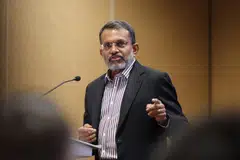
If not enough is done to decouple economic growth and emissions rise, the region may be forced to choose one over another, said Ravi Menon, Singapore’s ambassador for climate action.
To tackle the problems the region faces, Singapore is looking to work on three areas – carbon markets, nature-based resilience and climate resilience – as it prepares for its Asean chairmanship next year, he added.
Speaking on the sidelines of Temasek’s flagship sustainability conference Ecosperity Week on Thursday (May 21), he pointed out that the major advanced economies are already growing while reducing emissions.
Even in China, the world’s largest annual emitter, emissions have peaked, while its economy continues to grow.
While emissions are not set to peak in India until the 2040s, the country’s emissions are growing at a rate slower than its economy.
South-east Asia particularly vulnerable
The climate challenge in South-east Asia is more pressing, given that it is one of the most climate-vulnerable regions in the world.
Menon highlighted that the region may experience 60 more days of extreme heat annually by mid-century and faces a sea-level rise exceeding the global mean.
“South-east Asia faces approximately 100 climate disasters annually, affecting 80 million people each year,” he noted.
SEE ALSO



“And these costs are not evenly distributed. They fall disproportionately on vulnerable communities, smallholder farmers, and low-income households.”
The region faces multiple challenges. Its energy demand is set to double by 2040 on the back of a growing economy. Yet, it needs to achieve this growth while decarbonising; it must also adapt to the rising impacts of climate change.
Challenges abound
The three focus areas Singapore is planning to undertake as Asean chair next year face several obstacles.
Carbon credits, for one, have been plagued by integrity concerns over the last few years, affecting the demand and trade of these credits in the voluntary markets.
Many carbon credit projects face difficulties in securing funding due to high upfront costs, uncertain revenue streams and long payback periods.
“The answer is not to abandon carbon markets, but to rebuild integrity so that financing can follow,” said Menon. “We must continue to work on robust verification of emissions reduction, conservative baselines and real additionality testing.”
Singapore is working with partners, such as Integrity Council for the Voluntary Carbon Market, to strengthen the supply of credits, driving demand by purchasing credits aligned with the Paris Agreement, and providing guidance to corporate buyers on the responsible use of credits.
Nature-based solutions in the region, meanwhile, are under-invested, requiring US$54 billion annually by 2030 but getting only US$8 billion.
This is because nature’s value is not priced; there is also a lack of bankable nature projects, as well as difficulties in measuring the outcomes of such projects.
To resolve these challenges, there is a need to invest in better measurement solutions tailored to South-east Asia’s ecosystems, use innovative financing solutions such as combining blended finance with carbon credits, as well as mobilise demand through buyer coalitions and offtake agreements.
“What does success look like in the nature space? When a mangrove restoration project in South-east Asia is as financeable as a new industrial park,” said Menon.
“That is what Asean needs to work together on.”
The adaptation financing gap is also huge, given that just US$34 billion flowed into the region between 2021 and 2022, even though estimates show that it may require as high as US$400 billion annually.
This is because returns on adaptation projects are difficult to calculate, are diffused across many stakeholders, and are public goods that are typically financed by governments.
Menon said that adaptation requires a systemic response across several governments, corporates and financial institutions.
Developing good national adaption plans where adaptation projects are presented as an investment proposition allows capital markets to be tapped.
Corporate transition plans should integrate climate resilience, and financial institutions should price climate risk into financial decisions. Blended finance structures, meanwhile, can be used to catalyse private capital by de-risking adaptation through the injection of philanthropic or concessional capital.
Decoding Asia newsletter: your guide to navigating Asia in a new global order. Sign up here to get Decoding Asia newsletter. Delivered to your inbox. Free.
Copyright SPH Media. All rights reserved.
TRENDING NOW
PSD reviewing paper that alleges civil servants disproportionately bought homes near unannounced MRT stations

CapitaLand Investment’s retrenchments: Mind the downsides of a profitable business laying off staff

In a business takeover, how can landlords in Singapore protect themselves?

How Asia’s next generation is rewriting legacy through entrepreneurship

