Boards need to come clean on directors’ sustainability vision
A study by The Business Times finds room for more mature corporate ESG reporting
Annabeth Leow

[SINGAPORE] Environmental sustainability is, by now, a well-established concept in corporate governance, with more companies across the Asia-Pacific region reporting that they have made sustainability disclosures and implemented formal board oversight of regulatory compliance.
But whether directors are actually equipped to drive meaningful change in their ESG contributions remains to be seen.
While the international standards being adopted by enterprises set important industry benchmarks for boardroom behaviour, businesses cannot be allowed to turn corporate environmental responsibility into a performative bean-counting exercise.
The Business Times’ newly released Asia Pacific Sustainability Index (APSI) found that 92 per cent of the 700 companies assessed disclosed formal board responsibility for sustainability, while 77 per cent had board oversight of management’s monitoring efforts.
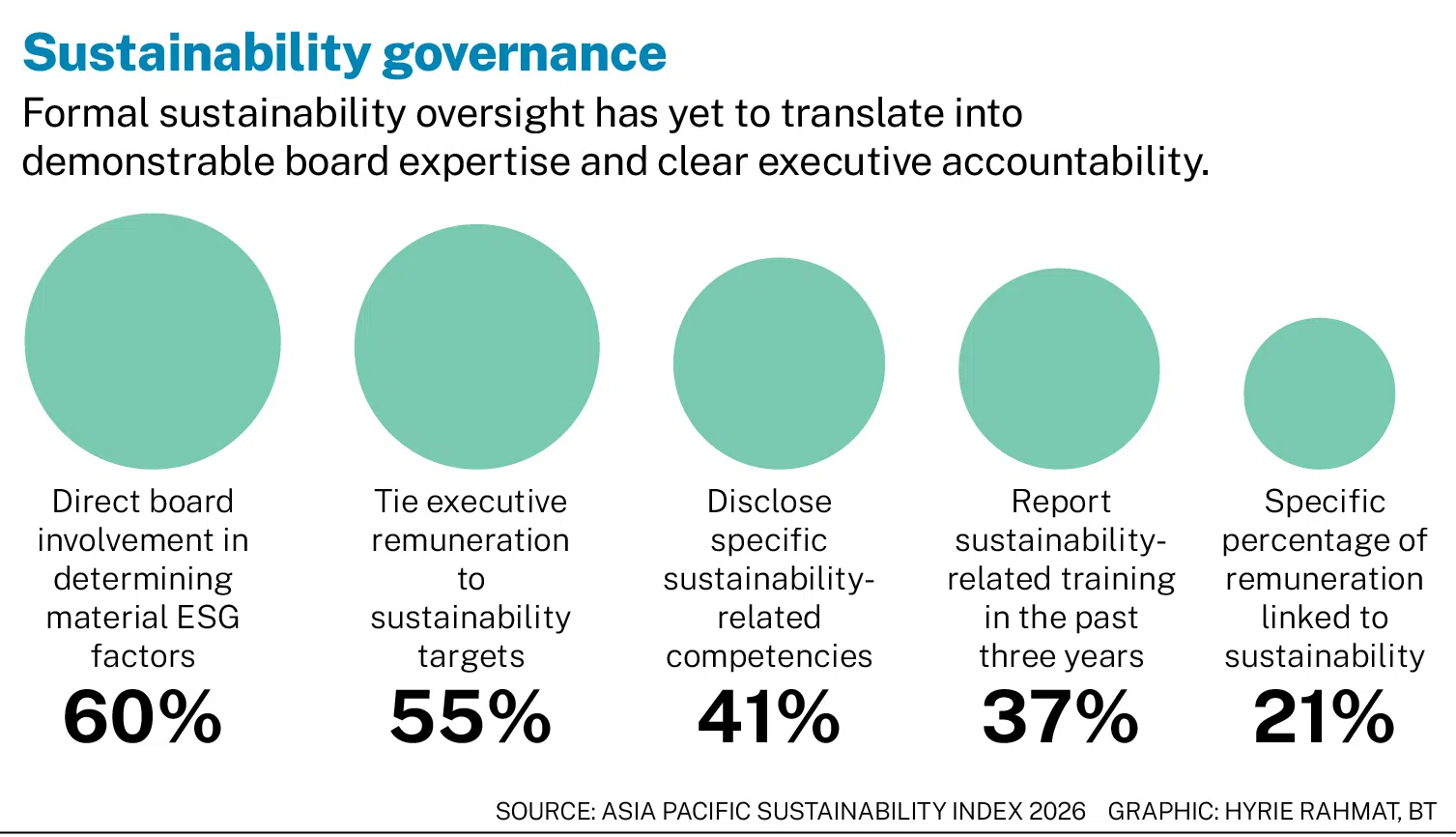
Yet, beyond the issue of how active a role directors in fact play – after all, just 60 per cent of companies reported direct board involvement in determining material ESG factors – is an even more important question: Do they have the vision and skills needed to land an impact?
Many shareholders and external stakeholders simply do not have the information to judge.

Connecting the dots
Perusing annual sustainability reports, observers often find companies reporting their ESG contributions by crunching numbers for metrics such as water and electricity consumption.
To their credit, regional businesses are doing very well on this front.
APSI, which was developed in partnership with the National University of Singapore (NUS) Business School’s Centre for Governance and Sustainability, found that 94 per cent of companies disclosed Scope 1 emissions. Under the widely used Greenhouse Gas Protocol, these are direct emissions from sources the companies own or control.

Meanwhile, 95 per cent disclosed Scope 2 emissions, or indirect emissions resulting from energy purchases.
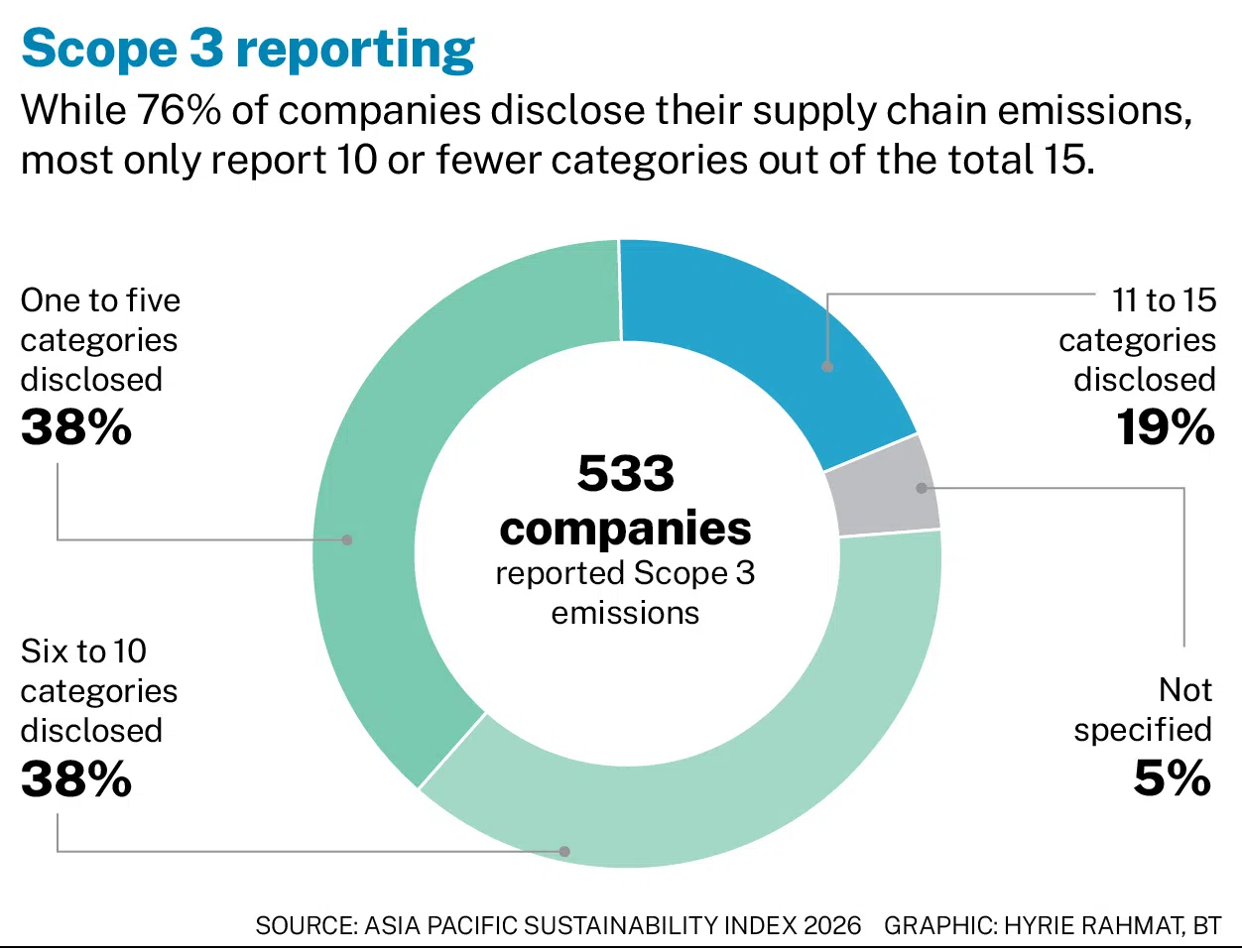
Where they fell short, though, was in Scope 3 emissions, which refer to all other indirect emissions caused by business activities. Of the 76 per cent of companies publishing such disclosures, less than one-fifth made reports in more than 10 of the 15 standard categories.
Better information can help organisations “by identifying where emissions hot spots reside in its value chain and potential climate-related risks, particularly transition risks, that may arise”, PwC Singapore’s sustainability and climate change practice leader Fang Eu-Lin told BT.
What’s more, while monitoring enables companies to take stock of their environmental footprint and reduce waste accordingly, tracking emissions data is only the starting point in assessing underperforming areas where companies can improve on sustainability.
Numerous other avenues can be considered, such as rejecting dangerous or pollutive chemicals, or investing in the development of alternative energy sources and materials.
To truly advance sustainability, boards need to have critical judgment and make sound decisions that reflect an understanding of interconnections across sectors and markets.
The quality of sustainability reporting “will improve when companies use the process of creating a sustainability report to evaluate their sustainability targets and progress, and take better measures for sustainability”, Professor Lawrence Loh, director of the Centre for Governance and Sustainability at the NUS Business School, told BT.
Yet, poor visibility on something as basic as their value chains’ emissions suggests that the corporate leaders tackling environmental challenges still lack the ability to see the big picture – and, in turn, the ambition and imagination to come up with credible and viable solutions.
Beyond risks and opportunities
Since business leaders are unable to plan for what they cannot envision, the lingering gap in emissions disclosures could thus be the canary in the coal mine for other shortcomings.
After all, sustainability leadership goes well beyond cuts to direct or even indirect emissions. Though these make for a great start, it is necessary to then plan actionable follow-ups – and many directors may still not have the capacity to deliver this level of strategy and direction.

APSI found that 84 per cent of companies disclosed climate-related risks and opportunities that they had identified, such as the possibilities of floods and droughts.
Yet, just 64 per cent analysed the financial and operational impact of different climate scenarios. Moreover, the vast majority of these were qualitative assessments. Only 28 per cent could produce measurable estimates on how climate change could hit their businesses.
That’s even as quantitative scenario analysis can shed light on how different climate outcomes will affect factors such as operating costs and revenue, as the report’s authors noted.
“Companies could begin by assessing the potential financial implications of physical risks, such as asset damage, operational disruptions and supply chain interruptions arising from extreme weather events, as well as transition risks,” BT’s report suggested.
The estimates generated could allow businesses to “better identify their vulnerabilities, prioritise investments and strengthen long-term strategic planning and resilience”.
The value of detailed scenario planning is obvious – but it requires directors to have the ability to anticipate and analyse complex sustainability-related risks and opportunities.
Unfortunately, they may fall short simply for want of exposure or knowledge.
Only 41 per cent of companies disclosed board members’ sustainability-related competencies, according to the index, while 37 per cent reported recent relevant training.
The paucity in knowledge and training “may result in lost opportunities from tapping sustainability as an economic returns driver”, such as innovating goods and services “that are good for both profits and planet” to gain a business edge, remarked Prof Loh.
Fang added that, while training is important, what’s really key is “whether directors have the skills and practical experience” to properly assess their companies’ readiness and resilience.
Spill the (green) tea
Shareholders deserve to know not just whether directors have the skills needed to offer adequate oversight of corporate sustainability initiatives, but also what is being done to remedy any gaps and help boards continuously build up their expertise and capabilities.
The task of accountability takes on added significance in the light of APSI’s finding that, while 55 per cent of companies said executive remuneration was pegged to sustainability, only 21 per cent specified how performance on these metrics actually translated into compensation.
Added transparency on the link between sustainability outcomes and executives’ short-term and long-term incentives would be to the benefit of stakeholders, the report observed.
Businesses in the Asia-Pacific Economic Cooperation (Apec) economies have rightfully been calling for clearer ESG disclosure frameworks and more consistent climate-related standards, as a poll by Singapore’s Apec Business Advisory Council recently found.
But boards must also be prepared to disclose relevant information to their investors in turn.
“A sustainability report is not for the company to feel good about itself,” Prof Loh noted. “It is a report card that tells stakeholders the triumphs and challenges in its sustainability journey.”
The Business Times Insights: Asia Pacific Sustainability Index 2026
Published by The Business Times and NUS Business School’s Centre for Governance and Sustainability, the Asia Pacific Sustainability Index (APSI) benchmarks corporate reporting across the region.
Using annual and sustainability reports, it evaluates 700 listed companies – the 50 biggest in each of 14 Asia-Pacific jurisdictions – spanning 11 sectors, including finance, energy, utilities and consumer staples.
Comparing disclosures across markets with different compliance rules is tough for investors and executives. To solve this, APSI uses a contextualised methodology, the MAGNET framework, through which it determines a base score, then applies a context factor for local regulations, separating actual disclosure quality from its jurisdiction-wide mandates.
For more insights, visit bt.sg/apsi.
Decoding Asia newsletter: your guide to navigating Asia in a new global order. Sign up here to get Decoding Asia newsletter. Delivered to your inbox. Free.
Share with us your feedback on BT's products and services