Issue 143: Sembcorp’s spin-off speculation; shipping’s green fuel rules

This week in ESG: Sembcorp’s Indian assets under spotlight amid strategic review reports; vanishing odds for global fuel carbon levy
Sustainable investing
Sembcorp’s potential India spin-off
Sembcorp Industries’ latest annual report strikes optimistic notes on renewable power in China and India, feeding speculation about potential moves to recycle capital in those markets.
In a leadership note to shareholders, Sembcorp chairman Tow Heng Tan and chief executive Wong Kim Yin say that renewables growth across South-east Asia, China, India and the Middle East is expected to “remain robust”, with capacity expected to double by 2028. Sembcorp operates gas, renewables and industrial and urban solutions businesses.
In India, Sembcorp’s hybrid projects have secured higher tariffs. In China, renewables capacity is expected to grow despite “near-term headwinds”, Tow and Wong write.
The shareholders’ note comes amid recent reports that Sembcorp is undertaking a strategic review of its business. Citing sources, Bloomberg reported in March that Sembcorp has appointed a financial adviser for the review.
Sembcorp said in response that it is always assessing options to enhance shareholder value, and that the assessments may not result in any transaction. The company said it will make the necessary announcements if any action is material and has progressed to a stage where there is a high level of certainty.
Although the company did not mention what options it might be assessing at this time, analysts speculate that the company could be looking to recycle capital in China or India.
OCBC Global Markets Research notes that when Sembcorp announced its 2023-to-2028 strategy in 2023, the company mentioned in-country capital recycling platforms for China and India renewables.
Indeed, Sembcorp plans to invest S$14 billion into its sustainability transition between 2024 and 2028, and this money’s got to come from somewhere. Sembcorp has said that it expects to fund half of that from operating cash flows, and a further 30 per cent from project debt. The remaining 20 per cent, or almost S$3 billion, is expected to come from corporate debt, capital recycling and partnerships.
If Sembcorp decides to sell some of its renewables assets to recycle capital, India might be the place to start.
DBS analyst Ho Pei Hwa observes that “the time looks ripe for securitisation of India renewable assets”, based on the size of the Indian portfolio.
As a market for a capital recycling programme, India ticks many boxes.
The first is the size of its operational portfolio and, just as importantly, the size of its pipeline to sustain a programme. For instance, if Sembcorp decides to sponsor and list a renewable infrastructure trust, it would need to have enough revenue-generating assets to place into the trust and then have a pipeline of projects that can be sold to the trust down the road.
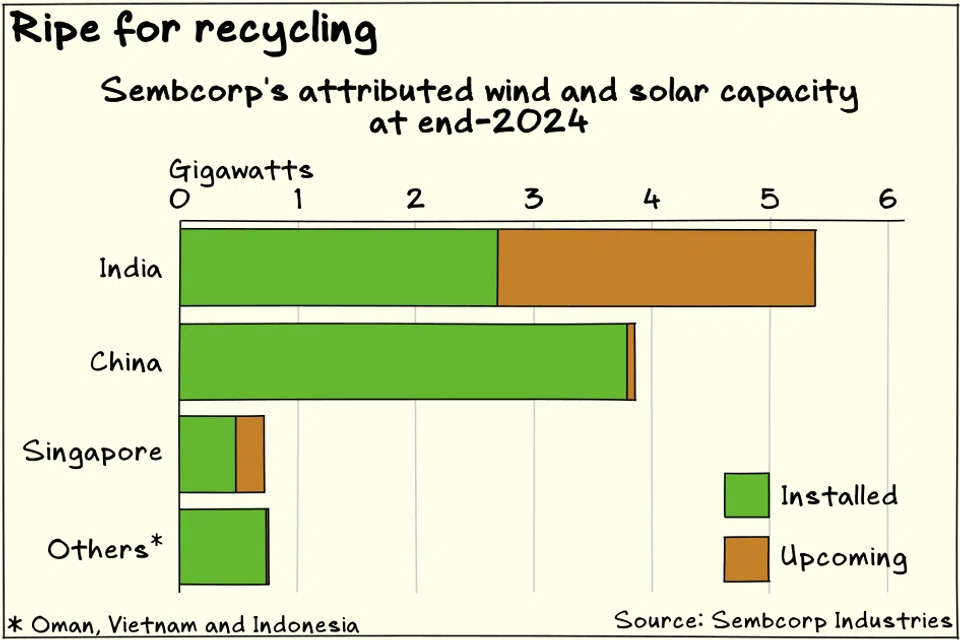
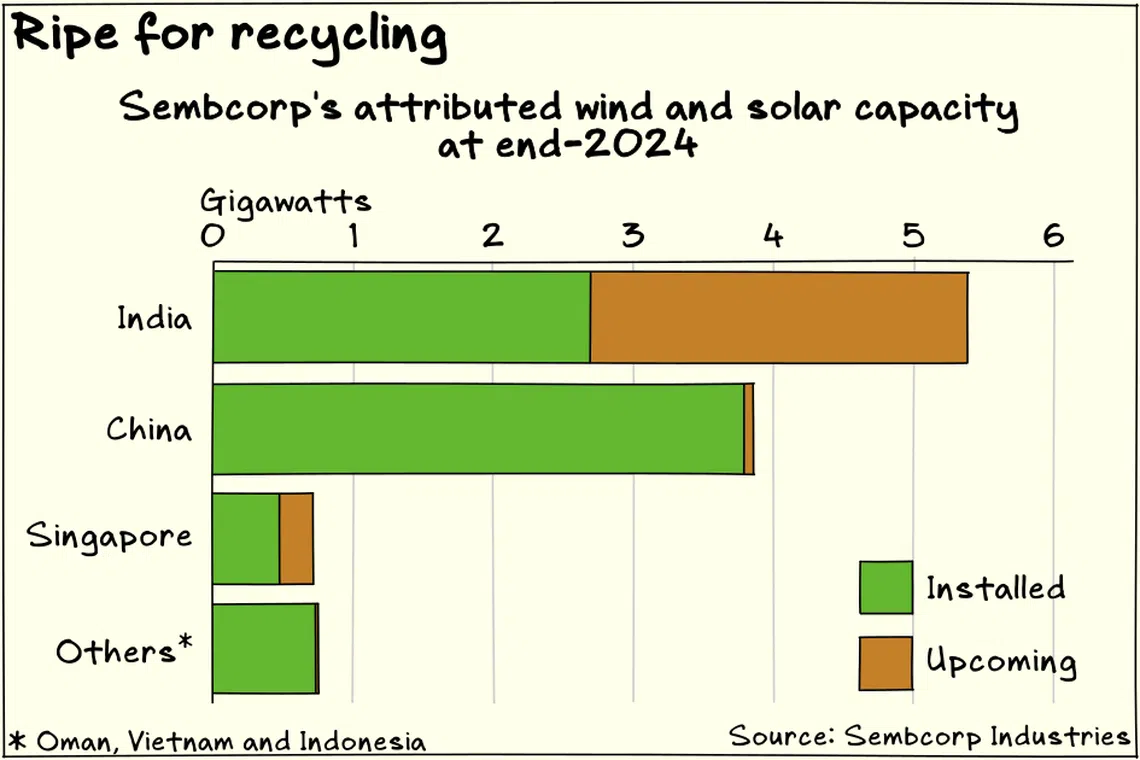
As of end-2024, Sembcorp reported about 5.4 gigawatts (GW) of attributable wind and solar capacity in India, half of which is installed and the other half is in the pipeline, either secured or under construction. That represents about half of Sembcorp’s entire installed and pipeline wind and solar capacity. India has a further 300 megawatt hours (MWh) of energy storage capacity being built in the country.
Sembcorp describes the Indian renewables space as a “growth market”, although it has not disclosed profitability figures for this segment of its portfolio. That growth is underpinned by India’s national policy to achieve 500GW of installed electricity capacity from non-fossil sources by 2030.
Most of Sembcorp’s assets in India are also wholly owned through subsidiary Sembcorp Green Infra, which makes it easier to package those assets for securitisation.
It’s a different story for Sembcorp in China, where most assets are held through joint ventures in which Sembcorp only holds a minority interest. Although the 3.9 GW of attributable installed and upcoming wind and solar capacity in China accounts for 36 per cent of Sembcorp’s global wind and solar portfolio, only a quarter of that – about 1 GW – is 100 per cent owned by Sembcorp. That could complicate spinning out those assets.
The China renewables market is also undergoing some turbulence, which might dampen valuations if the portfolio were to be put on the market today.
In north-western China, an oversupply of renewable electricity has led to increased curtailment, or forced reduction of power generation. This was a major factor in Sembcorp’s renewables net profit before exceptional items slipping 9 per cent to S$183 million in 2024. Sembcorp also took a S$19 million provision for receivables in China and lower wind speeds in India.
The China renewable electricity pricing outlook is also uncertain, with the government moving to a market-based pricing mechanism for on-grid renewable plants commissioned from Jun 1 onwards. Sembcorp says it is monitoring economic and regulatory developments in China and the impact on its China portfolio.
All of that notwithstanding, any spin-offs are probably on the shelf at this moment with global markets in turmoil following the US imposition of across-the-board import tariffs. Launching a listing of assets now would be selling into a historically bad market.
If and when markets stabilise, however, an India spin-off could well return to the table for Sembcorp.
Net zero
Fading chances for levy
A proposal for a global carbon levy on international shipping seems increasingly unlikely to gain enough support at the ongoing International Maritime Organisation’s Marine Environment Protection Committee meeting in London.
While the levy has support in Europe and many small island countries, opposition from a number of major shipping countries makes it politically pointless to push through the measure. Countries that have opposed the levy include Brazil, China, Indonesia, Malaysia, South Africa and Thailand. This week, the US also announced its opposition and withdrew from the meeting.
There are two alternative proposals to the levy on the table. The first – termed the International Maritime Sustainable Fuels & Fund, or IMSF&F – is a credits-based alternative tagged to emissions intensity requirements. Ships that fail to meet the emissions intensity threshold can either buy credits from ships that do better than required or pay the equivalent to a global fund that will be used, among other things, for decarbonising the sector.
The second alternative –proposed by Singapore and called J9 Bridge – is positioned as a compromise measure and is currently the base approach that is being negotiated in London. The J9 Bridge proposal also relies on credits, as with IMSF&F, but introduces compliance tiers so that the greater the underperformance, the heavier the penalty. The tiers aim to address criticisms that a credits-based system will be insufficient to drive decarbonisation quickly enough in the maritime sector.
While J9 Bridge appears to be a leading candidate at the moment, it has drawn its share of criticism, with opponents arguing that it won’t raise enough money for the global fund to support meaningful change. There’s also concern that credit-based systems can lead to the lock-in of liquefied natural gas as a fuel as shipowners adopt short-term solutions. Furthermore, some critics say that it is challenging to assess J9 Bridge properly because key aspects of the approach have not been decided, such as where to set the tiers.
Regardless of the outcome, the maritime sector pathway towards net zero will probably be more back-loaded without the levy. This could increase transition risks in the coming years for the sector.
Other ESG reads
- Sembcorp ties up with Indian oil and gas company for renewable energy projects
- Asia’s electricity prices to be increasingly impacted by renewables: BMI
- Clean power offers safety to China investors rattled by tariffs
- Johor, Singapore emerge as data centre hotspots amid Apac’s US$15.5 billion investment boom’
- UK unveils support for tariff-hit auto sector to go green
- Trump signs order to ‘turbocharge’ coal mining in United States