

Iran war raises urgency of climate transition, says Ravi Menon
He is one of two co-chairs of a platform set up to help busineses beef up their climate resilience and competitiveness
 Add BT as a preferred source
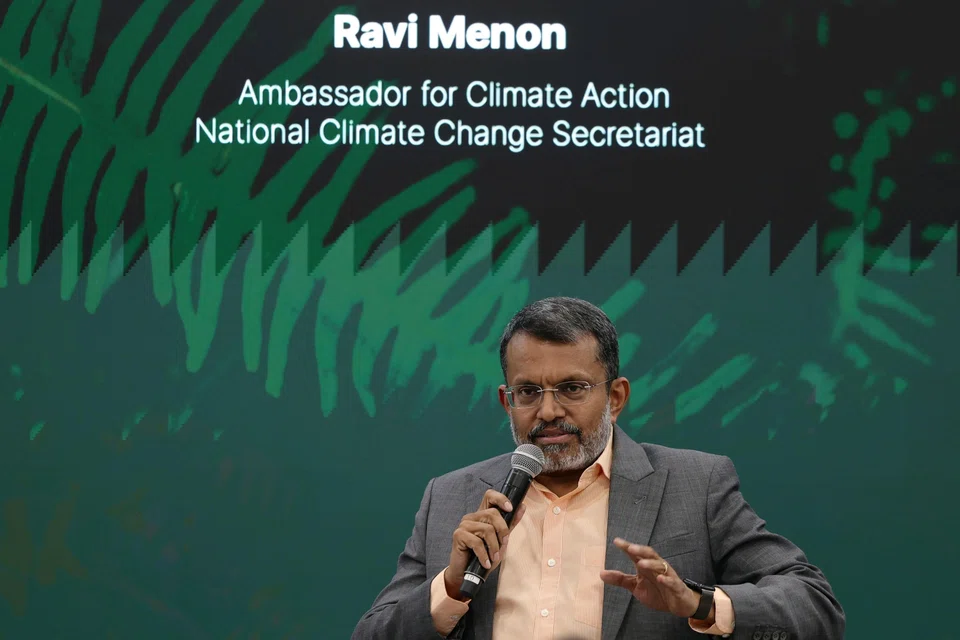
[SINGAPORE] Even though businesses and governments are focused on dealing with the rise in energy prices following the outbreak of the Iran war, the case for climate action has not been weakened, Singapore’s ambassador for climate action Ravi Menon said on Monday (Apr 6).
On the contrary, the current geopolitical crisis has strengthened the importance of the low-carbon transition.
He said: “We used to think of energy security and environmental sustainability as two distinct objectives, and sometimes contradicting one another. But I think what we’re seeing now is that, increasingly, they’re mutually reinforcing objectives – that energy security is environmental sustainability.
“If you think about it, the ongoing crisis is a reminder of the inherent vulnerabilities in the global oil and gas system.”
Global energy prices surged recently after supplies dropped sharply when Iran blockaded the Strait of Hormuz – a critical chokepoint in the global oil and gas supply chain – following attacks on the country by the United States and Israel.
Likening the previous oil crises of the 1970s and 1980s, and the recent Russia-Ukraine war to “bad movies” the world has seen multiple times, Menon noted: “We will see this movie again and again. The question is: Do we learn from this movie? Do we put in place measures to adapt our resilience?
“Companies and countries that prepare five, 10 years in advance of these global surges, I think, are better placed. And this time, energy security and environmental sustainability are coming together in a powerful way,” he added.
He was speaking at the launch of a platform set up by Singapore’s National Climate Change Secretariat (NCCS) and the Singapore Business Federation (SBF), which will coordinate the drive to help companies improve their climate resilience and competitiveness.
The platform, called the Council for a Competitive Climate Transition (C3T), will have two co-chairpersons – Menon and SBF’s chief executive officer Kok Ping Soon.
SEE ALSO



Also speaking at the launch, Minister for Sustainability and the Environment Grace Fu said that the ongoing Iran war has highlighted the importance of companies coming up with business continuity plans (BCPs) to mitigate risks, which would increasingly be climate-related.
“Do you have a BCP for climate? Are you operating in a country or in a place ... that has a BCP? What if there’s no water? What if there’s too much water? What if there’s too much heat that reduces the efficiency of your data centre, that requires you to cool it even more, and the water in the river that you use for cooling is too hot?”
C3T, the new public-private platform, will “convene and align” public and private stakeholders to implement initiatives, such as sectoral transition pathways and the national adaptation plan, said the NCCS and the SBF in a joint statement on Monday.
Singapore announced in March that it would develop its first national adaptation plan that will lay out the city-state’s long-term strategies to be a climate-ready nation. Climate adaptation refers to measures aimed at helping society prepare better for, and reduce vulnerabilities to, climate impacts.
Alongside efforts in drawing up this plan, the council will look into helping businesses better understand and prepare for climate-related risks, while identifying opportunities arising from the transition to a low-carbon future.
It will also seek to develop concrete solutions with industry to help businesses plan for and respond to climate change, in areas such as climate disclosure, green procurement and sustainable financing.
Menon said that invitations have gone out to government agencies, key sectors of the economy, as well as those in functions that cut across the whole economy, to be part of the council. However, the specific sectors were not disclosed.
Ultimately, the council aims to align policies with business realities, address the data gaps in this space, and unlock enterprise value, he added.
He explained: “It’s not about telling companies what to do. So we don’t foresee new requirements or validations. It is about co-creating solutions, given existing requirements or existing plans. So we need to translate requirements into solutions that are implementable by companies, and that’s what we’re trying to do here.”
The formation of C3T comes after SBF recommended, as part of its Budget 2026 wish list, to strengthen coordinated support for businesses undertaking the green transition, as well as respond to growing industry demand for practical approaches that could help companies seize new climate-related opportunities and manage climate risks.
In their statement, NCCS and SBF noted that businesses that reduce their carbon emissions will be more resilient against global energy shocks.
With climate change becoming more intense, its physical impacts will become more severe, the two parties said. “Businesses that better understand and mitigate their physical climate risks, such as higher ambient temperatures and extreme weather events, will be able to enhance the resilience of their assets, operations, workforce and supply chains.”
Decoding Asia newsletter: your guide to navigating Asia in a new global order. Sign up here to get Decoding Asia newsletter. Delivered to your inbox. Free.
Copyright SPH Media. All rights reserved.
TRENDING NOW

Singapore private housing is ‘decoupling’ from HDB market as buyer pools diverge: NUS survey

Simba’s 5G spectrum hurdle may accelerate Singapore’s telco market reset

Yen hits 40-year low in historic slide that’s rattled Japan

Malaysian tycoon Vincent Tan’s sell-downs point to pruning rather than an exit plan

