

Singapore’s 2025 carbon tax revenue holds steady; experts say continued use of tax ‘discounts’ likely
Quantum of transitory allowances and the specific firms they are given to have not been officially revealed
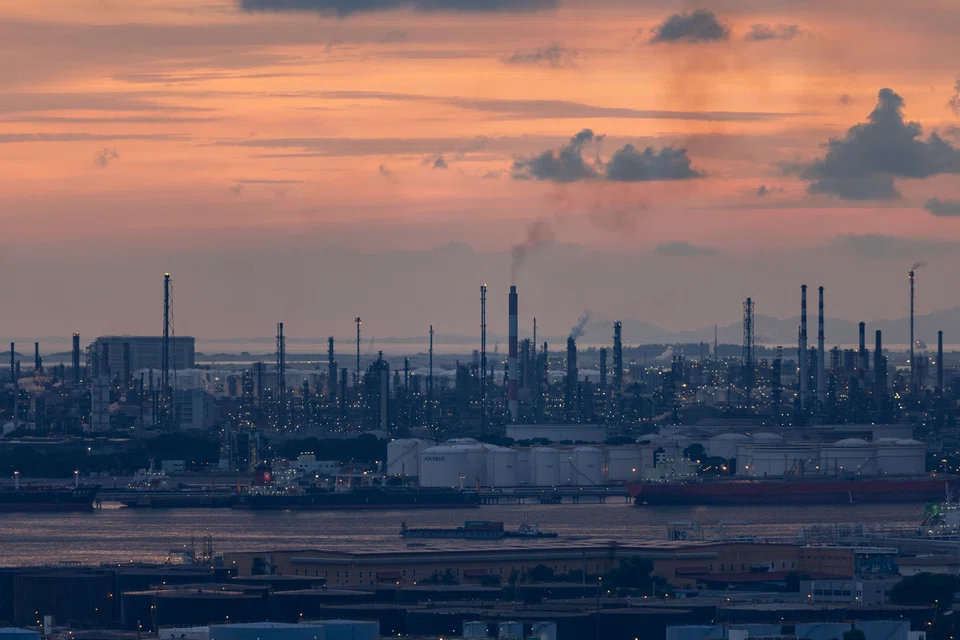
[SINGAPORE] The carbon tax revenue for emissions year 2025, expected to be collected by end-September, is comparable with the revenue collected for emissions released in 2024 at around S$660 million.
Experts said this likely reflects the continued use of transitory allowances for that year. These allowances act as a carbon tax “discount” of sorts and are given by the government to trade-exposed emitters to help them stay competitive.
These allowances were first implemented in 2024. But their quantum, which firms they were given to, and how long they would be in place for, were never officially revealed.
In 2024 and 2025, the carbon tax rate was S$25 per tonne of greenhouse gas emissions.
It was S$5 per tonne of emissions from 2019 to 2023. During this period, the carbon tax revenue collected remained relatively consistent at roughly S$200 million a year.
Assuming emissions for 2024 and 2025 remained at similar levels, the total tax revenue should be about S$1 billion.
But according to the Budget 2026 revenue and expenditure estimates document, the carbon tax revenue collected for emissions released in 2024 was about S$658.8 million, while the estimated carbon tax revenue collected for 2025 is about S$657.3 million.
A carbon tax incentivises large emitters to switch to cleaner energy, improve efficiency or adopt low-carbon technologies by making fossil fuel use costlier.
NUS’ Energy Studies Institute senior research fellow Kim Jeong Won said if similar emissions levels are assumed, the transitory allowances could be a significant reason for the shortfall in projected tax revenue, as they function as discounts on the carbon tax by reducing firms’ taxable emissions.

“It means that not all emissions are taxed at the full rate, thereby lowering the government’s projected tax revenue,” she said.
Queried on the lower-than-expected carbon tax revenue for emission years 2024 and 2025, a government spokesperson said: “It is not appropriate to assume that the taxable emissions have remained unchanged between 2025 and prior years.”
The carbon tax revenue collected in the first five years of the carbon tax scheme had remained relatively consistent.
Checks on Singapore’s first biennial transparency report, which details the Republic’s emissions over the years and submitted to the UN in November 2024, also showed a steady but upward trajectory in total emissions over the years.
Singapore’s total national emissions was 53.87 million tonnes (Mt) in 2020, 58.28 Mt in 2021 and 58.59 Mt in 2022.
The report – which provided emissions figures only up to 2022 – had also projected that total emissions for 2025 would be 62.21 Mt.
There are about 50 facilities in Singapore liable for the carbon tax, mainly from the manufacturing, power, waste and water sectors. These emitters are responsible for about 70 per cent of total national emissions.
The spokesperson said that the country’s carbon emissions, and hence carbon tax revenues, are determined by several factors.
These include companies’ business cycles, their decarbonisation efforts and their investments in cleaner and more efficient technologies.
She added that there has been no increase in the rate of transitory allowances nor the number of facilities provided such allowances.
Currently, more than 20 firms from the emissions-intensive, trade-exposed sectors are eligible to receive allowances. These are conditional on efficiency targets and companies’ decarbonisation plans.
She said that with the heightened uncertainty and headwinds in the global economic environment, companies may need more time and support to invest in cleaner and more energy-efficient technologies to reduce emissions.
The carbon tax rate will next go up in 2026 and 2027 to S$45 a tonne, and could reach between S$50 and S$80 a tonne by 2030.
Asked if the allowances will be extended to more firms, or if the amount of allowances will go up, given that the carbon tax rate will increase, the spokesperson added: “We are engaging (such) companies and, if necessary, will make adjustments to the allowances to mitigate the impact of the increase in carbon tax on business competitiveness while ensuring that companies continue to decarbonise.”
She said the government plans to release aggregated data on carbon tax allowances in 2027.
“The data is aggregated to strike a balance between providing transparency on allowances, while respecting the commercial sensitivities of our companies,” the spokeswperson added. THE STRAITS TIMES
Decoding Asia newsletter: your guide to navigating Asia in a new global order. Sign up here to get Decoding Asia newsletter. Delivered to your inbox. Free.
Share with us your feedback on BT's products and services






