Singapore’s novel green jet fuel levy could trigger production in S-E Asia: Airbus CSO

Wong Pei Ting
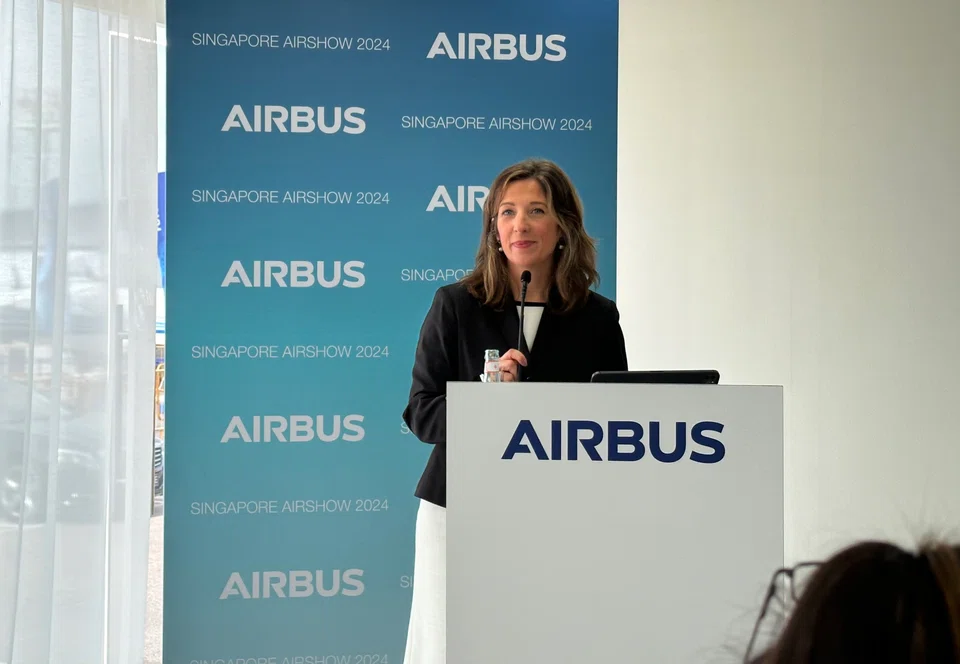
SINGAPORE’s recently announced green jet fuel levy might sound unambitious to the man on the street, as it aims to support a modest 1 per cent use of sustainable aviation fuel on departing flights from 2026.
Airbus chief sustainability officer Julie Kitcher, however, sees this step as a leap in an arena where countries had been waiting on one another to make moves at the sustainability crossroads.
Sustainable aviation fuel is currently three to five times the cost of ordinary jet fuel, so its early adopters face significant disadvantages.
Although existing aircraft can be powered by fuel blends comprising up to 50 per cent of the green fuel, way below 1 per cent of the greener fuels end up being used in the mix.
What’s missing is “a global set of policies for a global industry”, Kitcher said. “We need a level playing field that will not change competitive dynamics.”
Such policies are still elusive, but Singapore has committed to a near-term target of 1 per cent and a longer-term goal to raise the use of sustainable aviation fuel to 3 to 5 per cent by 2030.
These are “very positive and concrete” steps that show “pragmatic application”, she added.
Given its status as an aviation hub, Singapore’s move may even be the “strong signal” required to trigger wider green fuel production in South-east Asia. “We need to break the vicious circle of no supply because there is no demand, because the price is too high,” Kitcher said on the sidelines of last week’s Singapore Airshow 2024.
Supply sources
Within South-east Asia, Kitcher said Singapore’s move could catalyse the collection and processing of used cooking oil as a green fuel feedstock. Calling it a ready fuel stream that is “disappearing down drains” due to the lack of formalisation in its collection, she said Airbus is working with Singapore-based company Apeiron Bioenergy to study issues related to its collection.
Algae is another sustainable fuel feedstock that can be tapped from the region, she added, pointing out that Malaysia has plenty of it for the production of crude algae oil, which can be further refined into sustainable aviation fuel.
Malaysia also has an abundance of palm oil, which could help meet the green fuel supply requirements and maybe even lower prices for airlines, but Kitcher said the feedstock won’t be readily accepted as it still does not meet the criteria defined by the International Civil Aviation Organization (ICAO).
Only palm oil by-products are recognised under the ICAO’s Carbon Offsetting and Reduction Scheme for International Aviation.
Singapore’s Transport Minister Chee Hong Tat said at a regional meeting in September that palm oil should be included as feedstock for sustainable aviation fuel production. His view, however, is not widely accepted.
“Of course, it is up to a country to establish their feedstock source and the collection methodologies and production pathways. That said, it needs to qualify for (ICAO’s) sustainability criteria,” Kitcher said. “We see a growing consensus towards the acceptance that palm oil is not meeting that criteria.”
The carbon benefits of palm oil as a green fuel feedstock are “very low” when considering its overall impact on the environment, given oil palm plantation links to land-use change and deforestation, Kitcher said.
Over the longer term, Kitcher expects most of the region’s sustainable aviation fuel to come from alcohol-to-jet fuel, which can be derived from sugarcane waste, and power-to-liquid fuels. Power-to-liquid fuel uses renewables instead of waste or biological materials.
India, Thailand and Australia will likely emerge as “strong” supplier countries of these fuel types in time to come, she said.
Last week, Australian bioenergy company Jet Zero Australia and Shell-backed technology provider LanzaJet announced the start of engineering activities on a US$600 million sustainable aviation fuel plant in Australia’s North Queensland.
The plant, which is targeting its first full year of production in 2027, aims to produce 102 million litres of alcohol-to-jet sustainable aviation fuel and 11 million litres of renewable diesel annually.
This amount is between a fifth and a third of 2050’s predicted demand, according to Kitcher.
Finnish energy giant Neste’s current expected output of up to one million tonnes at Tuas, where used cooking oil and animal fat waste is turned into the fuel, pales in comparison.
The green fuel produced at the Queensland facility could reduce carbon emissions by more than 70 per cent over the emissions life cycle when compared with conventional jet fuel, Kitcher added.
Green lanes
Energy producers are moving slowly to pick up the opportunities of “visibility, security and longevity” around the demand for such greener fuels, Kitcher said. Meanwhile, a combination of carrots and sticks is needed for the green fuel to truly scale, she added.
For the industry to be on track for net zero in 2050, it needs to lift green fuel use to close to 10 per cent by 2030.
Japan is mandating that airlines use 10 per cent sustainable aviation fuel at its airports from 2030; while the European Union’s mandate is for a 2 per cent blend of the fuel by 2025, with the requirement rising to 6 per cent by 2030.
Europe and the United States, two major aviation markets, have drivers at different ends of the spectrum: Europe is “very heavily mandate driven” and the US is “very much more focused on incentivisation”.
Both models have their downsides, Kitcher said. In a pure mandate system, taxes collected may not be injected into innovation for sustainable aviation fuel technologies.
Under an incentivisation system, sustainable aviation fuel usage and market development are driven by individual airlines. The buy-in is not great under this model since airlines need assurance that they can be just as competitive as their competitors.
Singapore’s model – in which the Civil Aviation Authority of Singapore administers the levy to be paid by passengers, with the revenue used to buy sustainable aviation fuel – is promising, she said.
“Singapore is the first in terms of using an innovative approach to levying, and to stimulate economic policy,” she said.
As an early mover, could Singapore – or other governments, for that matter – secure any advantage? Kitcher sees some possibilities.
Governments could, for instance, work together to establish “green aviation lanes” to incentivise sustainable aviation fuel production where feedstock is abundant.
The green fuel produced could then be exported to a partnering offtaker country at a more attractive rate, she said.
“Every country has its own resources, its own ambition and pathways, and will move at its own pace,” she added. “I do believe that if we could have a collaborative policy, at least region by region, it would drive further production.”