Closing Philippine coal plants 5 years earlier could cut 290 metric tons of emissions
 Add BT as a preferred source
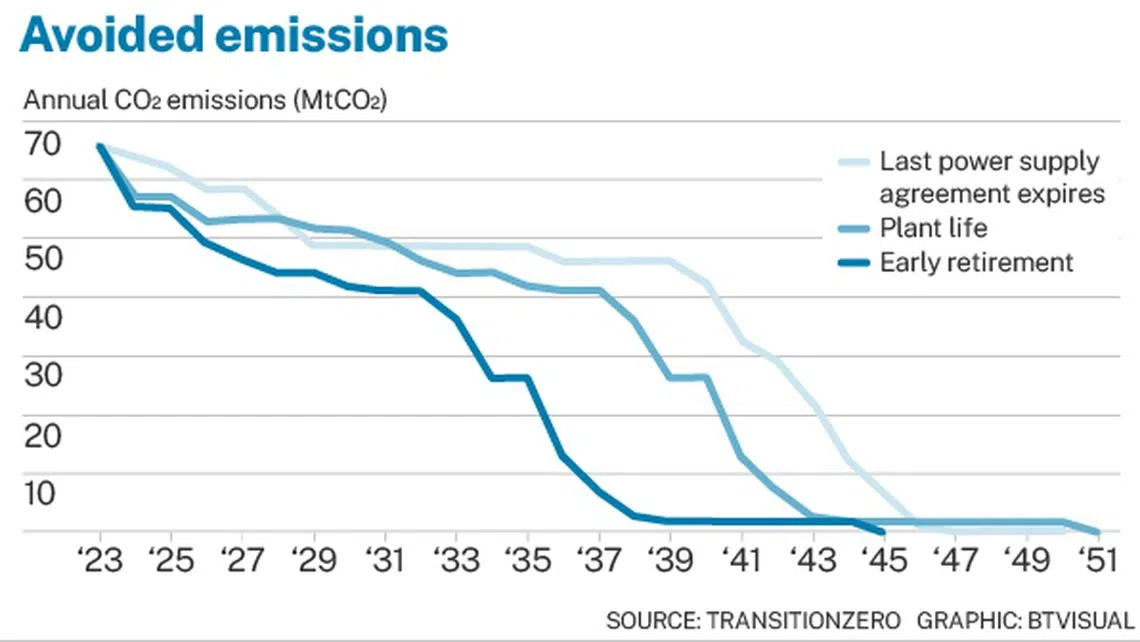
CLOSING coal plants in the Philippines five years before their original retirement date could prevent the release of 290 metric tons of carbon emissions – an amount which is nearly double the country’s emissions in 2022, indicated a report from climate tech non-profit organisation TransitionZero.
The existing coal fleet is slated to retire by 2047 if the coal plants run to the end of their plant life, or by 2051 if they retire only after their last power supply agreement expires.
Either of these two scenarios falls short of the International Energy Agency’s recommendation, which is for developing countries to end all unabated coal generation by 2040 for a shot at keeping the world’s warming under 1.5 deg C by 2050.
Although the country’s fleet is relatively young, retiring coal plants five years early could lead to their decommissioning around 2040. As at 2022, the country’s power profile remains dominated by coal with an installed capacity of 12.2 gigawatts (GW) from 58 coal units, covering 43.9 per cent of the energy mix.
“Without early retirement, emissions from the power sector will remain high until late 2040s, given coal’s dominance in the Philippine electricity mix,” TransitionZero said in the report.
However, the average abatement cost to buy and replace coal plants remains high, at about US$140 per tonne of carbon dioxide equivalent. This comprises US$41 to buyout power supply agreements and US$99 to replace the coal plants with solar and battery storage, according to the report.
The report also pointed out a wide range in buy-out costs, between US$19,200 and US$2.8 million per megawatt (MW) of capacity.
The high abatement costs means that most coal plant owners are reaping high profits, with long-term profitability averaging US$65 per megawatt hour (MWh).
“The high marginal abatement cost stems from high profitability in power supply agreements within the country’s current tariff structures, which include fuel cost pass-throughs that see consumers bearing the cost of high fuel prices and not benefiting from savings when prices drop,” said the report.



In addition, as the Philippines’ power market is liberalised, renegotiating power supply agreements involves a complex process with multiple counterparties as each one has varied durations.
There are also distribution utilities and electric cooperatives, which have a mandate to represent consumer interest and are responsible for securing affordable and reliable power for their captive market. For certain distribution utilities or electric cooperatives which have only one power supply agreement to serve full demand, or where alternative sources of generation are not readily available, negotiations may easily stall as interests may be hard to reconcile.
This underscores the difficulty of screening assets as each deal is unique, and plant owners have to be proactive in identifying opportunities for early shutdown. However, this also means that refinancing options need to be made available to plant owners. TransitionZero added that the Philippines’ energy transition plan needs to incentivise early adopters, and ensure that plant owners view early refinancing as a vital strategy.
Coal plant owners need to be convinced that early retirement is a critical business strategy. While coal plants are cash cows now, the changing business and political climate will see continued coal operations come under immense pressure as renewables start crowding out fossil fuels in the power sector.
Notably, renewable energy is already changing the cost game. A Solar Philippines Tarlac Corporation power supply agreement was recently awarded at US$53 per MWh – less than half the average coal tariff of US$138 per MWh.
About 2.9 GW of coal power supply agreements, which is equivalent to 25 per cent of the grid-connected capacity, are expected to expire by 2030.
“Despite their current profitability, coal plants face the risk of becoming stranded assets due to shifts in regulatory, business and political climates, which are likely to exert increased pressure on ongoing coal operations,” the report said. “It is essential to establish robust selection criteria to accurately determine transition schedules and guarantee that appropriate transition finance is made accessible.”
Decoding Asia newsletter: your guide to navigating Asia in a new global order. Sign up here to get Decoding Asia newsletter. Delivered to your inbox. Free.
Copyright SPH Media. All rights reserved.