Issue 121: Rethinking water economics; closing Asia’s decarbonisation gap

This week in ESG: Global commission issues landmark report on water; Asia’s large markets can do more to green up
Water policy
Mission control
The 194-page report by the Global Commission on the Economics of Water (GCEW) is a landmark call to action distilled from the work and knowledge of a small army of experts.
But out of the many names in just over three pages of acknowledgements – including Singapore President and Commission co-chair Tharman Shanmugaratnam, 32 researchers, six key experts and dozens of speakers at retreats and hearings – one stood out. That would be Commission co-chair Mariana Mazzucato, whose work on mission-oriented policy underpins the report’s recommendations.
With the GCEW’s endorsement, Mazzucato’s argument for government-led direction setting and shaping markets to serve public purposes could well be one of the past decade’s most influential ideas on how to confront large sustainability challenges.
The GCEW report highlights the urgent need to conserve fresh water. About 1.4 billion people currently live in “closed river basins” where demand exceeds supply for surface freshwater, also known as blue water. It is estimated that about 4 billion people experience severe water scarcity for some part of the year. If the world warms by 2 to 4 deg C, a further 3 to 4 billion people are projected to experience water scarcity.
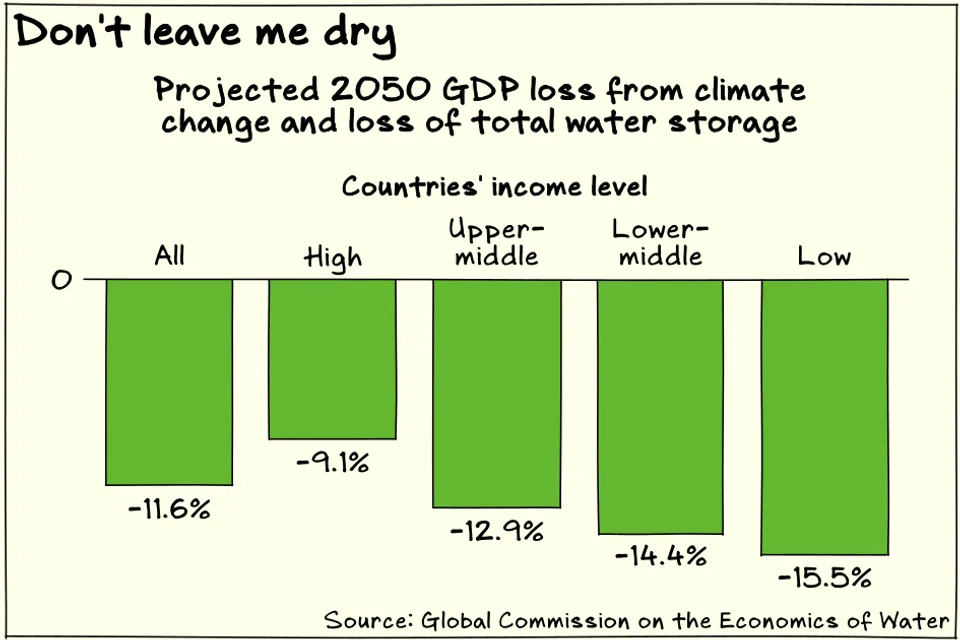
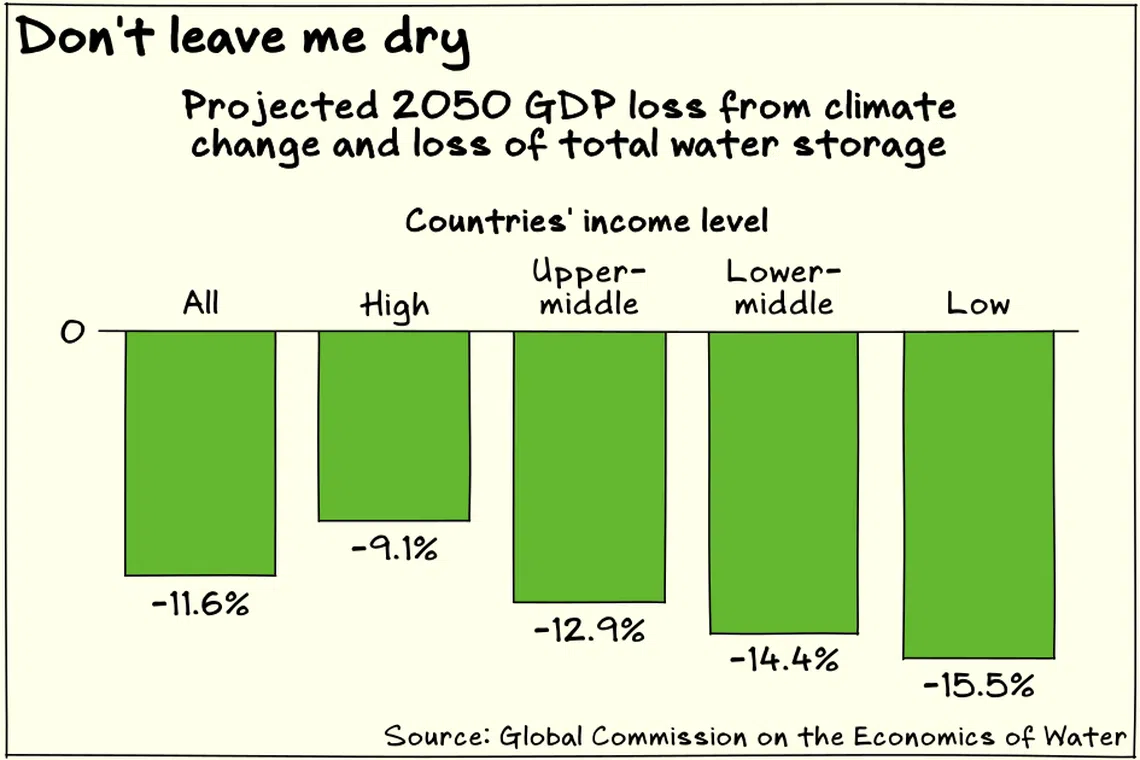
The water crisis could lead to GDP loss by 2050 of 8 per cent on average, and 10 per cent to 15 per cent among lower-income countries. More than half of worldwide food production would be at risk.
The report calls for water scarcity to be addressed as a global issue and as a fundamental, organising principle for sustainable development. Furthermore, water needs to be better accounted for, considering not just blue water but also green water, or usable freshwater retained in the soil.
In terms of the approach, the GCEW has embraced Mazzucato’s concept of mission-oriented policies.
The approach runs through a couple of fundamental principles.
The first is that the government must deliberately shape markets to achieve efficient, equitable and sustainable goals. This is a shift from a purer market-based approach that opposes governments “picking winners” on the basis that such interference is inherently inefficient. But mission-oriented advocates argue that unfettered capitalism tends to maximise negative externalities, which hurts society as a whole and trend towards resource hoarding, which is inequitable, unjust and unsustainable in the long term. Waiting for markets to fail and then fixing them is, in fact, an inefficient way to achieve sustainable outcomes.
The second principle is that policies must be driven by missions that are ambitious but realistic, measurable and time-bound, and mobilise cross-sector solutions. The focus is on outcomes, not outputs. Outputs are tangible products or activities, such as building water treatment plants; outcomes are broad, long-term impacts of outputs, such as improved public health or increased access to water. The distinction is emphasised because an output-centric approach could lead to spending on unimpactful infrastructure.
Many of the tools used in the Mazzucato approach, such as conditionality, aren’t new. For example, many foreign direct investment agencies, such as Singapore’s Economic Development Board, are well acquainted with extracting jobs and investment dollars in exchange for subsidies.
But what makes the approach a bold departure from previous convention is its challenge to the idea that the government should take a back seat to the market. In Mazzucato’s world, the government needs to be at the front and in the driver’s seat, holding the steering wheel while the market engine turns the wheels. Subsidies and fiscal deficits aren’t necessarily bad if they accomplish the mission.
But that’s an if that might also bear the greatest risk for this approach. Just as an empowered government can drive great positive change, it could also cause great harm if it is pursuing misguided missions.
Yet by empowering governments to shape markets in the pursuit of sustainable objectives, the approach could also be its greatest risk. Suppose a government views protecting livelihoods and cost of living as a prime priority; running deficits to maintain expensive tariffs or fossil fuel subsidies could well be justified.
To create proper missions and strategies, good data is critical. The GCEW is calling for a rethink of how much water is consumed. The current recommendation of water requirements is 50 to 100 litres per person per day, based only on basic health and sanitation. But the GCEW also considered an economy-wide accounting that looks at water use in all sectors, including food and industry, for adequate human development. That measurement yielded a sharply higher estimate of 4,000 litres of freshwater per person per day for a “dignified life”.
Fundamental values are also essential. In the case of water, for example, the GCEW urged that “justice and equity must be at the centre”.
Net zero
Getting over the hump
China, India, Indonesia, Japan, South Korea and Vietnam need to invest a combined additional amount of US$15 trillion (S$19.7 trillion) by 2050 to be aligned with a scenario where global warming is limited to 1.75 deg C, says a report by decarbonisation investment platform GenZero and BloombergNEF.
That would bring the total decarbonisation investment for those countries to US$84 trillion, 20 per cent more than the current US$74 trillion that the six countries are already on track to spend by 2050 if policy support for decarbonisation remains unchanged from current levels. However, the current policy and investment trajectory is aligned with a scenario where global temperatures increase by 2.6 deg C.
The power sector is a critical area for closing the funding gap, both by increasing investments in low-emissions solutions and by diverting capital away from fossil fuels.
The report stated that phasing out unabated fossil fuel generation is hampered by the absence of a competitive electricity wholesale market in places like Indonesia or Vietnam. Without meaningful pricing signals, it can be difficult to incentivise the closure of coal generators.
But is it really necessary to rely on market forces to incentivise the closure of coal generators? Of course it would be great to have those price signals, but if policymakers were serious about switching to more sustainable energy sources, there are many ways to move consumption choices in the absence of those price signals. The government could change the profile of power grids by subsidising the building of lower-emission alternatives in coal-supplied areas, while imposing significantly higher taxes on coal power or simply legislate the closure of coal plants. Perhaps it’s possible to achieve progress without having to wait for deep changes to electricity pricing markets and systems.
Other ESG reads
- Singapore ranks second in Apac for ESG bonds issuance in H1 2024: MSCI
- ST Engineering unit wins Lusail smart city project worth over S$60 million
- Kick-starting a green hydrogen supply chain across Asia and Africa
- Isca launches new sustainability guide for companies
- Over half of Singapore firms plan to invest S$700,000 or more in digital sustainability efforts: report
- Climate pact needs ‘hundreds of billions’ in state money: COP29 hosts