

Issue 123: Policy barriers to climate investment; board diversity beyond the numbers

This week in ESG: Think tank Convergence dives into climate blended finance stats; largest Singapore-listed companies hit board diversity milestone
Blended finance
Policy barriers in developing markets
A responsible commercial investor might be keen to allocate money towards renewable energy projects. But what if those projects sit in a market with slow government approvals and coal policies that keep the cost of the fossil fuel low? Would the enthusiasm wane?
Those conditions currently exist in Indonesia, says blended finance think tank Convergence. They’re significant reasons why commercial capital participation is so low in the country’s blended finance transactions – so called because they’re structured to enable concessional capital investing alongside commercial funding.
For developing economies like Indonesia, removing policy barriers is just as – if not more – important for achieving climate change commitments as attracting investments.
Convergence’s newly minted climate edition of its State of Blended Finance 2024 report showed that the value of climate blended finance deals more than doubled to US$18.3 billion in 2023 from US$8 billion the year before. Of the 78 climate blended deals in 2023, six were “whales” – deals worth at least US$1 billion.
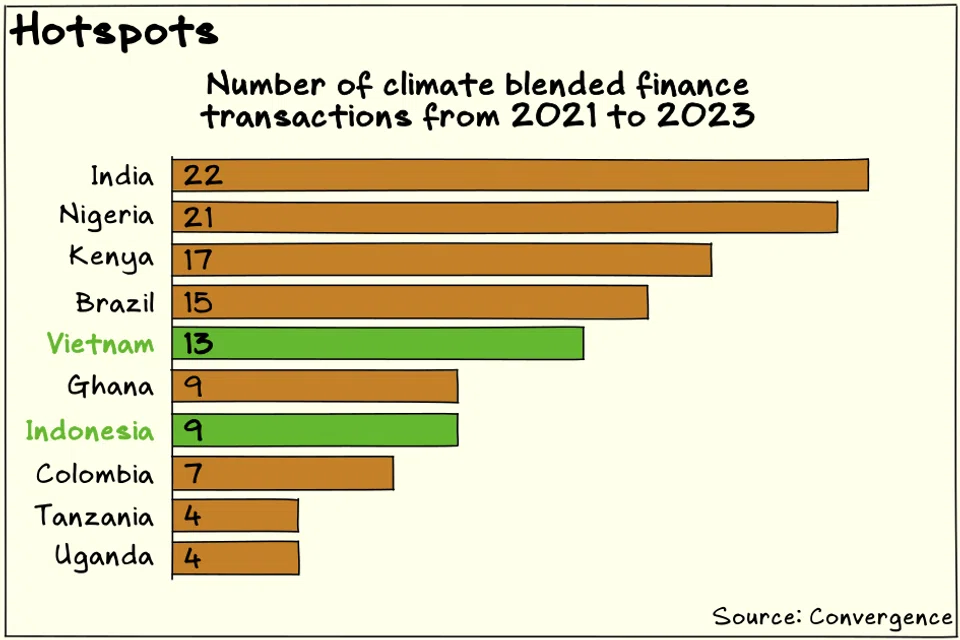
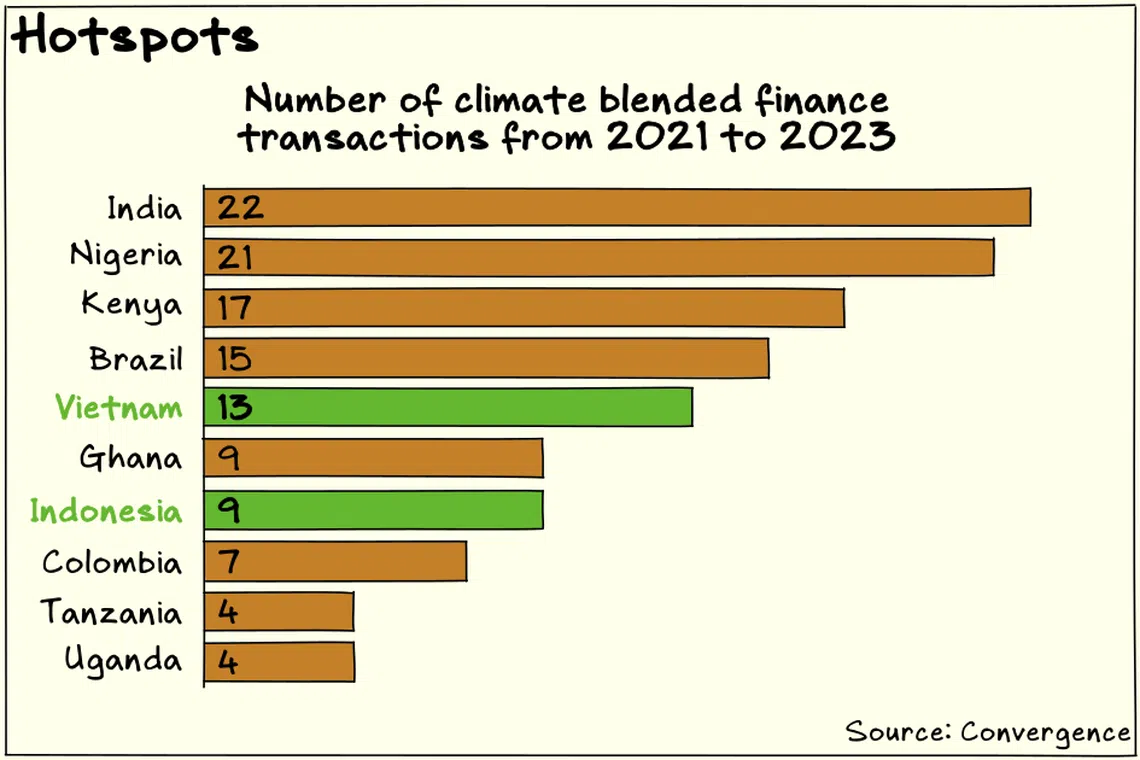
Among the most active countries were Vietnam, which saw 13 deals in 2023, and Indonesia, which saw nine deals.
Despite the buzz in emerging and developing South-east Asia, private commercial participation can be low, which makes it difficult to scale up blended finance in the region and to finance the achievement of countries’ international decarbonisation commitments.
For instance, the public sector funded 73 per cent of blended investments in Indonesia in 2023. About 48 per cent came from development agencies and multilateral donor funds.
Having that sweet public-sector money and donations is awesome, but there really isn’t a lot going around on account of these being concessional funding. So if you’re trying to close that trillion-dollar investment gap to meet your climate goals, you need to get the private sector involved.
Mobilising private capital is ultimately what blended finance is about. Concessional capital takes part at below-market terms to nudge the risk-reward balance for the rest of the deal to a point where private capital is comfortable getting involved. For example, a multilateral development bank like the Asian Development Bank might provide a first-loss guarantee for a project, reducing the risk enough for commercial banks to provide the bulk of financing. The goal is to leverage each concessional dollar to catalyse as much private money as possible.
But simply providing concessional capital and a blended structure isn’t enough. Private investors are also concerned about the policy landscape, since this also greatly affects success and impact.
In the Indonesian example, Convergence highlighted that the tendering process for renewable projects can take years before approvals are granted, which erodes investor confidence.
Legislated coal supply from domestic coal mines at capped prices also keeps the high-emitting fuel unnaturally cheap, making it challenging for renewable projects to be economically viable.
“The economics of renewable energy in Indonesia demonstrate less of a need for blended finance to subsidise renewables, and more so a reduction in subsidies for coal-fired power,” Convergence wrote.
Building technical capacity could help. For example, Convergence noted the need to create transition roadmaps and asset-by-asset suitability assessments for the early retirement of coal power plants in Indonesia.
Developing countries can also better mobilise domestic capital, especially in South-east Asia’s largest economies. Only 3 per cent of investments by Indonesia’s domestic financial institutions are climate-aligned, Convergence said, which suggests that significantly more domestic financing could be pointed towards climate objectives. Domestic financing represents lower cost of capital, since local lenders are less concerned about currency risk.
In fact, if Indonesia properly addresses the policy hurdles to its energy transition, blended finance might not even be necessary, Convergence stated. That’s because private capital appears to have the appetite for renewable electricity investments in Indonesia.
It’s a situation where private investors would really, really like some of the renewable energy projects that Indonesia’s warung is serving in the streets of Jakarta, but they’re not comfortable taking a bite until Indonesia sorts out some hygiene issues. Merely lowering the price won’t make them budge.
Board diversity
Structure matters
Singapore’s national board gender diversity movement looks poised to shift its focus beyond numbers as leading listed companies are expected to hit a key target slightly ahead of schedule.
Singapore Exchange chief executive Loh Boon Chye, who is also co-chair of the Council for Board Diversity (CBD), recently told a leadership forum that “board diversity must be fit for strategy, and not diversity for its own sake”.
Those remarks came as women took 25.3 per cent of board seats at the 100 largest Singapore-listed companies as at end-June. If that percentage can be maintained by the end of the year, CBD will be able to cross off its goal for women to occupy a quarter of the companies’ board seats by 2025.
CBD’s long-term objective is a balanced gender mix among Singapore boards and a broader consideration of other forms of diversity.
Making a convincing case for diversity has always been challenging. Over the past year, some companies and their stakeholders have pushed back against diversity, equity and inclusion amid questions about those policies.
Part of the problem may be that board diversity shouldn’t be pursued and assessed along one-dimensional yardsticks.
A June 2023 paper by researchers from Australia, Malaysia and New Zealand sought to analyse the impact of board diversity not only from a demographic lens but also from a structural perspective. A demographic consideration looks at diversity of gender, culture, tenure, social capital, expertise and age. A structural examination looks at board independence, size, chairmanship, board compensation and meeting frequency.
The study found that both demographic and structural diversity lead to better green and environmental innovation. More diverse boards on both dimensions also offset negative political risk and play a crucial monitoring role when there is an absence of external monitoring by institutional investors and analysts.
The takeaway is that merely going after numbers and targets isn’t enough. A company also needs governance systems and processes properly set up to ensure that the benefits of a diverse board can be properly tapped. In other words, it’s not just whether you get there but also how you get there that matters.
Other ESG reads
- Investment bankers helped polluters make ‘too much money’, says ex-PBOC chief economist
- CapitaLand Investment, LReit slip from top rankings in global ESG benchmark for real estate
- Arta Finance partners Temasek Trust’s Co-Axis to unlock US$30 million catalytic funding for impact projects
- COP16 chair hails biodiversity attaining ‘equal footing’ with climate crisis
- Growing green energy across Asean
- Against the odds: Aussie billionaire Cannon-Brookes snags conditional green light to power Singapore
TRENDING NOW

If Europe goes to war, the fallout will be felt in East Asia

Stocks to watch: Seatrium, MIT, Keppel Reit, Clint, UI Boustead Reit, Digital Core Reit, ST Engineering

Chairman’s role in spotlight with raft of proposed new rules for Singapore boards

Mapletree Industrial Trust posts 6.6% drop in Q2 DPU to S$0.0297

