Issue 125: COP29 carbon deal a potential win for Asia; Singapore’s US$500 million blended finance signal

This week in ESG: COP29 strikes quick deal on carbon markets; Singapore pledges US$500 million of concessional capital for climate action
Carbon credits
Early deal at COP29
The 29th edition of the annual United Nations Climate Summit (COP29) in Azerbaijan started with a bang as negotiators agreed to accept the framework for a global carbon credit market.
Asia is potentially one of the biggest winners of the move, as one of the world’s largest sources of voluntary carbon credits and holding one of the world’s largest stock of Kyoto-methodology credits that could be transitioned into the new framework.
The approval at COP29 lays the foundation to operationalise what is known as Article 6.4 of the Paris Agreement, which deals with a global market for carbon credits, including voluntary ones.
After previous COP negotiations failed to achieve consensus on the standards that will govern the market, the supervisory body that will oversee the market made a strategic pivot. Instead of asking countries at the summit to reach consensus on accepting standards, the supervisory body adopted a version of the standards before the meeting then put it to a vote that now required consensus to reject the standards.
It was a controversial move, taken by some countries and non-governmental organisations as an improper run-around. The Centre for International Environmental Law said the new standards contain language on carbon removals that could open the door to carbon capture and geoengineering projects that are “dangerous distractions” with the potential to weaken climate action.
Despite the protests, the gambit worked, and we now have standards for developing and assessing projects, and requirements for projects that remove greenhouse gases from the atmosphere.
Kyoto’s sunset
The new market that is being created is seen as replacing the problematic Clean Development Mechanism (CDM) credits market set up under the Kyoto Protocol, which was the predecessor of the Paris Agreement.
Among the key elements of the new Article 6.4 standards are rules governing additionality that are widely seen to be more robust than the CDM methodology.
Offsetting works only when the greenhouse gases being reduced or removed are beyond business as usual. Therefore the additionality principle requires that credits can only be issued for activities that would not have occurred if not for the sale of credits.
Unfortunately, many credits issued under the CDM system are no longer considered valid because they fail the additionality requirement. For example, many CDM credits were issued for renewable energy projects, even though those projects could and would have been carried out even without money from the credits.
But there’s another potential issue on the horizon, as negotiators will have to grapple with the question of whether some of the current CDM credits can be transitioned and allowed to trade under the new Article 6.4 standard. Many of those credits that are seeking transition are for renewable projects, a prospect that has drawn sharp criticism from some corners.
Asian potential
Some of the biggest holders of renewable power CDM credits seeking to transition them to the new standard are in Asia, with China and India among the largest sources, according to an analysis by Climate Home News.
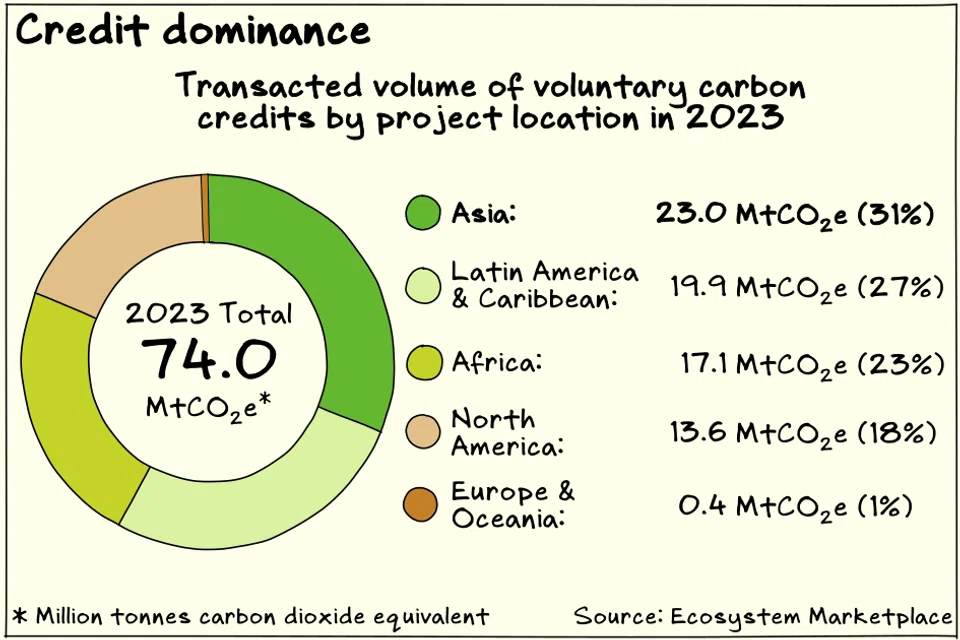
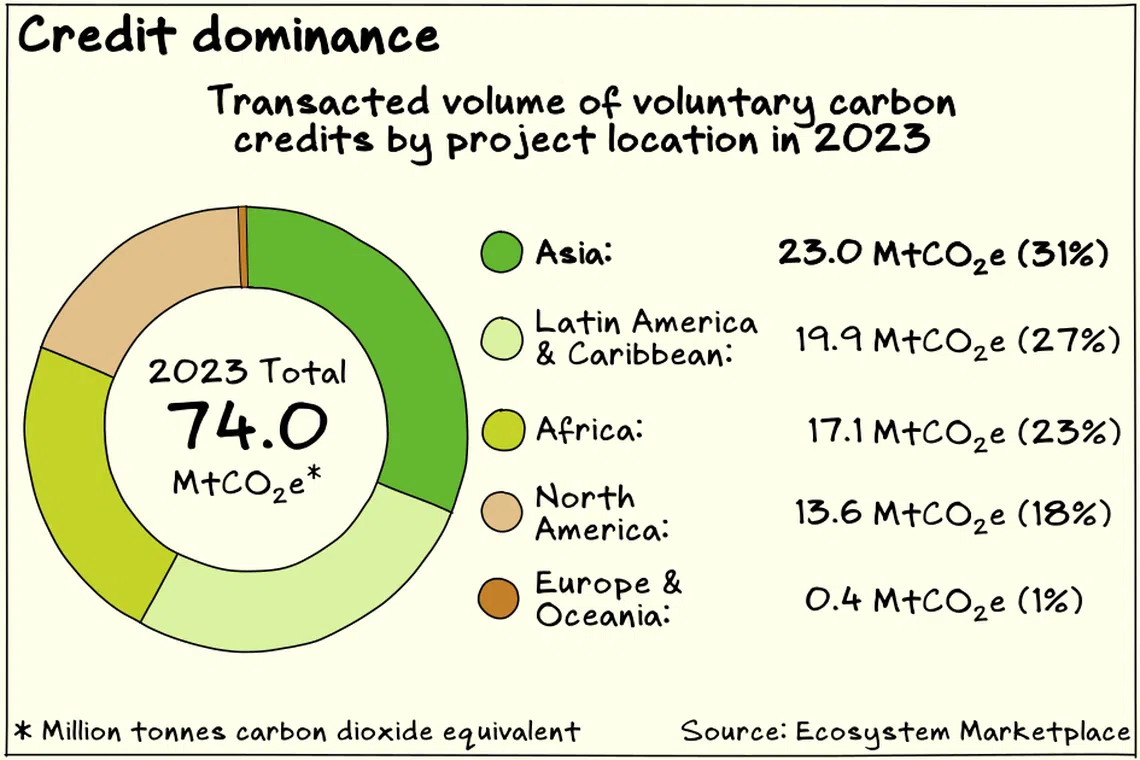
Asia also happens to be one of the largest issuers of voluntary carbon credits, based on data by Ecosystem Marketplace. In 2023, Asia-based credits issued for 23 million tonnes of greenhouse gases were traded, representing just under a third of global traded volume.
A new global marketplace for voluntary credits could therefore be a potential boon for Asia, although the extent of the benefit is still uncertain.
One wildcard is the extent to which forestry-related credits can be accepted, since Asia is a major source of Redd+ credits – credits issued for reducing emissions from deforestation and forest degradation. Most Redd+ credits are considered “avoidance” credits, which means that while the projects issued the credit aren’t removing additional greenhouse gases from the atmosphere, they’re preventing the creation of new emissions. For instance, a project that prevents a plot of forest from being cut down for farming could receive Redd+ avoidance credits.
Article 6.4 doesn’t currently allow avoidance credits, Carbon Market Watch has said. That may limit the amount of credits that many of the forestry projects in Asia can claim under the new standards. Cookstove projects would also not qualify.
Blended finance
Singapore’s strategic investment
Singapore has pledged US$500 million of concessional capital on a dollar-for-dollar matching basis under its Financing Asia’s Transition Partnership (Fast-P) blended finance initiative.
It’s a strategic move by Singapore, which is both facing pressure to contribute to a new global climate fund and trying to develop as a sustainable finance hub.
When Singapore announced Fast-P in 2023, it set a goal of mobilising US$5 billion of blended capital to support climate transition in the region. Blended finance uses structures that allow concessional capital to reduce the risk on viable but unbankable projects so that private funders can participate. The hope is that the newly announced matching commitment will allow the initiative to obtain US$1 billion of concessional monies, which can then be leveraged to catalyse US$4 billion of private capital.
To put those amounts in context, the total global value of climate blended deals in 2023 was US$18.3 billion, based on data by blended finance think tank Convergence. It’s unlikely for all US$5 billion under the Fast-P to be deployed in a single year, but the amount is still substantial enough to make a meaningful difference to the global blended finance market.
Singapore’s big splash reflects a national mission of becoming a hub for sustainable finance. Within that goal, blended finance has been identified as a segment of priority. In Asia, especially, blended finance is seen as a way to scale up much-needed climate action investments.
But beyond the market development aspect of the move, Singapore could also be sending a signal about its willingness to voluntarily provide developmental capital to its less developed neighbours. A key item on the agenda at the UN Climate Summit in Azerbaijan (COP29) is a climate fund known as the New Collective Quantified Goal (NCQG) that is to be supplied by the world’s developed nations for the benefit of developing countries.
Singapore, which on a per capita basis is one of the wealthiest nations in the world, has faced calls to be included in the NCQG as a donor country. That would impose obligations on Singapore to contribute to the fund.
But Singapore, which maintains its status as a developing nation, has steadfastly opposed any move that could classify the country as developed. Singapore Sustainability and the Environment Minister Grace Fu has said that while Singapore will not accept being included as a donor country to the fund, it is willing to contribute on a voluntary basis and will not draw on the fund.
In that light, the Fast-P commitment is a US$500 million message that Singapore is ready and willing to back up its offer to voluntarily contribute to the NCQG.
Other ESG reads
- Money, money, money... and Trump: What’s at stake at COP29
- UOB cuts 2023 financed emissions in most ‘dirty’ sectors except steel
- Temasek-backed GenZero and Trafigura to invest US$100 million in Colombian carbon project
- COP29: EDB launches grant to support early-stage carbon projects
- Growing need for blended finance in Asean as investors expect higher returns: BlackRock
- Corporate directors in South-east Asia to get more guidance on climate governance