

Issue 126: Singapore sets peak emissions date; Asean Taxonomy’s existential threat

This week in ESG: National emissions to decline only after 2028; clock ticking for Asean to improve sustainable finance interoperability
Net zero
Peak emissions in 2028
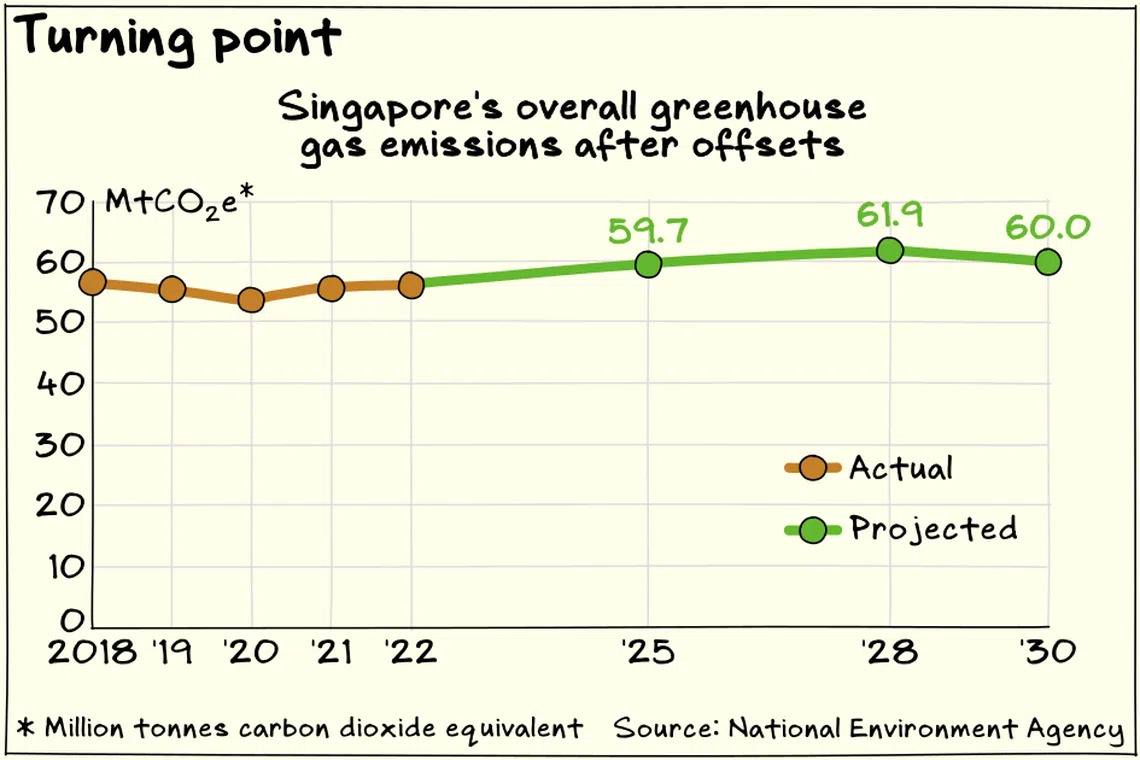
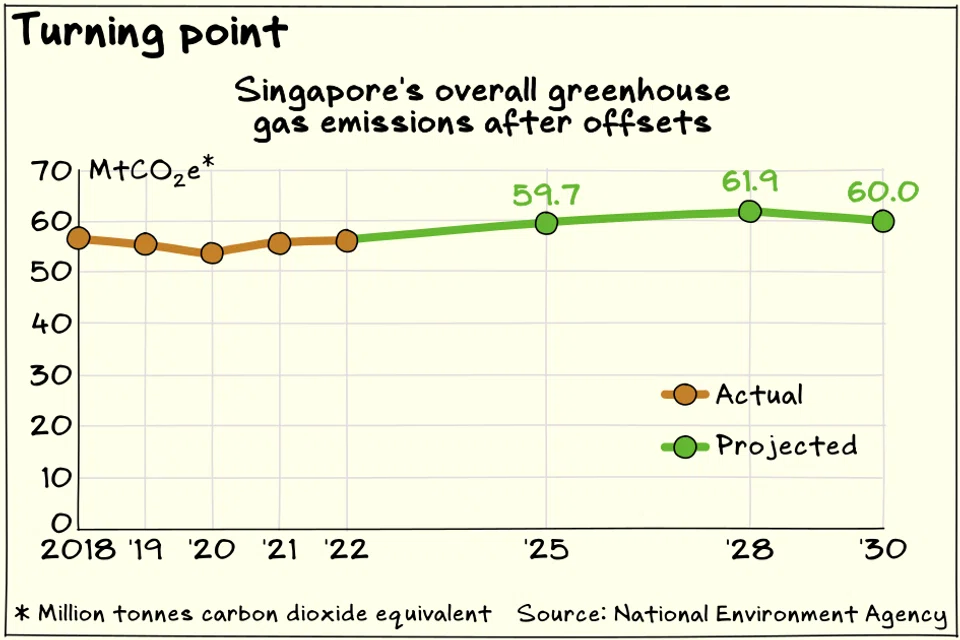
Singapore has set 2028 as the year when its greenhouse gas emissions are expected to peak, making the next three years a critical period for setting up the country’s coming energy transition.
Singapore released two progress reports on its emissions over the past week. The first is a Biennial Transparency Report, which provides updates on Singapore’s whole-of-country performance on its climate targets under the Paris Agreement. The second is the GreenGov.SG report, which covers emissions by the Singapore public sector.
Here are some takeaways.
Greater transparency
The new reports contain new information that provide greater insight into the decarbonisation metrics and strategies that the Singapore government is using.
For example, the GreenGov.SG report includes waste data for the first time, showing that total waste disposed at government facilities increased 1.3 per cent to 218.7 million kilogrammes in the year ended March 2024 as activity levels at tenanted industrial areas and some public-facing locations returned to normal. The reporting period is referred to by government convention as fiscal year 2023.
However, when averaged out, the amount of disposed waste worked out to 0.38kg per person per day, which was 9.1 per cent lower than the year before. The public-sector target is to reduce the average to 0.29kg per person per day by 2030.
Perhaps of greater significance are projections in the Biennial Transparency Report that Singapore will hit peak net emissions of 61.92 million tonnes of carbon dioxide equivalent (MtCO2e) in calendar year 2028. This the first time that Singapore has specified 2028 as the year in which it expects peak emissions. Previous disclosures have put the peak between 2025 and 2028.
Peak emissions include offsetting 2.51 MtCO2e of emissions per year through carbon credits, without which emissions in 2028 could reach 64.43 MtCO2e.
Past 2028, national emissions are expected to begin declining to around 60 MtCO2e with offsets in 2030, en route to a goal of net zero by 2050. It means that, on average, Singapore will have to cut emissions by about 3 MtCO2e per year for 20 years after 2030, or about 5 per cent of 2030 emissions each year, all while presumably growing the economy.
For 2025, Singapore expects to report 59.7 MtCO2e of emissions with offsets, and 62.21 MtCO2e without.
Energy priority
Emissions from energy-related activities are the largest source of national emissions for Singapore, accounting for 84 per cent of the total in 2022, excluding offsets. That is the latest year with actual reported emissions numbers.
With only three years to peak emissions, steps to decarbonise the energy segment is likely to be a top priority for Singapore in the next few years. Past 2028, the energy landscape could undergo major changes as Singapore’s energy mix changes.
For the purpose of the Paris Agreement commitments, the energy segment covers a broad range of activities, including energy industries, manufacturing industries and construction and transport. Waste-to-energy incineration is also included in the energy segment where the waste is fossil-based. Biomass incineration for energy is excluded.
A key pillar of the energy transition is importing low-carbon electricity, with six Gigawatts of imports targeted by 2035. Singapore has started entering into import agreements, with 10 projects granted conditional approvals, of which five have progressed to conditional licences. The setting up of infrastructure to enable imports, such as a regional grid, remains an ongoing challenge.
Singapore is also investing in and exploring other fossil fuel alternatives, including a deal with the United States to study nuclear technology, and research and tests into hydrogen-based fuels.
One aspect of the energy transition that has not received much discussion is the phasing out of fossil fuel-based energy facilities. In order to bring emissions down, Singapore cannot merely add low-carbon sources to its energy mix; it must also stop burning fossil fuels for energy.
The waste-to-energy sector could be especially challenging. Waste incineration in Singapore not only produces energy, but also reduces the need for landfills in a land-starved country. Carbon capture could potentially mitigate emissions from this sector, but the efficacy of carbon capture and sequestration is still uncertain. Getting to net zero means that Singapore must also pursue a robust waste reduction strategy.
Whole-of-country effort
While the Singapore government holds significant influence over some of the largest emitting segments of the economy, its leverage can only go so far.
The choices of individuals and the private sector, in particular, are particularly important. For example, the government could invest in cleaner waste treatment solutions, but the cost of doing so is greatly mitigated if individuals and businesses make more responsible consumption choices.
The GreenGov.SG report takes great lengths to highlight actual solutions taken by the public service to mitigate emissions and waste. An interesting case study discusses how the Energy Market Authority fit two workstations instead of one into each cubicle in order to fit an expanding department. The move led to 70 per cent savings, the report says. It would be interesting to know how the department’s staff feel about the sardine-fication of their office.
All the same, it’s clear that the report is intended to not only provide a progress report, but also to serve as an educational resource for organisations looking to embark on the same journey.
Indeed, in a foreword, Minister for Sustainability and the Environment Grace Fu writes: “We have shared some of the challenges we faced and our experiences, which we hope are useful to organisations or groups looking to implement sustainability strategies”.
Sustainable finance
Asean Taxonomy’s interoperability threat
Singapore has become the third market to join the Multi-Jurisdiction Common Ground Taxonomy, which until now has been a bilateral initiative between China and the European Union.
With Indonesia also in discussion to potentially join the effort, South-east Asia’s Asean Taxonomy for Sustainable Finance could face pressure to achieve interoperability sooner rather than later.
Taxonomies define activities that are eligible for financing that can be considered for sustainable finance. They’re fundamental to sustainable finance; without a taxonomy to set the bar, there would be little confidence that a green bond was actually financing a green activity.
But the growth of sustainable finance has been hampered by different jurisdictions having different taxonomies. For instance, an investor from Europe might not be comfortable buying a green bond based on the Indonesian Taxonomy because the investor might not be able to claim it as a green investment in the investor’s home market.
To address the fragmentation, China and Europe in 2021 published the Common Ground Taxonomy to map their respective taxonomies onto each other. They have continued to update it.
The addition of Singapore gives the industry the means to create sustainable finance products that can be bought and sold in all three markets, which benefits all three jurisdictions involved.
If Indonesia is able to join the Common Ground Taxonomy as well, two of South-east Asia’s largest sustainable finance markets would become interoperable with what would now be a global fraternity of interoperable sustainable finance taxonomies.
It raises a natural question about whether the Asean Taxonomy is being left behind.
The Asean Taxonomy was created by the Association of Southeast Asian Nations’ member states to, among many reasons, enable sustainable finance for the region in a way that took into account South-east Asia’s unique circumstances. For example, the Asean Taxonomy had one of the earliest sets of rules to allow for the early phase-out of coal-fired power plants as a transition activity, providing a path for retiring the region’s large and young fleet of coal plants.
The Asean Taxonomy was also designed to accommodate the wide diversity of levels of development within Asean, where GDP per capita in Singapore is more than 47 times that in Cambodia. This has led to a tiered taxonomy that allows a less-ready country to adopt less rigorous standards, and to progress towards stricter thresholds as it becomes more able to do so.
The Asean Taxonomy’s need to accommodate these diverse circumstances and goals have made it challenging to become more interoperable with international taxonomies. Although the need for global interoperability consistently shows up in feedback during the Asean Taxonomy’s consultations, the Asean Taxonomy Board has not publicly announced much in the way of progress.
In the latest version of the Taxonomy, the Asean Taxonomy Board acknowledged the importance of improving interoperability, but did not provide concrete plans to do so. It wrote: “International investors have expressed a wish to see alignment with international standards to make green investment comparable in Asean. However, alignment of the Asean Taxonomy with international standards is not straightforward and investors understand the benefit of the Asean Taxonomy being tailored to individual Asean Member States.”
Singapore and Indonesia are clearly not waiting for the Asean Taxonomy to act, and for good reason. There’s a world of capital out there and a tremendous amount of need in the region that could use the money. You snooze, you lose.
The risk for the Asean Taxonomy is that if it is no longer needed for the region’s largest sustainable finance markets to access the world and for the world to access the region’s largest markets, the markets may simply move on without the Asean Taxonomy. A taxonomy is only meaningful if people use it.
Other ESG reads
- COP29 climate financing target likely to fall short of developing countries’ needs: report
- US$34 billion asset manager plans to hire in Singapore for climate finance
- COP29: More policy alignment needed in S-E Asia to unlock potential from new carbon trading rules
- COP29: Singapore and Zambia ink carbon credit deal
- Battery energy storage systems: South-east Asia’s key to renewable energy resilience
- Tokyo’s scorching summers focus public anger against tree cutting
TRENDING NOW

Government to bring forward raising of retirement age, give employers more financial support to create flexi-load jobs
Former minister Maliki Osman, Revolut chairman join Asia Gulf Holdings advisory board

Is Manila Asia’s new dining hot spot?
Simba at risk of losing operating licence over spectrum misuse

