

Issue 59: Geo Energy shows coal not so stranded; transition bonds’ missing standards

In this issue: Geo Energy pays a premium for coal mining assets, while Barclays’ sustainable finance head wants better clarity on transition finance standards
Singapore
Coal play still a big deal
The idea that coal assets will become stranded – and businesses should therefore stop investing in them – hasn’t really materialised in Asia.
That is why Geo Energy Resources has just agreed to pay US$154 million for significant stakes in Indonesia-listed coal miner Golden Eagle Energy and coal infrastructure developer Marga Bara Jaya. The deal will trigger a public offer from Geo Energy for the rest of Golden Eagle Energy that it does not hold, which means Geo Energy might have to pay even more to own up to 75 per cent of Golden Eagle Energy.
A deal like this seems to go against the “stranded asset” thesis for coal. The thesis posits that carbon-intensive assets, among which anything related to thermal coal is near the top of the list, will become illiquid as the world seeks to avoid the worst of global warming. It’s an important argument that is widely cited to shift capital away from climate-unfriendly assets and positions.
But it’s hard to argue that coal in Asia is stranded when a listed company such as Geo Energy is willing to pay a premium of 12 per cent for a coal mine with a remaining life of about 20 years. Moreover, there is nothing in Geo Energy’s statements on the deal to suggest the company is worried about stranding.
Geo Energy isn’t an irrational investor. In its annual report for 2022, chairman and chief executive Charles Antonny Melati’s description of coal trends felt like chest-thumping aimed at coal doubters.
“Coal demand outlook for 2023 remains robust on the back of China’s reopening from previous ‘zero-Covid’ policies, and the steady global economic recovery supported by various economic stimulus,” he wrote in the annual report. “The soaring gas prices, low hydropower generation, and modest increase in nuclear power generation have pushed European countries back to coal to support their economic activities, particularly during the current economic downturn. With China accounting for the world’s largest coal consumption, this heralds an exciting phase for our group.”
In explaining the new deal, Melati was all about long-term growth: “With reserves of more than 300 million tonnes, the group aims to expand its production to further fuel its strategic growth in the long term. Upon the completion of new infrastructure, the group will be able to ramp up production to up to 25 million tonnes per year with lower costs and greater operational efficiency.”
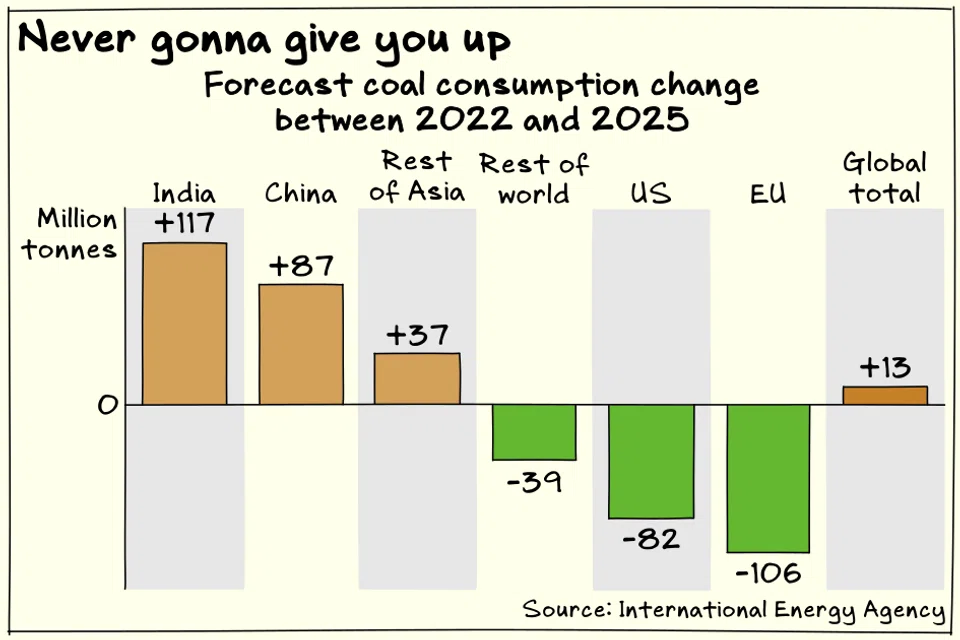
The biggest hurdle to cutting off investments in coal in Asia is that demand for the fuel is still robust. Coal consumption in the region has been growing, and is not expected to peak until around 2025. Even then, the post-peak outlook is shaped more like a plateau than a cliff.
It’s not as if Asia isn’t investing in renewable energy. The problem is that overall energy consumption is expanding rapidly as well, along with population and economic growth. For example, Vietnam’s PDP8 power plan aims to put the country on a sustainable energy footing. The plan calls for coal’s share of the national power output to fall from the 31 per cent currently to 20 per cent by 2030; but because total output will be higher in the new decade, coal power output is expected to increase to 30 gigawatts by 2030 from 21 GW in 2020.
An S&P Global report in July 2022 argued thermal coal will remain important for Asia in its energy transition because there is currently no easier replacement.
“Economic realities in the Asia-Pacific region mean that any significant reduction of coal consumption will prove challenging,” S&P wrote. “Large Asian economies are experiencing a strong rise in electricity demand, which is set to continue over the coming decades to sustain economic growth. When it comes to meeting new demand, coal is still seen as the most affordable option for base-load power.”
Under these conditions, coal doesn’t seem like such a bad investment.
Access to capital is not that big of a concern, either. One of Geo Energy’s principal bankers is Singapore-based UOB. UOB has pledged not to finance any new projects related to coal-fired plants and thermal coal mines, and to fully exit financing for the thermal coal sector by 2039.
That has not been a problem for Geo Energy, which has turned to Indonesia’s Bank Mandiri for US$220 million in facilities to help fund the acquisition.
Bank Mandiri says it is committed to provide sustainable financing to support the transition to a low-carbon economy, but it does not have a plan to transition away from coal. Even if Bank Mandiri eventually decides to stop financing coal, Geo Energy should have no shortage of willing lenders. Only five South-east Asian banks are currently members of the Net Zero Banking Alliance, and they are all from Malaysia and Singapore: CIMB, DBS, Maybank, OCBC and UOB.
Carbon pricing, such as carbon taxes, could help level the playing field for renewable power. But progress has been slow in South-east Asia, and it remains to be seen whether governments are willing to impose prices that are high enough to change behaviour.
Until more sustainable alternatives can generate enough power to replace coal and do so at competitive prices, demand for coal in Asia will continue to exist.
Other Singapore reads
- OCBC’s Mike Ng to take on new group chief sustainability officer role
- Singapore-listed companies’ codes of conduct least effective compared to global peers: LRN report
South-east Asia
Send some guidance from above
Does the sustainable finance industry lack sufficient agreement on what credible transition finance should be? Barclays’ global sustainable finance head Daniel Hanna seems to think so, pointing out that the International Capital Market Association does not yet have a set of transition bond principles.
Principles have been established for other types of ESG bonds, including those labelled green, social, sustainable and sustainability-linked.
It’s a gap that should be addressed as the industry begins to explore projects that aim to hasten the retirement of coal-fired power plants. There are two types of ESG bonds: use-of-proceeds bonds, where proceeds can only be used for aligned purposes; and sustainability-linked bonds, where use of proceeds are not constrained, but borrowers’ cost of borrowing are pegged to their performance against sustainability indicators.
Sustainability-linked structures have been touted as a way to achieve transition outcomes, since their impact is at the entity level. But coal phase-out projects have distinct enough requirements for what is considered credible that they wouldn’t fit easily into a sustainability-linked structure. Transition bonds, which would be use-of-proceeds bonds, might be needed to fill that gap.
To complicate matters, the regulatory taxonomies and frameworks to support such principles are still in flux. In Singapore, for example, the financial sector task force authoring the country’s sustainable finance taxonomy is still consulting on including coal phase-out. Even if they are accepted as is, some of the proposed criteria are set to expire in 2025, after which new criteria must be written. For projects that can take years to complete, this level of uncertainty doesn’t help.
Other South-east Asia reads
- Fund managers prefer using ESG bonds to reach net-zero: survey
- G20 fails to reach agreement on cutting fossil fuels
Other good reads
TRENDING NOW

Two Singapore-listed palm oil firms named in Greenpeace report on Indonesian plantation fires
Singapore Airlines flight returns to San Francisco after ‘unruly’ passenger incident

Singapore looking into which companies responsible for haze-causing fires: PM Wong
Deluge IPO 3.86 times subscribed ahead of SGX debut

