Temasek unlikely to meet 2030 climate targets, says CEO Dilhan Pillay
In the current global landscape, ‘the transition will be far more uneven, contested and non-linear’

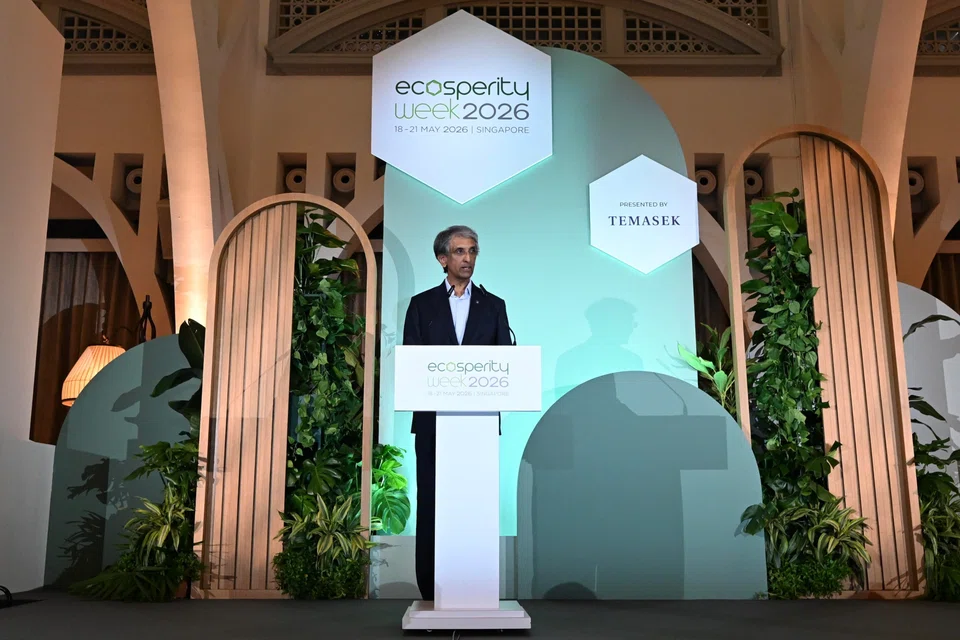
[SINGAPORE] With the low-carbon transition becoming increasingly complex and non-linear, it is unlikely that Temasek will meet its interim 2030 climate targets, said its chief executive officer Dilhan Pillay.
The world is facing a collision between long-term ambition and near-term constraint, he added.
This is as markets continue to be rocked by volatility due to geopolitical tensions and two ongoing wars, higher financing expenses affecting the cost of capital and slowing down long-term investments, and fossil fuel staying entrenched in several hard-to-abate sectors while global energy demand rises from the use of artificial intelligence.
“Therefore, the transition will be far more uneven, contested and non-linear than previously anticipated in many ways,” noted Pillay, who was speaking at a dinner reception on Monday (May 18) at Ecosperity Week, Temasek’s flagship sustainability conference.
“This is the reality we at Temasek are confronting in our own climate journey,” he added.
While the Singapore investment company is likely to miss its 2030 climate targets, it is still committed to its ambition of achieving net-zero portfolio emissions by 2050, he said.
“What we committed to achieving come 2030 still serves as an important directional marker, befitting of our ambition, and we will continue to press forward on every available lever, but our pace must reflect today’s reality.”
When the investor first set its climate targets in 2019, global momentum in climate action was not only building, but capital was relatively abundant, interest rates were low, and global supply chains were largely stable as well.
At the time, Temasek set a target for net-zero portfolio emissions by 2050. It also aimed to halve its portfolio emissions from 2010 levels to 11 million tonnes of carbon dioxide equivalent (tCO2e) by 2030.
SEE ALSO


Based on its latest sustainability report, Temasek’s total portfolio emissions for 2025 came in at around 21 million tCO2e.
That said, Pillay noted that its emissions have declined by around 30 per cent since the targets were set in 2019.
The sustainability report also indicated that Temasek’s portfolio carbon intensity has gone down by 52 per cent from 2010 levels, while its portfolio weighted average carbon intensity has fallen by 23 per cent from 2022.
However, the overall prognosis is that its 2030 emissions may not improve enough to let it reach its target, due largely to its exposure to Singapore Airlines (SIA) and energy player Sembcorp.
The aviation sector is one of the hardest to decarbonise, Pillay noted. Although SIA already operates a young and fuel-efficient fleet, sustainable aviation fuel is the the most critical avenue for the sector to decarbonise.
Yet, the green fuel remains low in supply and it is significantly more expensive than conventional jet fuel.
As for the power sector, renewable energy is already a commercially viable and mature decarbonisation solution. But countries are increasingly prioritising energy security and affordability, as well as grid stability, even as they pursue long-term decarbonisation goals.
This is because of the fast-growing demand for energy amid geopolitical volatility.
While renewables will drive decarbonisation and account for most of the future capacity growth, thermal baseload power will continue to play an important role in maintaining grid stability and affordability during the transition, said Pillay.
“The reality is that the world can’t transition overnight. A credible transition is not simply about shutting assets down quickly – it is about replacing them responsibly while preserving energy security, affordability and grid reliability along the way.”
He added that the current landscape is not a temporary disruption but the operating environment on which Temasek needs to base its planning.
Although the Iran war has made the case for renewable energy stronger, fiscal positions are tighter, policy signals are less predictable, and AI has resulted in a significantly higher level of energy demand.
“Navigating this complexity requires disciplined decision-making and a clear long-term lens, while at the same time addressing short-term volatility, whether (with) respect to markets or even politics,” he said.
Temasek’s approach towards sustainability is therefore defined not just by climate, but also the wider area of sustainable business models.
Pillay said the investment company will continue to deploy capital aligned with the trend of sustainable living, engage its portfolio companies in their decarbonisation efforts, and embed climate considerations into its investment decisions.
Decoding Asia newsletter: your guide to navigating Asia in a new global order. Sign up here to get Decoding Asia newsletter. Delivered to your inbox. Free.
Copyright SPH Media. All rights reserved.