

Hidden rules, not tariffs, are the real hurdle to expanding in South-east Asia
The region is not one market, and firms need local eyes and an exit plan, panellists say

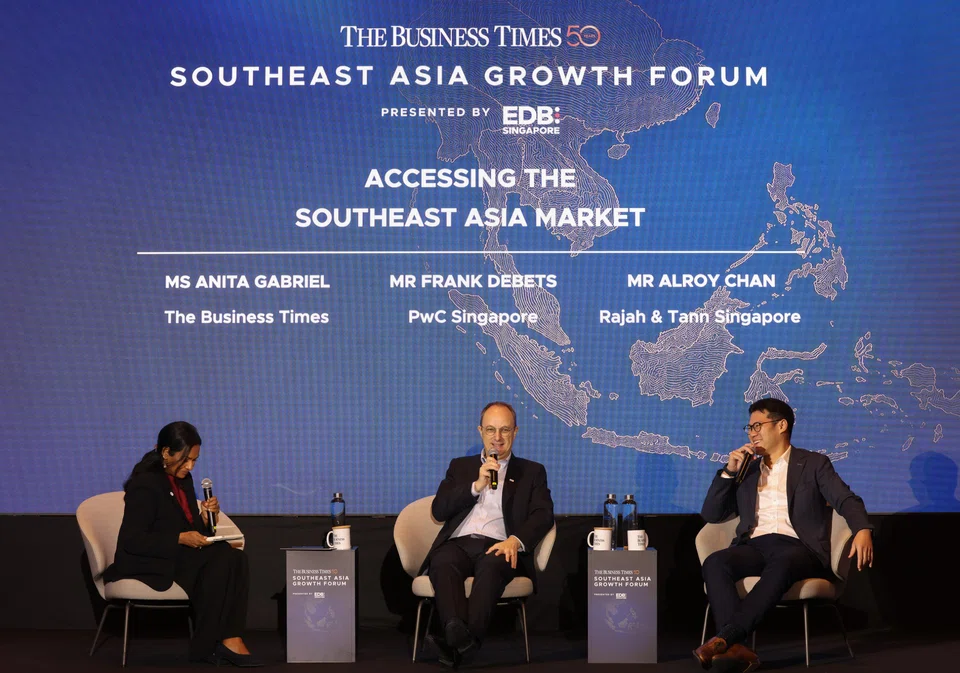
[SINGAPORE] For companies expanding into South-east Asia, the biggest hurdle is not tariffs but inconsistent and unclear rules, said Frank Debets, Asia-Pacific customs and trade leader at PwC Singapore, at a forum on Wednesday (Nov 18).
He was speaking on a panel on accessing the South-east Asian market at the South-east Asia Growth Forum, organised by The Business Times and the Singapore Economic Development Board (EDB). BT’s deputy news editor Anita Gabriel, moderated the panel discussion.
Tariffs are “a number” and relatively easy to predict, Debets said. Meanwhile, permits, licences, labelling and local rules are harder to find out about, with some published only in local languages or official gazettes, and implementers can interpret vague wording differently.
He likened trading across South-east Asia to the film Edge of Tomorrow, in which the hero relives the same day: send a shipment, see where it gets stuck, learn, and try again.
Preparation pays off, he said, whether through technology, outsourcing, or in-house staff who monitor the rules and collect the data needed to comply.
He raised an example of an apparel company which found it was still paying large duties despite existing Asean trade deals because its small suppliers saw no benefit in filing certificates of origin.

It trained its hundreds of suppliers to obtain certificates of origin, which give goods duty-free access, and told them it would stop buying from any that shipped without one. That saved more than S$5 million within a year, he said.
Such ambiguity is simply the reality of doing business in the region, said Alroy Chan, deputy head of the corporate commercial practice at Rajah & Tann Singapore.
It predates US-China tensions, he said, and firms should understand the policy rationale behind rules and weigh the risk. Friction, he said, is not a reason to stay out.
Not one market
Rules vary by country because the region is not a single market, Debets said.
It is about 11 territories that often compete for the same investment, and as multinationals report no Asean line item, firms struggle to get one view and to decide where to go first.
Chan said firms stumble by applying a one-size-fits-all Asean structure and strategy to countries at different stages of development.
Choosing where to go depends on what a company makes, Chan said. For semiconductors and healthcare, Singapore and Malaysia are relevant, but for electronics the choice is usually Vietnam, in either Ho Chi Minh City or Hanoi.
His advice is to pick one or two head markets, win there, and use Singapore as the platform.
He raised the example of a client in wearable artificial intelligence (AI) that chose to expand into Indonesia because it is the largest market, has the most manufacturing and has more flexible capital controls than Vietnam.
Local eyes, and an exit plan
Both panellists said firms need their own people in market.
Chan said companies need “boots on the ground” that they control, through an employer-of-record arrangement, a distributor or an agent.
Debets cautioned that the easy route of finding a local partner can lock firms in later, for instance where only one importer is allowed per brand.
Chan said firms stumble by picking the first distributor rather than the right one, and should keep agreements tight but leave room to terminate.
Firms should also plan the exit, not just the entry, said Chan. A perfect contract means nothing if it is not signed, and that people over-focus on how to enter.
With volatility from tariffs and political tensions, exit rights and flexibility matter, he said. Pharmaceutical firms, for instance, should secure power of attorney over product registrations.
Why Singapore
Singapore is worth the premium, Chan said, citing stability, connectivity, trusted courts and arbitration, and strong intellectual property protection.
Debets said companies value predictability and certainty above all, and praised EDB for taking time to understand what a business needs.
The panellists differed on what business functions to keep here.
Chan said not to manufacture in Singapore, where land is expensive, apart from prototypes, and to base leadership, sales, fundraising and contract signing here.
Debets disagreed, saying countries without a manufacturing base struggle to stay relevant and Singapore still has a role in quality control and end-stage manufacturing.
Chan later agreed that high-end manufacturing such as pharmaceuticals, semiconductors and robotics can stay in Singapore.
US export controls
Asked about the alleged chip diversion case involving Singapore-based Megaspeed and the new US licensing requirements for Singapore, Malaysia, Indonesia and Thailand, Debets said the issue is not specific to the region. Export rules have existed for decades but were rarely enforced here, he said, and regulators now scrutinise what companies tell customers.
A review for a large carmaker found 100,000 of its 500,000 products were controlled, with brake pads among them, and companies of any size should check whether their products are controlled.
Chan said firms should know their customers and suppliers, put audit clauses in contracts and be able to show remediation efforts.
Singapore’s strength, he added, is that US and Chinese AI labs compete and collaborate here, which he said no other place offers.
Red flags include a customer asking a firm to sell to one company but ship to another, or an unexplained change in volume, Debets said. Such checks add effort and cost, he said, but “you cannot afford not to do it”.

Decoding Asia newsletter: your guide to navigating Asia in a new global order. Sign up here to get Decoding Asia newsletter. Delivered to your inbox. Free.
Copyright SPH Media. All rights reserved.
TRENDING NOW

Nvidia reinstates Jensen Huang as CEO; Trump says move poses no national security risk

Beyond the greenback, Vietnam’s big borrowers turn to Asian-currency bonds

Indonesia’s coal tycoon Low Tuck Kwong replaced as Bayan Resources president-director

Six workers file employment claims against Crystal Jade Food Manufacturing

