Balancing growth and resilience: Strategic insights from Singapore’s top financial leaders
Best CFO winners of the Singapore Corporate Awards 2026 discuss how they are leveraging AI, redefining the modern finance function to drive sustainable shareholder value, and more.

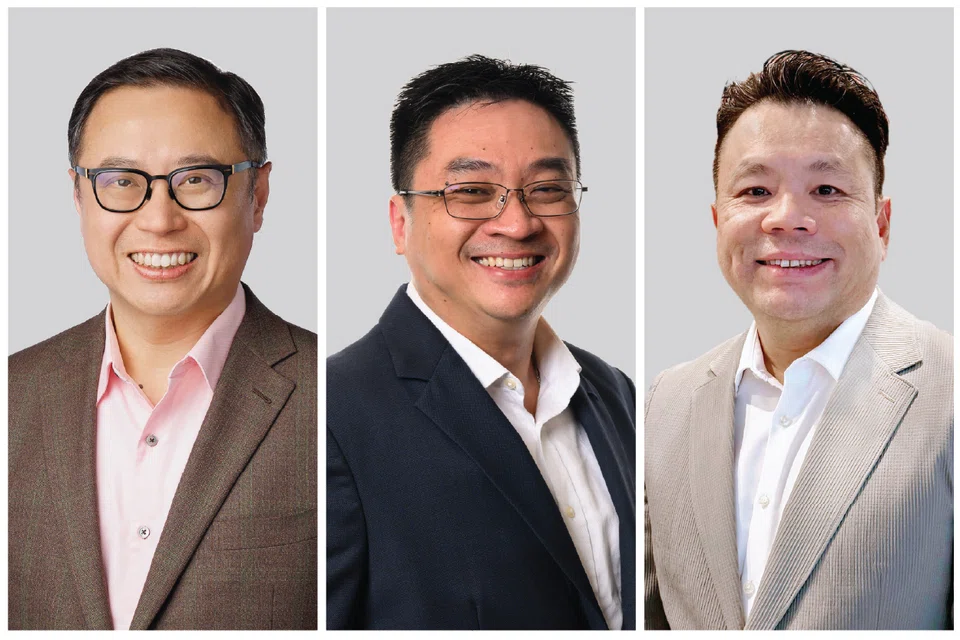
ROUNDTABLE PANELLISTS:
- Arthur Lang, group chief financial officer, Singtel;
- William Tan, group chief financial officer, Tiong Woon Corporation Holding;
- Jim Teh, group head, corporate development, Pan-United Corporation.
Moderator: Dylan Tan, editorial projects editor, The Business Times
IN AN environment marked by shifting interest rates and macroeconomic uncertainty, how are you evolving your capital allocation strategy to balance immediate operational resilience with the investments needed to drive long-term, sustainable shareholder value? Arthur Lang: Given the current macroeconomic uncertainty, we believe in having as much strategic optionality as possible. In order to create sustainable long-term value, we’re not choosing between resilience, growth or shareholder returns but building the capacity to deliver all three.
Active capital management is core to our ST28 strategy. Cash generated from operations and associate dividends continues to fund our business needs and at the same time ensure that we grow dividends and earnings in a sustainable manner.
At the same time, with AI taking hold, we are making considered investments in digital infrastructure and digital services. Rather than relying solely on balance sheet expansion, we are actively recycling our capital to fund growth and reallocate the capital to higher return businesses. We also work with private capital partners to co-invest in capital intensive businesses as evidenced by our multiple partnerships with KKR in the digital infrastructure space. In the last two years, we have unlocked 75 per cent of our S$9 billion mid-term asset recycling target so far. This provides additional capital to fund new growth opportunities and return capital to our shareholders while maintaining financial discipline.
Our active capital management strengthens business resilience, increases strategic optionality and supports sustainable shareholder returns over the long term. This is why S&P Global recently upgraded Singtel for the first time since the company was first rated by the agency, citing our regular asset recycling and anticipated earnings recovery as instrumental in sustaining our balance sheet strength and financial flexibility even as we manage elevated capital expenditure and increased shareholder distributions.
Jim Teh: Our strategy is to strike a balance between sustainable cash generation and ensuring financial resilience.
We work on three strategic pillars. First, we invest in human capital – our people, R&D and digital capabilities – to strengthen our core ready-mix concrete (RMC) & cement business and grow our technology subsidiary, AiR Digital Solutions. Second, we invest in our hardware – on recurring capital expenditure to maintain smooth operations and on strengthening our supply chain infrastructure to support the growth of our core business. Third, we ensure sustainable returns to our shareholders.
Being disciplined on these three priorities enables us to strengthen operational resilience, reinvest for future growth and create long-term value for our shareholders.
SEE ALSO




William Tan: For a capital-intensive business like Tiong Woon, capital allocation has to balance resilience with the willingness to invest through the cycle. Our approach is therefore not simply to reduce spending when uncertainty increases, but to be more deliberate about where every dollar of capital is deployed.
The first priority is to maintain a resilient balance sheet, adequate liquidity and sufficient financial flexibility to withstand volatility. At the same time, excessive conservatism can be counterproductive. Taking a long-term view, we continue to invest steadily and carefully where we see sustainable demand, particularly in productive assets, technology and capabilities that strengthen our core heavy lifting, transport and engineering businesses, to provide best-in-class integrated solutions to our customers.
We take a disciplined approach to assessing expected returns, cash flows, utilisation and downside scenarios, while also looking actively at capital recycling. Capital tied up in lower-return or non-core assets is redeployed where it can create greater value. This is reflected in how we manage our fleet: we continue to invest in equipment that expands our capabilities and supports expected demand, while divesting underutilised assets and redeploying that capital more effectively.
Our capital structure, financing mix and dividend decisions take into consideration our cost of capital, risk-adjusted shareholder returns and the need to preserve balance-sheet resilience.
Ultimately, I see capital allocation as an exercise in stewardship. The CFO’s role is not simply to minimise risk or maximise short-term earnings, but to ensure that today’s decisions preserve optionality while building the capabilities required for sustainable growth and long-term shareholder returns.
As artificial intelligence and digital tools reshape the finance function, how are you leveraging these technologies to drive strategic insights, while simultaneously managing the new types of risks they introduce?
Jim Teh: AI and digital tools sharpen our operational and financial insights to make better strategic and operational decisions. They also help us identify blind spots and areas to strengthen controls for risk management across the group. In the process, upskilling strengthens our people and helps improve their lives.
Managing the risks that come with AI and digitalisation is ultimately about developing a strong cybersecurity culture. We meet recognised international standards and continue to strengthen our cybersecurity capabilities as threats evolve. Getting to where we are today has been a continual process of building awareness across the organisation – of the importance of safeguarding organisational and personal data, the serious impact of a breach on our business and stakeholders, and the need to stay vigilant at all times.
Arthur Lang: The opportunity presented by AI goes way beyond productivity. Our finance teams are already applying AI to actual business problems and finding that its real value lies in extracting critical intelligence previously beyond our reach.
We are therefore looking at AI on several levels. There are immediate productivity gains, but we are also developing capabilities that can combine financial and operational information with external market, investor and competitive intelligence. The ambition is to move finance progressively from reporting what happened to anticipating what could happen next – which will put us on a front foot as we make a myriad of important decisions.
We recently ran a group CFO AI challenge which helped us to crystallise this thinking. One of the strongest lessons learnt was that we can move from visualisation to intelligence – use AI to synthesise information, identify what matters, surface options and support management decisions.
We encourage our people to embrace AI as a tool to free up their time and focus on higher-value work. At the same time, we’re mindful of the risks. We want to ensure people don’t see AI as a threat to their jobs or become overly reliant on it to the point where they stop thinking critically. AI should augment human capability, not replace human judgment.
Our measure of success will not be how much AI we use but whether AI helps us make better decisions, manage risk more effectively and create greater value.
William Tan: Technology is changing finance not so much by replacing professional judgment, but by changing where we spend our time and how much information we can analyse.
AI and digital tools can take on more of the searching, organising and processing of large volumes of structured and unstructured information. This can reduce time spent on repetitive work and allow finance professionals to focus more on identifying patterns and anomalies, understanding business drivers, evaluating risks and opportunities, and supporting management decisions.
For me, the objective is augmentation, not abdication. AI should sharpen human intelligence, not dull it. A model can process information at tremendous speed, but accountability for financial decisions cannot be delegated to an algorithm.
Professional scepticism, understanding of the underlying business and sound judgment remain essential.
The same technologies can also strengthen strategic insight by enabling finance teams to analyse larger datasets, test scenarios more quickly and identify emerging trends that may not be readily apparent through conventional analysis. The value, however, ultimately depends on the quality of the data, the questions being asked and the judgment applied to the output.
The risks are also evolving. Data confidentiality, cybersecurity, unauthorised access, model reliability, inaccurate or fabricated outputs and over-reliance on automated conclusions all require attention.
Governance therefore needs to develop alongside adoption, including clear rules on data usage, validation of important outputs and appropriate human oversight.
The bigger risk is a widening gap between professionals who learn to work effectively with AI and those who do not. Ultimately, competitive advantage will come not simply from access to AI, but from combining technology with trusted data, sound judgment and people who know how to ask the right questions.
The demands placed on the finance department have never been more complex. What is your strategy for upskilling your current team, fostering a culture of high ethics, and identifying the next generation of financial leaders?
William Tan: The finance professional of the future cannot be just a technically competent accountant. Technical foundations remain essential, but increasingly we also need commercial understanding, digital fluency, communication skills and the judgment to operate effectively when there may not be a textbook answer.
My approach is to work, learn and grow together. Formal training is important, but people often develop fastest when they are given meaningful responsibilities, stretch assignments, cross-functional exposure and the opportunity to participate in real business decisions. At Tiong Woon, our broader people-development priorities span technical excellence, digital literacy, collaboration, communication and leadership capability. We also use mentorship, cross-functional exposure and leadership development to broaden people’s perspectives and prepare high-potential employees for greater responsibilities.
Capability, however, has to be anchored in character. Integrity is never negotiable, but ethical behaviour also needs to be supported by the way an organisation is designed. We want to add good friction and remove bad friction – to make right things easier and wrong things harder. That means having appropriate controls, clear accountability and escalation channels, while removing unnecessary bureaucracy that prevents good people from doing the right thing efficiently. To me, this is also part of finance’s broader role of stewardship: protecting the organisation while enabling it to create value responsibly.
When identifying future leaders, I look broadly at competence, character and capacity to lead. Beyond technical ability, I look for people who take ownership, exercise sound judgment, remain curious, collaborate effectively, communicate clearly, demonstrate empathy and resilience, and develop the people around them.
Ultimately, succession planning should not be about identifying one replacement for one role. It is about continually building a deeper bench of people who are ready and trusted to carry greater responsibility when the opportunity arises.
As an engineer-turned-accountant operating in an environment characterised by profound volatility, uncertainty, complexity and ambiguity, I believe accountants have an important role to play as stewards of capital, corporate doctors and partners of business – to report, protect, rehabilitate and create value – and in so doing safeguard livelihoods and combat climate change.
Jim Teh: Again, it starts and ends with setting the right culture, and providing clarity on the role of every corporate function in Pan-United. We see ourselves as business partners and value creators, and as risk managers that identity blind spots in our respective functions. For the finance function, ethics and governance are non-negotiable priorities in everything we do.
When it comes to the next generation of financial leaders, we look for individuals who have a curious mindset and are committed to continual learning. They must be willing to challenge themselves and the business to continually improve, provide leadership in areas beyond core financial reporting, and stay grounded in integrity, ethics and good governance.
Arthur Lang: The finance professional of the future will need a different combination of capabilities. Strong financial fundamentals, professional judgment and integrity remain non-negotiable. But increasingly, our people will also need to know how to work with AI, interrogate data, challenge its outputs and convert information into business insight and action.
Financial professionals need to also be “sentient” to multiple stakeholders and their objectives as we navigate the company across complex environments. In order for this to happen, they must engage with their business partners, customers, stakeholders and other parties including bankers. I frequently encourage them to use AI for many of their mundane jobs and spend the time that is freed up to engage and communicate, which is something AI obviously cannot do.
In the past, finance people were trained to be good at reporting financial data and look at trends. Now they need to be the partner to the CEO or business head to drive business outcomes and see where the puck will be.
I’m willing to take calculated risks on people as I believe no one is ever 100 per cent ready for a job. Once I see a person is about 80 per cent there, I’m happy to give them the opportunity to step up, grow into the role and shine.
Ultimately, high-performing finance people should also be goalkeepers who score goals.
Investors are increasingly focused on both financial and non-financial metrics. How are you leading your organisation to go beyond baseline regulatory compliance to tell a cohesive, transparent story about your sustainability and overall value creation?
Arthur Lang: I have always been an advocate for transparent and measurable disclosures because trust is built when investors understand how long-term value is being created. Going beyond compliance is about giving investors a clear line of sight to the drivers of value creation and the progress being made against set targets.
We engage consistently with the investment community and have broadened our outreach to retail investors through multiple platforms including social media and financial influencers, making our story more accessible to a wider audience.
But transparency is not just about reach. It is about being clear and authentic to all investors. Where we have done well, we should explain why. Where we have not done so well, we should be open and humble enough to tell it as it is and be clear on what we are doing about it.
We have provided guidance for more than a decade and have continued to refine it alongside business priorities and investor expectations. In addition to financial guidance, we disclose operating and medium-term metrics that help investors track value creation over time.
We take the same pragmatic approach to sustainability reporting. As one of the first companies in the region to adopt IFRS S2, we view sustainability disclosures as an important way to understand long-term risks, opportunities and resilience. In an increasingly complex geopolitical environment, societal impact can no longer be treated as an ESG metric. We have to look at it as a strategic risk that affects business decisions and long-term value creation.
Transparency is about helping investors make the connection between today’s decisions and tomorrow’s value.
Jim Teh: For Pan-United, sustainability is not a good-to-have. It is a must-have. It is central to our purpose to decarbonise the world with concrete. It is core to our business strategy and decision-making.
Through product and process innovation, we pursue low-carbon concrete technologies that can help reduce the carbon footprint of development projects and the built environment. Today, low-carbon concrete solutions constitute over 60 per cent of our concrete business.
We continue our R&D into developing concrete using recycled and waste materials to sustain circularity. We also establish benchmarks and measurements to track carbon emission reduction, among other initiatives such as renewable energy usage and energy-efficient projects. Our scientists and engineers are developing next-generation concrete solutions to address broader sustainability challenges such as climate resilience.
Our sustainability culture creates value on two fronts. Commercially, our low-carbon technologies help customers meet sustainability targets and green certification requirements. In the process, deepening our business relationships and creating new revenue opportunities. Operationally, we lower costs through more efficient use of energy and resources.
William Tan: I believe sustainability is most meaningful when it is integrated into how a business creates value, rather than treated as a separate reporting exercise.
For an asset and people-intensive business such as ours, issues such as workplace safety, workforce capability, fleet utilisation, fuel and energy efficiency, asset renewal, governance and risk management ultimately have financial consequences. The objective is therefore to help stakeholders understand the relationship between these operating fundamentals and our long-term financial performance.
Finance has an important role in bringing measurement discipline, controls and accountability to this process. FY2025 marked our inaugural application of IFRS S2 climate-related disclosures, building on our existing TCFD-based (Task Force on Climate-Related Financial Disclosures) climate analysis and further embedding sustainability considerations into risk management, strategic planning and investment decisions.
The objective is not simply to produce more disclosure, but to connect non-financial measures to the risks, decisions and economic outcomes that matter to the business.
Transparency also means resisting the temptation to present only favourable indicators. Investors should be able to understand the trade-offs, risks and assumptions behind our strategy.
For me, good corporate reporting should ultimately answer a relatively simple question: how does the company deploy its financial, physical and human resources today to create sustainable value tomorrow? When that story is coherent, sustainability reporting becomes part of the broader value-creation narrative rather than merely a compliance requirement.
Decoding Asia newsletter: your guide to navigating Asia in a new global order. Sign up here to get Decoding Asia newsletter. Delivered to your inbox. Free.
Copyright SPH Media. All rights reserved.