Striking the right balance: Strategy, culture, and continuity at the highest level
Gold winners at the Singapore Corporate Awards 2026 reveal how they balance short-term pressures with long-term resilience, foster constructive boardroom culture, and ensure robust succession planning

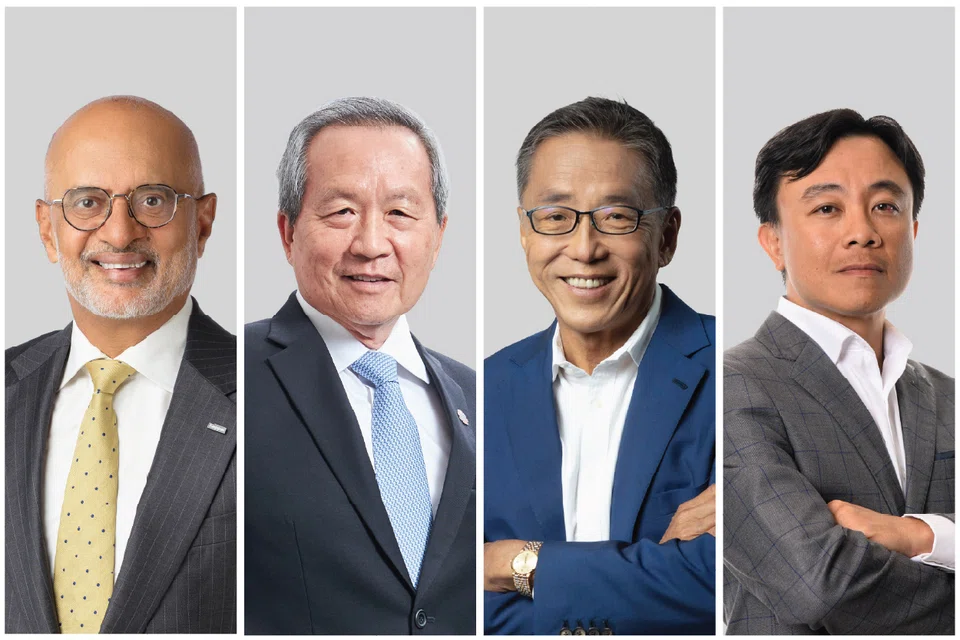
ROUNDTABLE PANELLISTS:
- Piyush Gupta, chairman, Keppel;
- Teo Ming Kian, chairman, Singapore Technologies Engineering;
- Ho Kwon Ping, founder and executive chairman, Banyan Group;
- Michael Ang, executive director and chief executive officer, Tiong Woon Corporation Holding.
Moderator: Dylan Tan, editorial projects editor, The Business Times
Amid global uncertainty and rapid technological disruption, what key trends are the board watching most closely, and how are you guiding the company to balance short-term performance pressures with long-term strategic goals?
Piyush Gupta: We have to distinguish between long-term trends and shorter-term disruptions. Geopolitics will remain unpredictable in the foreseeable future and technology will continue to be disruptive. But some fundamental needs will not change. People will continue to need energy, connectivity and conducive places to live, work and interact. Climate change, the energy transition, AI and digitalisation are changing how those needs are met, and these macrotrends create opportunities for companies like Keppel.
The question is how we pursue these opportunities with discipline. Real assets can be very capital intensive. Our asset management model allows us to invest alongside our limited partners (LPs) and scale our operating businesses without having to fund everything ourselves. This creates opportunities for our LPs, and also for Keppel as we grow our funds under management, as well as our recurring income.
From the board’s perspective, we need to focus on positioning the company for the long term, while also delivering results today. That is reflected in how the company’s performance is measured and management is remunerated. Our corporate scorecard takes into account both near-term financial and non-financial outcomes as well as longer-term strategic priorities. For example, we have announced our 2030 targets for funds under management and asset monetisation and are working towards them.
Teo Ming Kian: Creating long-term shareholder value is the key focus of the board and the company as a whole. That means building sustainable competitive advantages not just for today but positioning ourselves for the future through clear thought-out strategy, capability building with R&D, innovation, talent and brand equity, conscious at all times of the risks, and our responsibility on ESG.
As a global company with our stated purpose of harnessing technology and innovation to enable a more secure and sustainable world, we cannot but stay abreast with the rapid and accelerating technological advancements, geopolitical tensions and the disruptions that they could cause. Such a challenging environment calls not just for an unwavering focus on our long-term goals, but our agility and nimbleness to navigate hurdles along the way.
Fortunately for ST Engineering, coming to 60 years old, established as a technology multiplier for the Singapore Armed Forces (SAF) in 1967, innovativeness and resilience have been baked into our culture and value system. Despite the many challenges we faced and overcame in these years, we have since built a strong heritage of developing solutions for customers across defence, critical infrastructure, aerospace and smart cities.
SEE ALSO



The board will continue this heavy responsibility to build on this strong foundation with an eye cast to the future, but also on the obstacles that could trip us up along the way.
Ho Kwon Ping: The confluence of three current trends may create a tipping point for unprecedented disruption: First, there will be a civilisational reset as Western civilisational dominance over the past several centuries gives way to more co-equal and competing civilisations, not only in geopolitical or geoeconomic power balance, but also in societal values and notions of governance. Second, climate change has shifted the focus from mitigation to urgent climate adaptation – a distressing but urgent reality for which most people and companies were unprepared. Third, AI is not a tsunami destroying everything in its wake but is more like evolution at warp speed – accelerating change faster than anything we’ve experienced before. These may seem to be super-macro global trends but they’ll impact even small companies like ours, so we’re assessing the implications of each trend on our current and future business.
Short term vs long term? As I observed above, with AI as an accelerant for evolution at warp speed, it’s becoming harder to define what is short or long term anymore. We really have to think on our feet, be creative with scenarios, and be ready to execute the meaning of crisis in Chinese (wei ji): something which brings both danger (wei) and opportunities (ji).
We cannot predict exactly what will happen. The question is whether we are prepared for what we cannot predict.
Michael Ang: The board is closely monitoring geopolitical and trade uncertainty, changes in demand across our core sectors, cost and financing pressures, and the pace of technological change. We are also watching opportunities in sectors such as data centres, semiconductors, infrastructure and specialised logistics, while remaining mindful that demand can vary across markets and project cycles. As an asset-heavy business operating in Singapore and the region, we must continue to improve safety, reliability, productivity and customer service while managing our fleet and capital carefully. To balance near-term performance with long-term priorities, the board reviews financial and operational performance together with progress against the group strategy. Capital is allocated selectively to fleet renewal, technology, people development and regional growth where there is a clear business case.
What specific risk management frameworks and governance practices has the board established in recent years, and how do you foster a board culture that encourages constructive pushback to safeguard the company’s success?
Ho Kwon Ping: In 2025, we reviewed our Tier 1 risks, including the controls in place and plans for improvement. We also established key risk indicators, which are tracked as lead indicators and reported to the audit and risk committee.
On governance, six of our 10 directors are independent. They meet at least twice a year without management and without the non-independent directors to assess management’s performance, with feedback coming back to me through the lead independent director. Our non-executive directors also meet quarterly without management.
But structure alone doesn’t produce candour. You have to ask for it. I tell people, “I need your feedback, and I need you to disagree with me,” because my own family will tell you I can otherwise dominate a room. As chair, I try to shepherd the discussion back to first principles, breaking the problem into clear, logical parts before emotion or ego gets in the way.
Michael Ang: The group maintains a risk management process to identify, assess and monitor key risks, including market, credit, operational, safety, regulatory, cyber and climate related risks, reviewed periodically with oversight by the board and relevant board committees. A sound governance culture also depends on open discussion. Directors are encouraged to challenge assumptions, ask for supporting evidence and raise concerns early, with relevant committees providing additional review in their respective areas.
Piyush Gupta: Risk management is not about avoiding risks. Any company that wants to grow has to take risks. The important thing is to understand what risks you are taking, why you are taking them and where you draw the boundaries.
At Keppel, this is anchored by our board risk appetite framework, with clear key risk indicators and defined thresholds across financial and non-financial dimensions. The board risk committee regularly reviews emerging risks through deep dives into geopolitical developments, cybersecurity, artificial intelligence and business transformation risks. But frameworks only take you so far. Good risk governance depends on the quality of the discussion around the table. We encourage directors to challenge assumptions, test different scenarios and robustly debate the risk-reward trade-offs. Constructive pushback is important as it can lead to better decisions.
Ultimately, the board’s role is to give management clarity on the company’s risk appetite and the confidence to operate within it. If we get that balance right, it would allow management to retain the entrepreneurship and innovation needed to grow, while maintaining the discipline necessary to protect long-term value.
Teo Ming Kian: Our customers rely on us to keep aircraft flying, strengthen defence capabilities and support critical infrastructure where reliability, safety and resilience are paramount. This places a premium on strong governance, disciplined risk management and a clear focus on emerging risks. Trust is hard earned and none on the board and in the company would want to put that at risk.
We encourage constructive debate and diverse perspectives, because better decisions emerge with robust and open discussions. In a rapidly changing environment, the board’s role is not only to oversee risk management, but to ensure the company remains trusted, resilient and relevant for the future.
How does the board objectively measure its own success and align director compensation with shareholder interests, while simultaneously ensuring robust succession planning for long-term continuity?
Michael Ang: The board conducts an annual evaluation covering the board as a whole, its committees and the contribution of individual directors, with a focus on board composition, meetings’ effectiveness, quality of information, oversight and decision making. Director remuneration is reviewed through a formal and transparent process. Independent directors receive fees that reflect the scope of their responsibilities and commitment. Executive director remuneration is aligned with the role, company performance and individual contribution, and is reviewed and approved by the remuneration committee to ensure it supports long-term value creation and shareholder interests. Succession planning is overseen by the nominating committee and covers board renewal, leadership continuity and the development of internal talent, with ongoing review to ensure the organisation remains well positioned for the future. While the processes are there, there is always room for improvement. The marketplace changes at an increasing pace, but we are also cognisant that the changes/strategies need to be balanced, gradual and evidenced-based.
Teo Ming Kian: A board should ultimately be judged by whether the company is fundamentally stronger and better positioned for the future than when it assumed stewardship. That means creating sustainable shareholder value, maintaining high standards of governance, and ensuring a strong pipeline of leadership. Succession planning is critical and is an ongoing responsibility of the board.
Directors receive part of their remuneration in company shares, aligning their interests with shareholders.
Ho Kwon Ping: We have a formal annual process to assess the effectiveness of the board, its committees and individual directors. The evaluation uses objective criteria including open communication, meaningful participation and rigorous decision-making. To preserve the independence of the overall result, I abstain from completing the board evaluation questionnaire.
Remuneration is overseen by an entirely independent remuneration committee, with appropriate safeguards to manage conflicts of interest, and no director is involved in deciding his or her own remuneration. Non-executive director fees are independently benchmarked and subject to shareholder approval, while performance-related remuneration for executive leadership is linked to corporate and individual performance and long-term value creation.
Succession is treated with the same discipline. The nominating committee reviews succession plans for the board and senior management, particularly the chairman, CEO and key management, alongside board renewal, director development and the skills needed for the group’s future.
Piyush Gupta: I believe that a good board has to be willing to assess itself as rigorously as it assesses management. At Keppel, we conduct a structured annual evaluation process led by the chairman of our nominating committee, who used to be our non-executive and lead independent director, but I have taken over the chairmanship from July this year. Every director contributes quantitative and qualitative feedback on areas including board composition and independence, governance, risk, CEO oversight and succession planning. From time to time, we bring in independent consultants to facilitate the review and provide an external perspective. The findings support the board’s continual improvement, renewal and succession planning.
The nominating committee regularly reviews the skills, experience and diversity we need for where Keppel is going, supported by rolling diversity objectives and external search consultants where appropriate.
To ensure that directors’ interests are aligned with shareholders, non-executive directors receive 30 per cent of their fees in Keppel shares, and from FY2026, we have introduced a minimum shareholding requirement for the chairman and non-executive directors during their board tenure, which is equivalent to a year of the board member’s basic fee or the total number of shares awarded, whichever is lower. Our fee structure is also periodically benchmarked against comparable listed companies and prevailing market practrices, with advice from independent external consultants.
The key thing is to plan for renewal and succession, well before the need arises. That is how we build continuity over the long term.
With evolving regulatory expectations and polarising views on ESG, how does the board find the right balance to integrate sustainability into the broader business strategy and persuade leadership to actively stay the course?
Teo Ming Kian: A company cannot exist alone and must take its responsibility in the community, and the world at large seriously. We believe in this, and this is reflected in our purpose statement to enable a secure and sustainable world. Therefore, the board and the company fully subscribe to the importance of ESG, which takes into account the interests of all stakeholders. Sustainable shareholder returns can only be achieved when a company operates on sound ESG principles. As such, sustainability is embedded in our strategy and informs how we make decisions, invest and grow.
Beyond our own operations, many of the solutions we develop help customers build smarter, more efficient and more sustainable communities. Sustainability is therefore not just about how we run our business, but also about the impact our business creates.
Piyush Gupta: The debate around ESG has become more polarised. But I think one has to separate discussions about the ESG label and how granular disclosure requirements should be, from the underlying issues such as climate change, energy and water security, and resource constraints. These challenges are real, and need to be addressed.
For Keppel, the question is quite simple: does sustainability make the business more resilient and future-ready, and are there business opportunities for Keppel to provide solutions that can help to address these global challenges? The answer to both questions is yes.
You can see this in areas such as power and data centres. Our hydrogen-compatible Keppel Sakra Cogen Plant allows us to provide reliable power today with one of Singapore’s most efficient power plants, while retaining flexibility as the energy transition evolves. Our Floating Data Centre project is another example of addressing in a practical manner the land, energy and water constraints associated with data centres, which the world needs, especially with growing AI adoption.
Of course, there are trade-offs to be made. Not every sustainable solution may be immediately commercially viable, and the transition may not happen in a straight line. Boards have to be clear-eyed about that.
So I would not frame this question as persuading management to stay the course on ESG. Sustainability has already been embedded in Keppel’s strategy, in how we manage risks, and how we create value. The role of the board is to continue to focus on areas where sustainability initiatives make commercial sense, strengthen our operations and create long-term value for our stakeholders.
Michael Ang: The board oversees the group sustainability priorities, governance and reporting, focusing on matters relevant to the business, including safety, energy use, climate related risks, workforce development and responsible operations. We have taken practical steps such as using solar energy, improving energy efficiency, renewing equipment and investing in employee training. Not every initiative will deliver an immediate financial return, so the board focuses on priorities and targets that are realistic, properly resourced and monitored.
Ho Kwon Ping: For over three decades, sustainability has been integral to how we operate and create value. We have always taken a broader view, beyond carbon and climate to include social and economic sustainability, how we treat our associates, and how we contribute to the communities and ecosystems on which our destinations depend.
These are our fundamental values, and the board’s role is to ensure they remain embedded in the group’s strategy and decision-making. We began sustainability reporting 20 years ago, well before it became a regulatory requirement, and sustainability and climate-related risks are integrated into our enterprise risk management framework with board oversight.
Last year, we established a dedicated corporate sustainability & impact function and completed our first double materiality assessment, with board participation and validation of the resulting material topics. The findings informed our inaugural Sustainability Impact Lab, bringing leaders across the group together to set priorities from 2026 and advance a more enterprise-wide, impact-led approach. Sustainability KPIs are also built into performance management and remuneration.
When that discipline is part of how the business is run, the label itself matters much less. That is what keeps us on course even as the debate around ESG changes.
Decoding Asia newsletter: your guide to navigating Asia in a new global order. Sign up here to get Decoding Asia newsletter. Delivered to your inbox. Free.
Copyright SPH Media. All rights reserved.