

Bright skies ahead for Clean Kinetics’ global growth
Energy SME aims to use solar power for social good
Annabeth Leow
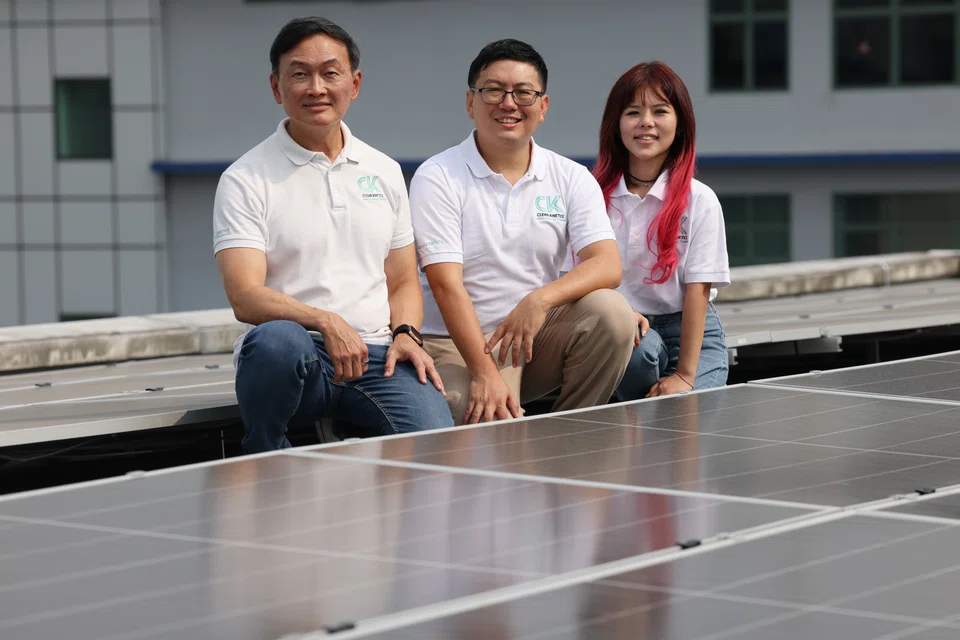
[SINGAPORE] Small and medium-sized enterprises (SMEs) may find the solar panel business a tough market, but homegrown Clean Kinetics punches confidently above its weight.
That’s because “scale of impact does not require scale of size”, said chief development officer Lee Kah Lup.
“What it requires is the willingness to commit to difficult markets, a partnership model that assembles the right capabilities for each opportunity, and a culture where every contractual commitment is treated as non-negotiable.”
Clean Kinetics nabbed the title of Impact Enterprise of the Year (SME) at the Sustainability Impact Awards 2026, which are jointly organised by The Business Times and UOB.
Co-founded in mid-2021 by Lee Kah Lup, Wilson Lee and Reine Tan, Clean Kinetics produces clean electricity across South-east Asia and the Middle East, with a specific focus on the energy needs of social services such as schools and public transit networks.
The startup aims to align its solar projects with industry verticals where “clean infrastructure can deliver the clearest public good”, explained Tan, who serves as the business team lead.
“That alignment with purpose is what draws our team to this work.”
Unconventional markets
Clean Kinetics does not shy away from entering markets that may pose what chief engineering officer Wilson Lee described as “greater entry complexity for an SME”.
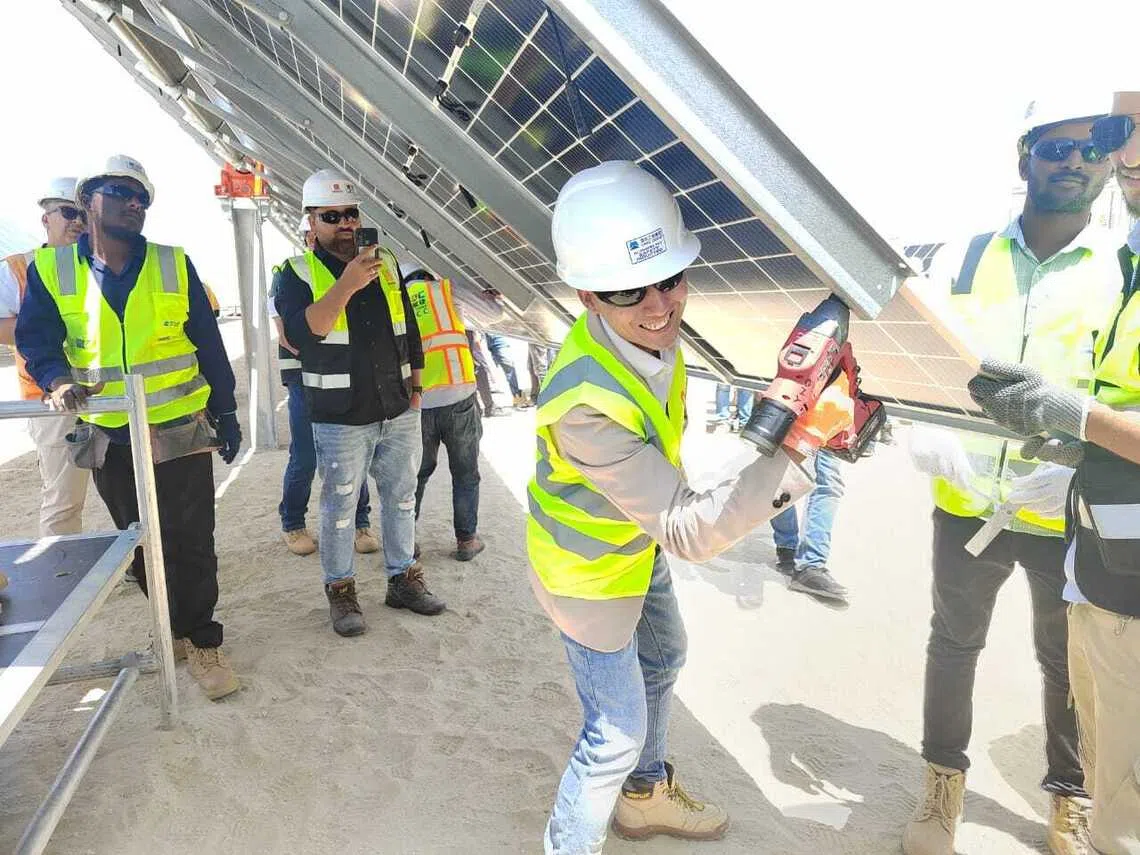
Notably, the company ventured into the Middle East in 2024, with Saudi Arabia, Jordan, Dubai and Qatar now jointly making up about 20 per cent of group revenue.
SEE ALSO










Ongoing hostilities in the region, which broke out in end-Feb 2026, have created “real operational challenges” for the team, Wilson Lee acknowledged.
“During the initial months of heightened tensions earlier this year, air travel restrictions and logistics disruptions affected site access and supply chains,” he recounted. “Some of our ground-mounted solar installations also sustained damage from aerial debris.”
Even so, the management’s resolve to invest in this market remains unshaken.
Wilson Lee affirmed that “we regard our Middle East presence as a long-term commitment”, with Clean Kinetics still pursuing more opportunities regionally.
He noted that the company was able to meet its contractual obligations despite the conflict – including completing a 154 megawatt-peak (MWp) solar project in Saudi Arabia ahead of schedule.
Clean Kinetics also expanded into Thailand and Malaysia in 2025.
South-east Asia now contributes about 10 per cent of group revenue, and the company is exploring opportunities in neighbouring Brunei, Vietnam, the Philippines and Indonesia.
Its unconventional market strategy has paid off.
The top line came to S$15.3 million in the 12 months to Mar 31, 2025 – up from S$365,000 three years prior – and Clean Kinetics is on track to deploy 300 MWp of clean energy solutions across its portfolio in 2026, according to Wilson Lee.
Laying out one pillar of the growth strategy, he said: “We are deepening our presence in existing markets through newly established local offices, which give us stronger on-the-ground relationships and faster response to project opportunities.”
But the business model is not limited to supplying or installing solar panels.
Through a partnership with ST Engineering, where Lee Kah Lup was previously a former vice-president of marketing, Clean Kinetics taps technology such as artificial intelligence to monitor and maintain the solar installations for as long as their full 25-year lifespan.
Clean Kinetics’ involvement doesn’t stop at the end of the product life, either.
It is piloting an initiative to examine how silver, copper, silicon and aluminium can be recovered from ageing solar systems for industrial recycling by specialised partners, to be reintroduced into the supply chain.
The company is studying the feasibility of scaling up solar recycling across its portfolio, which Lee Kah Lup noted “would enable us to integrate this capability directly into our core operations”.
Clean Kinetics is also in talks with regulators and industry bodies about the implications of its recycling initiative on the management of solar energy systems.
Said Lee Kah Lup: “The approach is directly replicable across the wider industry in Singapore and across Asean, where similar end-of-life challenges will emerge as regional solar adoption matures.”
Since Clean Kinetics is already involved in installing solar systems, “we should take responsibility for decommissioning them responsibly at end of life”, he told BT. “That closed-loop model is what we are building towards.”
Indeed, he observed that solar recycling changes what used to be a disposal cost borne by clients. Now, it “has been repositioned as a contribution to their circular economy targets” instead.
“For our recycling partners, this has created a revenue category that did not commercially exist for them before and that matters for the long-term viability of specialised solar recycling in Singapore.”
Solar for social good
To stay ahead of saturation in a maturing solar installation market, Clean Kinetics is also counting on collaboration in other areas where energy solutions can deliver social impact. “We are also deliberately broadening our scope beyond solar,” said Wilson Lee, noting that industry partnerships help broaden the company’s scope, while green mobility, smart parking and water infrastructure are avenues to augment the core business.
He said: “These adjacencies allow us to serve the same government and institutional counterparts we already know well, while positioning Clean Kinetics ahead of market saturation.”
That’s as Clean Kinetics has inked deals in Jordan to own and operate electric vehicle (EV) charging stations, and to offer smart parking solutions in commercial districts.
Such a setup does not simply allow the company to capitalise on adjacent capabilities. Instead, EV chargers are directly integrated with the solar installations – ultimately “creating integrated clean energy ecosystems rather than standalone installations”, as Tan put it.
The company also aims to green public transit by deploying Jordan’s first electric school buses, which will replace diesel vehicles for some 10,000 students.
“The current two-year pilot is designed as a foundation for long-term fleet growth across Jordan’s public school system,” said Tan, adding that exposure to EVs from young can build up “familiarity with clean mobility in a region historically dependent on fossil fuels”.
Beyond transport, Clean Kinetics has installed solar panels at more than 30 schools in Singapore, as well as in Chiang Mai and Chiang Rai in Thailand, and Sandakan in Malaysia.
Switching to solar power can lower energy bills by 30 per cent to 40 per cent, and the funds saved can be redirected to student welfare and educational resources, Tan told BT.
Existing solar installations on school campuses may even bring in more business by piquing the interest of commercial and residential property owners – as she observed: “Each new school we install becomes a visible demonstration site for the communities around it.”
Moreover, these international initiatives “are structured for expansion, not just completion”, Tan emphasised.
For instance, Clean Kinetics is now pursuing water and bus opportunities in Jordan, which she noted “would significantly broaden what we deliver in that market”, on top of growing its EV charging and smart parking footprint and “building on an established platform”.
Other long-term plays include Bhutan, where Clean Kinetics has embarked on a joint venture to build and supply 500MWp of solar power to the grid under a 30-year purchase agreement.
This deal is expected to help Bhutan meet emerging data centre infrastructure needs with a utility-scale solar farm, Tan told BT.
“We are working closely with Bhutan’s government authorities to ensure phased delivery aligns with the kingdom’s national clean energy strategy and its emerging data centre infrastructure needs,” Tan said.
“It is a sovereign relationship we are building for the long term, and it will anchor our presence in the broader region,” he added.
Clean Kinetics credits the scope of its portfolio to a deliberately wide network of stakeholders, including ST Engineering and Chinese electric bus manufacturer Higer.
These partners offer capabilities in their own domains of expertise that Clean Kinetics does not have, while “we bring them genuine project opportunities in markets they may not have entered on their own”, Tan said.
“The fact that we have delivered against difficult commitments in challenging markets is what keeps the network strong.”
Added Wilson Lee: “We are actively building new local networks in each country to develop the next wave of opportunities.”
Nimble and niche
Wearing its size as a badge of honour, Clean Kinetics pitches itself as a smaller, more agile enterprise able to deliver projects in markets that may be too risky for its competitors.
Larger companies may steer clear “because the project scale, sovereign counterpart risk, and regulatory complexity sit outside their standard investment criteria”, said Lee Kah Lup, while most SMEs do not have the capital commitment and operational depth needed.
But he is confident in the investment case for Clean Kinetics and the strength of its pipeline.
Having raised S$4.3 million in Series A funding, it is now in active talks with prospective investors, and has netted S$1.75 million in pre-Series B commitments from shareholders.
“Clean Kinetics occupies a position in the market that is genuinely difficult to replicate,” Lee Kah Lup told BT. “Sustainability is not a reporting exercise for us. It is the business itself.”
Decoding Asia newsletter: your guide to navigating Asia in a new global order. Sign up here to get Decoding Asia newsletter. Delivered to your inbox. Free.
Share with us your feedback on BT's products and services
TRENDING NOW
Companies still in search of AI use cases with worthwhile ROI, says Broadcom’s CEO
Malaysian king buys stake in Singapore-listed mining firm expanding into rare earths

Once staunchly pro-China, Malaysian Chinese businesses are now distancing themselves from Beijing

Singapore’s wealth management success should extend to everyday families

