

‘Retrofit-first’: Stolz Engineering optimises old cooling towers with sensor, AI-powered platform for energy savings
The company plans to deploy the platform by Q1 2027
Koh Kim Xuan
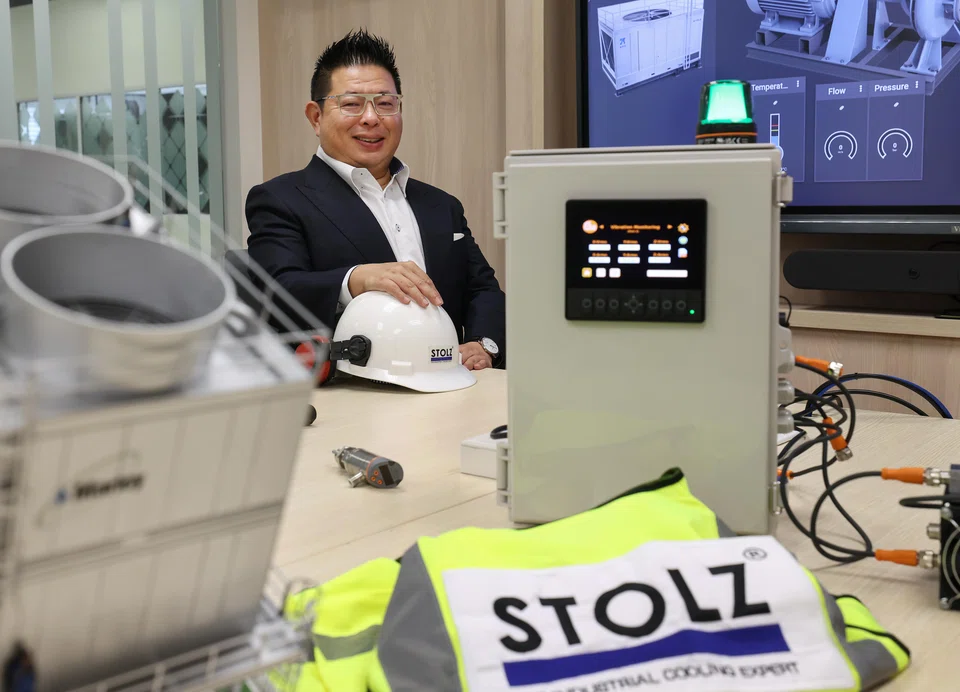
[SINGAPORE] As companies with large-scale industrial operations in Asean face mounting pressure to meet decarbonisation targets, many may opt for replacement of existing, inefficient cooling towers, which can be disruptive and costly.
To this, engineering services provider Stolz Engineering developed a solution that transforms old cooling towers into sustainability assets through technology.
Named the “Smart Cooling Tower IoT (Internet of Things) Sustainability Framework”, it integrates existing operational data, where available, with additional non-invasive IoT sensors installed on cooling towers.
Using data from the sensors, the platform automates the optimisation of cooling tower functions such as adjusting fan speeds. Information generated can also be reviewed by or guide operators to further improve the facilities.
Stolz’s solution follows the “retrofit-first” sustainability approach, which prioritises improving existing buildings to enhance sustainability over demolition and rebuilding.
“Our philosophy is that you must be able to measure before you can improve,” said Stolz founder and chief executive officer Mark Tan.
'%3e%3cpath%20d='M12.1475%2025.5262C13.7713%2025.4295%2014.94%2023.913%2014.94%2021.8832C14.94%2019.5359%2013.474%2018.093%2011.5917%2018.093C11.3745%2018.093%2010.9582%2018.093%2010.8393%2018.1413V25.2086L11.8891%2025.5745C11.8891%2025.5745%2012.207%2025.5262%2012.1475%2025.5262ZM11.4934%2017.6281C13.2567%2017.6281%2014.3843%2016.4292%2014.3843%2014.4501C14.3843%2012.372%2013.275%2011.2973%2011.4339%2011.2973H10.8393V17.6305H11.4934V17.6281ZM6.66078%2025.6482L7.39265%2025.5492C8.02617%2025.4502%208.26403%2025.3053%208.26403%2025.1097V11.6149C8.26403%2011.4193%208.1451%2011.3709%207.23484%2011.249L6.68137%2011.173L6.6219%2010.7588H11.9508C15.7153%2010.7588%2017.0624%2012.0797%2017.0624%2014.1578C17.0624%2015.9666%2015.7748%2017.1909%2013.4969%2017.6305V17.7041C16.111%2017.948%2017.6571%2019.5382%2017.6571%2021.7636C17.6571%2024.3318%2015.8937%2026.0417%2012.1109%2026.0417H6.60132L6.66078%2025.6482Z'%20fill='%232B2B2B'/%3e%3cpath%20d='M20.6287%2025.6505L21.5596%2025.5515C22.1725%2025.4779%2022.4104%2025.3076%2022.4104%2025.112V11.249H21.9346C20.073%2011.3479%2018.982%2013.0095%2018.408%2014.6227L18.1907%2015.5018H17.6555L18.1701%2010.7588H29.3837L29.6421%2015.4787H29.1664L28.9491%2014.6227C28.3728%2012.8645%2027.3047%2011.2743%2025.5002%2011.249H24.9856V25.1856C24.9856%2025.3812%2025.1251%2025.4548%2025.9965%2025.5515L26.7695%2025.6505L26.829%2026.0417H20.5693L20.6287%2025.6505Z'%20fill='%232B2B2B'/%3e%3c/g%3e%3cdefs%3e%3cclipPath%20id='clip0_5242_21648'%3e%3crect%20width='24'%20height='16.8'%20fill='white'%20transform='translate(6%2010)'/%3e%3c/clipPath%3e%3c/defs%3e%3c/svg%3e)
Established in 2007, the company has supported an installed base of more than 1,000 cooling towers across Singapore and the region, with operations in Singapore, Malaysia and Thailand. Its clients include a large semiconductor plant in Woodlands, pharmaceutical plants such as Pfizer, Lonza and GSK, and data centres operated by Global Switch and Singtel.
Stolz won an Impact Enterprise Excellence Award (SME) at the 2026 Sustainability Impact Awards, jointly organised by The Business Times and UOB.
The award recognises businesses and individuals who have had a positive impact on the environment and community.
SEE ALSO










The firm aims to deploy the AI-integrated platform by Q1 2027. Within two years, Tan aims to implement the solution across its 1,000 facilities in Singapore.
How it works
IoT field sensors and instruments are mounted on towers. They track temperature, water usage and pressure, weather and mechanical health of cooling infrastructures. Raw data from these physical sensors is then transmitted through an IoT gateway that delivers the information onto a cloud platform.
Artificial intelligence (AI) then turns the data into meaningful insights human operators can act on. Information is visualised as real-time dashboards, alerts and reports, and environmental, social and governance insights.
According to the company, the framework enhances operational visibility, reduces energy demand and lowers carbon emissions and extends asset lifecycle performance.
It validated the platform through a proof-of-concept (POC) using a cooling tower from educational institution Singapore Polytechnic.
The sensors and platform were tested under actual operating conditions.
Based on the proof-of-concept results, Stolz estimates that applying the framework to a 40-cell cooling-tower installation with a combined capacity of approximately 60,000 refrigeration tonnes could potentially deliver annual energy-cost savings of up to S$2 million, depending on its operating profile, electricity tariff and achievable optimisation..
The proof of concept demonstrated up to 47.5 per cent fan-energy savings under the tested operating conditions. When applied at scale, such optimisation could deliver significant energy, cost and carbon-emission reductions, subject to each facility’s load profile and operating conditions.
“Cooling has become increasingly important especially for emission critical industries. It needs to be consistent,” said Tan, raising AI data centres and semiconductor plants as examples of facilities requiring intense cooling. He added: “The question right now is not so much about how companies can provide more cooling, but how it can be provided responsibly and more sustainably.”
Plans for Asean
As the platform aims to reduce energy demand and carbon emissions by buildings, Stolz sees it supporting the Singapore Green Plan 2030. The firm believes that Singapore’s sustainability challenge is not only to develop new green infrastructure, but also to improve the performance of existing infrastructure already operating today.
Beyond Singapore, the company plans to roll out the platform for cooling towers across Asean, particularly Malaysia and Thailand where the company already installs towers. The framework is scalable across Stolz Engineering’s regional operating presence in Singapore, Malaysia and Thailand, supporting lower energy demand, improved operational resilience and more practical climate adaptation pathways across climate-vulnerable Asean regions.
Decoding Asia newsletter: your guide to navigating Asia in a new global order. Sign up here to get Decoding Asia newsletter. Delivered to your inbox. Free.
Share with us your feedback on BT's products and services
TRENDING NOW

Companies still in search of AI use cases with worthwhile ROI, says Broadcom’s CEO

Malaysian king buys stake in Singapore-listed mining firm expanding into rare earths

Once staunchly pro-China, Malaysian Chinese businesses are now distancing themselves from Beijing
Singapore’s wealth management success should extend to everyday families

