

Capital was yesterday’s problem in Asean’s energy transition. Where it lands is today’s challenge
Sustainability Impact Dialogue panellists say region needs bankable projects and clearer rules

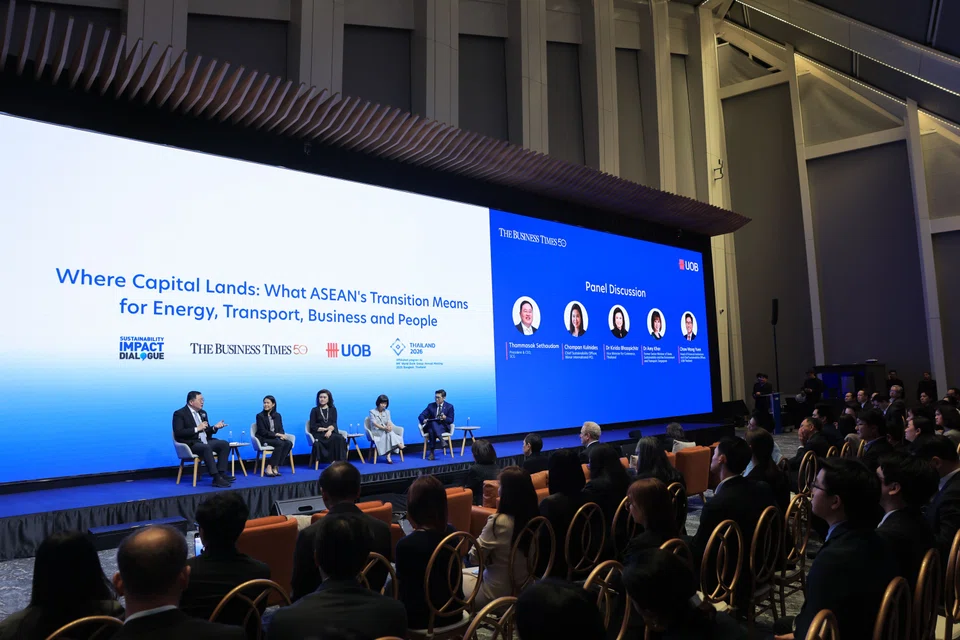
[BANGKOK] For all of the global capital eager to fund South-east Asia’s energy transition, financing tends to flow not simply to where emissions are highest or where it is needed most socially – but to projects that can deliver viable returns.
The challenge nowadays is increasingly less about liquidity or ambition than of project bankability, infrastructure readiness, taxonomy standardisation, policy clarity, regulatory certainty, risk-sharing mechanisms and commercial returns.
This tension ran through a panel discussion on Asean’s energy transition at the latest edition of the Sustainability Impact Dialogue on Wednesday (Sep 30) evening in Bangkok.
Policymakers and business leaders debated where the most attractive investment opportunities lie, what signals to watch for, how governments and the private sector should share the burden, and who ultimately foots the bill for lower-carbon production.
Panellists pointed to a series of trade-offs that will shape how quickly Asean’s transition moves: between environmental gains and commercial returns; upfront costs and long-term competitiveness; speed of policy direction and lead time; as well as regulation and room for tech developments.
Jointly organised by The Business Times and UOB Thailand, the session was centred on the theme “Where Capital Lands: What Asean’s Transition Means for Energy, Transport, Business and People”.
'%3e%3cpath%20d='M12.1475%2025.5262C13.7713%2025.4295%2014.94%2023.913%2014.94%2021.8832C14.94%2019.5359%2013.474%2018.093%2011.5917%2018.093C11.3745%2018.093%2010.9582%2018.093%2010.8393%2018.1413V25.2086L11.8891%2025.5745C11.8891%2025.5745%2012.207%2025.5262%2012.1475%2025.5262ZM11.4934%2017.6281C13.2567%2017.6281%2014.3843%2016.4292%2014.3843%2014.4501C14.3843%2012.372%2013.275%2011.2973%2011.4339%2011.2973H10.8393V17.6305H11.4934V17.6281ZM6.66078%2025.6482L7.39265%2025.5492C8.02617%2025.4502%208.26403%2025.3053%208.26403%2025.1097V11.6149C8.26403%2011.4193%208.1451%2011.3709%207.23484%2011.249L6.68137%2011.173L6.6219%2010.7588H11.9508C15.7153%2010.7588%2017.0624%2012.0797%2017.0624%2014.1578C17.0624%2015.9666%2015.7748%2017.1909%2013.4969%2017.6305V17.7041C16.111%2017.948%2017.6571%2019.5382%2017.6571%2021.7636C17.6571%2024.3318%2015.8937%2026.0417%2012.1109%2026.0417H6.60132L6.66078%2025.6482Z'%20fill='%232B2B2B'/%3e%3cpath%20d='M20.6287%2025.6505L21.5596%2025.5515C22.1725%2025.4779%2022.4104%2025.3076%2022.4104%2025.112V11.249H21.9346C20.073%2011.3479%2018.982%2013.0095%2018.408%2014.6227L18.1907%2015.5018H17.6555L18.1701%2010.7588H29.3837L29.6421%2015.4787H29.1664L28.9491%2014.6227C28.3728%2012.8645%2027.3047%2011.2743%2025.5002%2011.249H24.9856V25.1856C24.9856%2025.3812%2025.1251%2025.4548%2025.9965%2025.5515L26.7695%2025.6505L26.829%2026.0417H20.5693L20.6287%2025.6505Z'%20fill='%232B2B2B'/%3e%3c/g%3e%3cdefs%3e%3cclipPath%20id='clip0_5242_21648'%3e%3crect%20width='24'%20height='16.8'%20fill='white'%20transform='translate(6%2010)'/%3e%3c/clipPath%3e%3c/defs%3e%3c/svg%3e)
Some 80 government officials, policymakers and business leaders from the region convened for this edition of the dialogue series, which was held overseas for the first time.
The session is also an official affiliated programme of the 2026 annual meetings of the International Monetary Fund and World Bank Group.
The Wednesday event was graced by guest of honour Chayawadee Chai-anant, assistant governor of the corporate relations group and spokesperson at the Bank of Thailand (BOT).

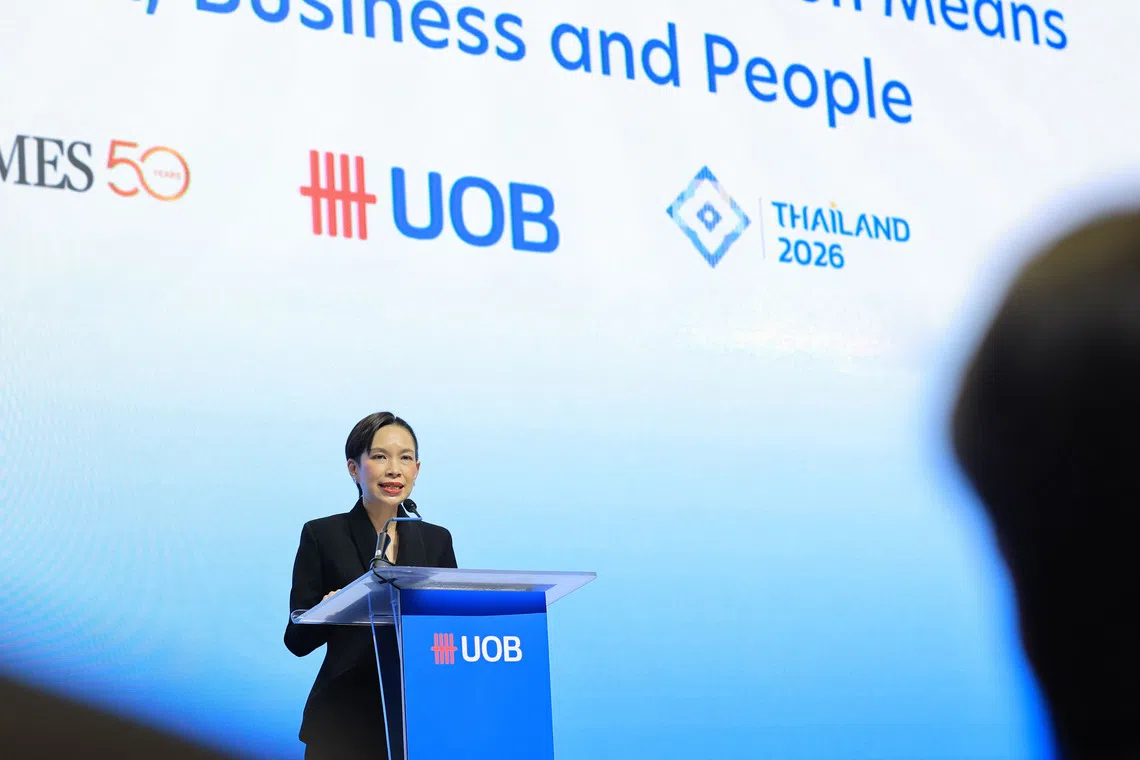
In her opening remarks, the assistant governor highlighted the importance of capital with purpose in practice.
“For financial institutions, businesses and policymakers, our task is not simply to mobilise more capital, but (also) to help it reach credible solutions that build resilience and strengthen the country’s competitiveness,” she said.
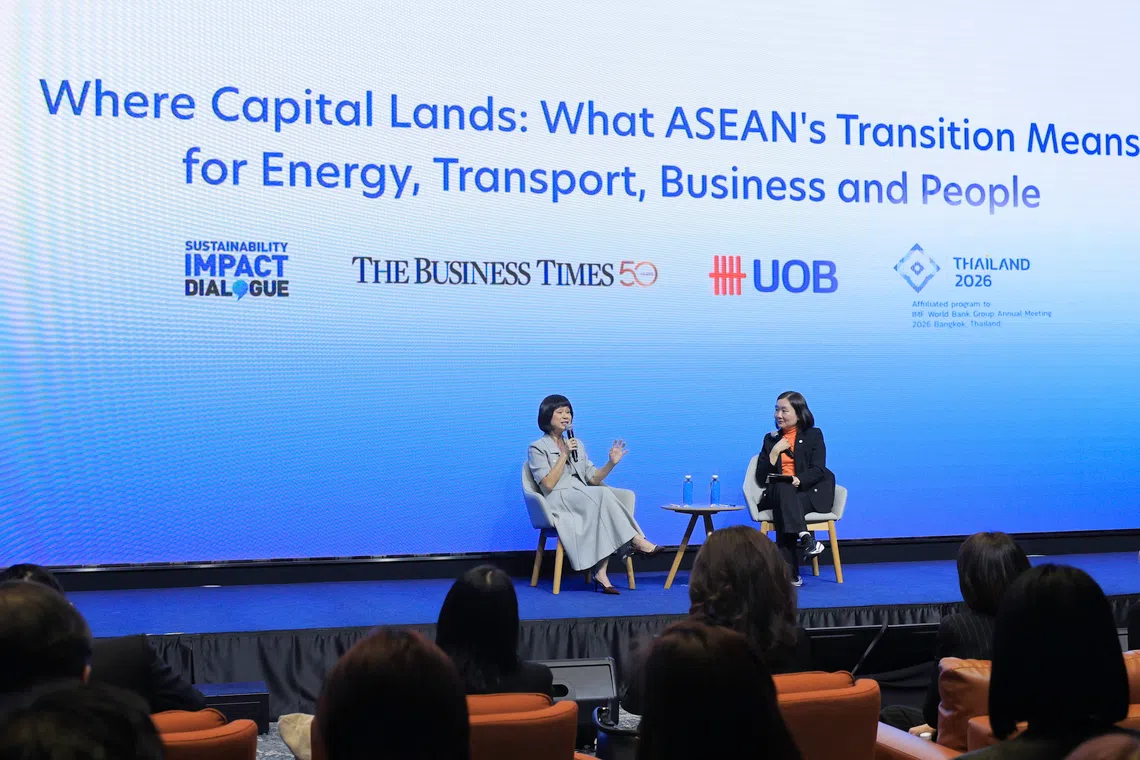
Dr Amy Khor, Singapore’s former senior minister of state for sustainability and the environment as well as transport, spoke at a fireside chat moderated by BT editor Chen Huifen.
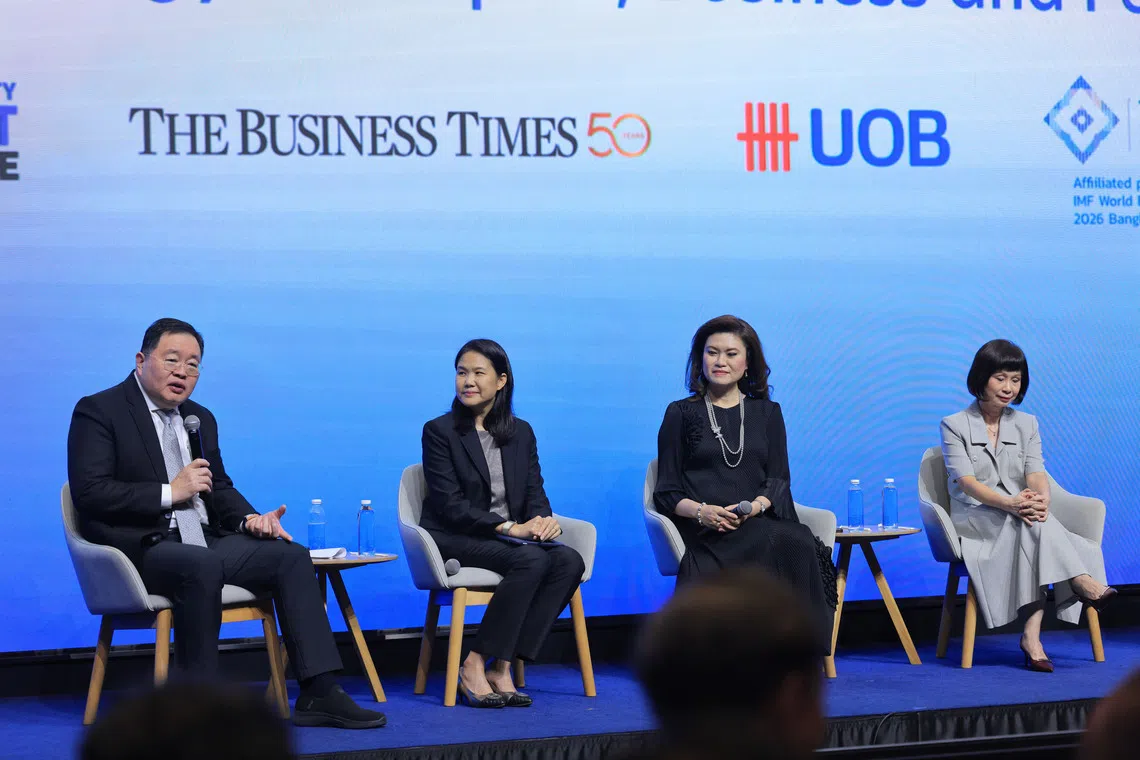
The retired politician also joined the panel discussion moderated by Chow Wong Yuen, chief sustainability officer and head of financial institutions at UOB Thailand.
The hour-long discussion featured Dr Kirida Bhaopichitr, Thailand’s vice-minister for commerce, and the kingdom’s representative on the governing board of the Economic Research Institute for Asean and East Asia.
The other two panellists were from the private sector: Chompan Kulnides, chief sustainability officer of Thailand-listed hospitality and leisure giant Minor International; and Thammasak Sethaudom, president and CEO of the kingdom’s largest industrial conglomerate Siam Cement Group (SCG).
Where money is moving
Asked where Asean’s transition investment is likely to see the strongest growth, Dr Khor and Thammasak both made a case for power grids.
Dr Khor said: “Three focus areas that we can place some bets on: renewable energy and grids; the second one will be about low-carbon transport and mobility infrastructure; and the third one will be on energy-efficient industrial and digital infrastructure.”
She pointed to the recent Leaders’ Retreat between Singapore Prime Minister Lawrence Wong and Thai PM Anutin Charnvirakul, both of whom reaffirmed the importance of developing multilateral and multidirectional power trade in the region and agreed to work towards establishing the Asean Power Grid.
Minor’s Chompan believes that capital will flow to where risks and returns are understood and measurable.
For hospitality operators, that means investments that both meet sustainability commitments and generate operational savings.
In Thailand, where businesses face repeated floods and often significant damage, she expects more capital to go towards mitigating risks related to climate events – not necessarily for immediate returns, but to protect the future sustainability and well-being of businesses.
How corporates put the capital to work
This logic extends beyond where capital is deployed to how companies decide where to put it and how they weigh transition investments against competing uses of the same money.
SCG, which operates in among the hardest sectors to decarbonise – cement, construction materials, chemicals and packaging – offers one example of a trade-off that paid off.
Cement is the group’s highest-emitting business, but also a low-value-added, capital-intensive and slow-growing one, said Thammasak.
He noted: “When I was the chief financial officer, the first thing I tried to do was sell the business.”
Instead, SCG decided to invest in low-carbon cement, concluding that nobody else could decarbonise the business as effectively.
But when it made the investment six years ago, there was no market for it as the regulatory framework in Thailand then did not allow the use of low-carbon cement, he said. Undeterred, SCG doubled down on its investment and worked to improve its product and push for updated industrial standards.
“We moved the whole cement industry in Thailand to low carbon and now everyone is (doing it),” remarked Thammasak. “It helped the cement industry in Thailand to stay more competitive and more profitable.”
The experience illustrates the trade-offs involved in transition investment, he added. Companies often have to absorb upfront costs first before generating returns.
But the key is to ensure that the investment is spread out over time, he said. “If I spread it over four years, six years, or even 10 years, you may not even notice.”
Who pays first?
But with such green initiatives often costing more before they cost less, panellists were posed the question of who should absorb the burden in the early stages: the producer, customer, lender or government.
Dr Kirida maintained that it has to be done in a collective way, but argued that she would advocate for equity over equality.
“If micro, small and medium enterprises have to pay as much as big companies or as the government, they will not be able to afford it; retail customers could not be able to afford them as well. We all have a part to play, but (our share of) the pie might not be of the same size,” she said.
Dr Khor agreed that everyone has a part to play – costs should be shared but not equally.
“Producers, for instance, can work on improving technology, optimising and so on, to reduce costs. Consumers may have to pick up some of the green premium,” she noted.
She continued: “Financiers too can do their part – if they are very objective and try to understand the risks better, maybe they can lower the financing cost. The government (then comes in) in terms of regulation, incentive, as well as enabling infrastructure.”
Decoding Asia newsletter: your guide to navigating Asia in a new global order. Sign up here to get Decoding Asia newsletter. Delivered to your inbox. Free.
Copyright SPH Media. All rights reserved.






