

Grab US listing: Anthony Tan's super vote and 4 notable details



SUPER-VOTING rights, deep losses and regulatory risks are in the spotlight for Grab, as the nine-year-old company guns for the public markets.
Grab, whose core businesses are ride hailing, delivery and financial services, is pursuing a US$39.6 billion merger with a US-listed SPAC (special purpose acquisition company) with some notable features.
A deeper look at Grab's financial figures and shareholding details reveals some interesting aspects of its post-listing strategy. Here are five things to note from regulatory filings:
1. Super vote for a "super app"?
Grab's chief executive Anthony Tan will control 60.4 per cent of the company's voting power after the SPAC merger, thanks to a dual-class structure that will grant the co-founder disproportionate voting rights.
This mirrors the controversial practice of "super voting" shares by some US tech companies.
According to a cap table on Grab's presentation, he will own a 2.2 per cent stake in the company post-merger, comprising 162.9 million Class B ordinary shares. Each Class B share is entitled to 45 votes, in contrast with the one vote accorded to each Class A share.
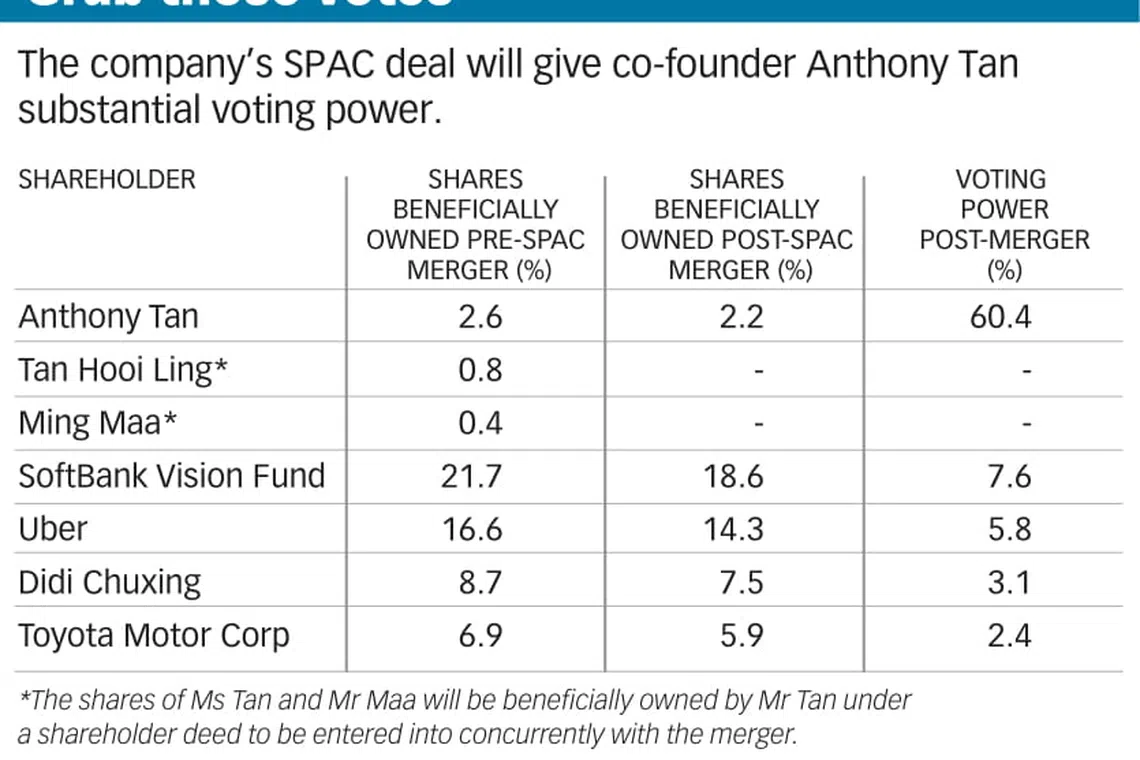
Of his total stake, 122.8 million shares are under his own name, 25.6 million shares under co-founder Tan Hooi Ling and 14.4 million shares under Grab president Ming Maa. The shares of Ms Tan and Mr Maa will be beneficially owned by Mr Tan under a shareholder deed to be entered into concurrently with the merger, the filing states.
FULL STORY: Grab to give Anthony Tan 60.4% voting power
2. Risks include corruption and reclassification of gig worker
In its outline of risk factors, Grab said it has "substantially completed" an investigation into potential violations of certain anti-corruption laws related to its operations in one of its markets. It has voluntarily self-reported the potential violations to the US Department of Justice, it said.
The company does not believe the issues would result in material financial penalties.
Separately, Grab noted that if its drivers were reclassified as employees, there may be adverse business, financial, tax and legal consequences for the company.
This comes as jurisdictions around the world debate the issue of gig worker rights and protection. Uber reclassified its 70,000 drivers in the UK as "workers" entitled to a minimum wage, following a Supreme Court ruling on a case brought against the company. The European Union is drafting plans for a reform on gig worker rights and statuses.
In South-east Asia, labour leaders and the authorities in Singapore and Indonesia have looked into legislation surrounding self-employed persons.
3. Path to profitability
Grab recorded a net loss of US$2.7 billion in FY2020 ended December, on the back of US$1.2 billion in net revenue (gross billings less base and excess incentives). This marked an improvement from the US$4 billion loss in FY2019, with US$455 million recorded in net revenue.
The delivery segment was the main driver of revenue growth, likely boosted by the Covid-19 pandemic. Adjusted net revenue (gross billings less base incentives) rose from US$0.2 billion to US$0.8 billion in 2020.
And despite the spotlight on South-east Asia's largest market, Indonesia, no single country contributes more than 35 per cent of adjusted net revenues for Grab.
The group's liabilities significantly outweighed its assets. Total liabilities stood at US$11.8 billion as at Dec 31, 2020, against total assets of US$5.5 billion.
This was largely due to US$10.7 billion in liabilities from convertible redeemable preference shares after several rounds of fundraising. The company had cash and cash equivalents of US$3.5 billion.
4. Valuation appears more bullish than peers
Grab's US$39.6 billion valuation would be more than double its latest US$16 billion valuation. Based on the company's pre-money enterprise value (EV) of US$30.4 billion, analysts noted that some peers have more sobering revenue multiples.
Grab's valuation could be pegged to that of Sea. According to consensus estimates on Bloomberg, Sea is expected to hit an enterprise value (EV) 10 times its revenue by 2022. Meanwhile, Grab's presentation implies a FY2022 EV to net adjusted revenue multiple of 9.2 times.
However, some reckon that Grab's valuation should be much more conservative than that of Sea, given clear divergences in how the companies were affected by the pandemic: Sea was a beneficiary, and Grab took a hit to its ride-hailing business.
Analyst Shifara Samsudeen, who publishes on SmartKarma, said in a Tuesday note that Grab's proposed valuation "seems over-ambitious", as "Alibaba Group and Tencent Holdings, which operate across multiple businesses including fintech, are currently trading at much lower multiples".
Grab's peers in food delivery and ride hailing, Doordash and Uber, have similar multiples, but both are expected to be Ebitda-positive by 2022. Grab is expected to be Ebitda-positive only by 2023.
DoorDash's projected FY2022 revenue is about 9.4 times its enterprise value; Uber has an EV-to-revenue ratio of 5.4 times.
5. Deliveries a major growth driver
Grab expects its deliveries business to be the biggest driver of adjusted net revenue by 2023. Overall, it is projecting to hit US$4.5 billion in adjusted net revenue in three years, of which delivery will account for 48.9 per cent.
A key metric to watch would be its take rate, which refers to the percentage of adjusted net revenue the company keeps from gross merchandise volume. Delivery's take rate climbed from 5 per cent in 2018 to 15 per cent in 2020.
This is expected to remain steady for the next three years. Still, it is forecasted to be lower than mobility's 20 per cent steady-state take rate by 2021.
Meanwhile, Grab is attempting to diversify its financial services arm. Payments accounted for 93.6 per cent of the segment's adjusted net revenue in 2020, before adjusting for intercompany transactions.
In fact, the company expects payments revenue to trend downwards till FY2022, possibly affected by increased competition from the likes of Shopee and Gojek-Tokopedia.
That said, adjusted net revenue from financial services is expected to grow at an annual rate of 23 per cent from 2020, to US$630 million in 2023. There is a notable 43.5 per cent year-on-year jump in 2023, possibly partly due to plans to launch a digital bank in Singapore in 2022.
READ MORE:
TRENDING NOW

Government to bring forward raising of retirement age, give employers more financial support to create flexi-load jobs

If Europe goes to war, the fallout will be felt in East Asia

Indonesia stocks suffer worst plunge in nearly 30 years as MSCI proposes standalone status

Vietnam’s northern provinces, not Hanoi or Ho Chi Minh City, are powering near 10% GDP growth

