

Employment in Singapore falls by record 103,500 in Q2

Singapore
EMPLOYMENT fell by a record 103,500 in the second quarter of the year, a staggering four times the previous record contraction - in the first quarter - of 25,600, according to the Singapore Ministry of Manpower's Labour Market Report on Monday.
But other major indicators such as retrenchments and unemployment stayed below past peaks, as firms took cost-saving measures for an unprecedented number of workers.
To "detect shifts in the employment situation in a more timely manner", the MOM will release unemployment rates on a monthly basis.
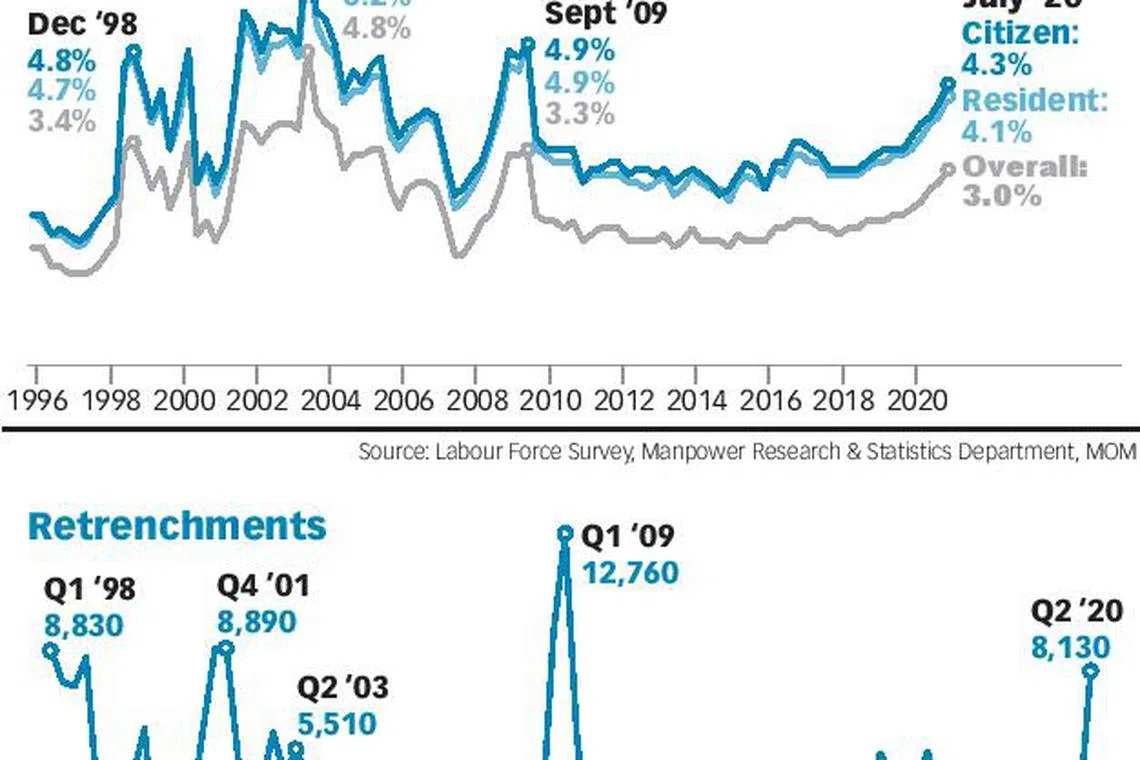
Retrenchments more than doubled to 8,130 in the quarter, compared to 3,220 in the first quarter. This was still below previous peaks during the dotcom bubble and the Global Financial Crisis.
Just over half of those retrenched were PMETs (professionals, managers, executives and technicians), with the incidence of retrenchment rising sharply for non-PMETs.
The sharp rise in retrenchments came even as firms took temporary cost-saving measures to retain staff, with a record number of employees affected. In the second quarter, 43,130 employees were placed on temporary layoffs, while 38,600 were placed on a short work week. Such measures likely reduced the number of retrenchments, said the MOM.
But the number of such workers may fall in the months ahead, said OCBC head of treasury research and strategy Selena Ling, as firms start to recognise "that the new normal for certain industries like aviation and hospitality will take months if not years to recover".
Seasonally adjusted unemployment rates rose over the quarter, with the overall unemployment rate at 2.8 per cent in June, up from 2.4 per cent in March; the resident unemployment rate at 3.8 per cent, up from 3.3 per cent; and the citizen unemployment rate at 4 per cent, up from 3.5 per cent. But these, too, were below past recessionary peaks.
With 24,000 job seekers placed into opportunities curated by the National Jobs Council from March till July, "this probably mitigated the fallout in the labour market and helped to keep the unemployment rate lower than otherwise would have been the case", said Ms Ling.
The increase in the resident unemployment rate was driven by a rise in short-term unemployment, as the seasonally-adjusted resident long-term unemployment rate actually dipped marginally to 0.8 per cent, from 0.9 per cent previously.
The resident rate of re-entry into employment after six months declined to a low of 58.4 per cent.
Job vacancies edged down to 42,400 as at June, from 46,300 in March. Together with the increase in unemployed persons, this lowered the seasonally adjusted ratio of vacancies to unemployed persons to 0.57 in June, down from 0.71 in March.
Some sectors did, however, see more vacancies in the second quarter compared to the first quarter. These sectors included public administration and education, administrative and support services, as well as food and beverage services.
With employers deferring hiring and employees less likely to leave jobs, the seasonally-adjusted recruitment and resignation rates fell to respective record lows of 1.1 per cent and 1.2 per cent.
Sectors seeing the greatest falls in employment during Q2 were those hit hardest by "circuit-breaker" and safe-distancing measures, such as construction (-13,600), food and beverage services (-22,900), retail trade (-8,000), arts, entertainment and recreation (-7,600), and administrative and support services (-7,600).
Weak external demand also took a toll on employment in the wholesale trade (-7,900) and manufacturing (-8,900) sectors, although the electronics sub-sector recorded a rise in employment with 1,000 more workers in the second quarter.
With the latest figures, total employment excluding foreign domestic workers contracted by 129,100 in the first half of the year. The losses were disproportionately in the foreign workforce, with foreign employment falling 5.7 per cent or by 66,400, compared to the 2.7 per cent or 62,700 decline in local employment.
Firm closures accounted for just 3.8 per cent or 2,355 of the decline in local employment in the first half.
In a separate statement, the MOM said it expects softness in the labour market to persist, "with continued weakness in hiring and pressure on companies to retrench".
But it noted areas of strength in the economy, with expected growth for electronics and precision engineering, biomedical manufacturing, information and communications, as well as finance and insurance.
Economists expect indicators to remain gloomy in the coming months. Labour market conditions are likely to remain challenging into the fourth quarter, said Ms Ling, noting that recent surveys show persistent caution over the economic outlook and hiring intentions.
UOB economist Barnabas Gan sees the overall unemployment rate rising to 3.5 per cent by the end of the year.
Expecting retrenchment and unemployment to keep rising in Q3 and Q4, National Trades Union Congress assistant secretary-general Patrick Tay urged businesses and workers to continue with restructuring and reskilling, in a Facebook post.
READ MORE: Precision engineering is growth industry for Singapore: Chan
TRENDING NOW

Simba admits exceeding spectrum limits amid failed M1 deal; parent company Tuas’ full-year profit surges 277%

‘Our bread and butter’: Family-run Loo’s Hainanese Curry Rice hands reins to third generation

StarHub, Keppel confirm talks over potential M1 deal

Grab executives buy back shares after stock hits 3-year low on Atome deal

