Infrastructure offers 'silver lining' amid global slowdown
Surbana Jurong chairman Liew Mun Leong says TPP, One-Belt-One-Road initiative can reignite global growth
Singapore
AMID slowing global growth, mounting political uncertainty and divergent monetary policies, trade pacts that promote infrastructure development are a "silver lining", Liew Mun Leong, chairman of Surbana Jurong and Changi Airport Group believes.
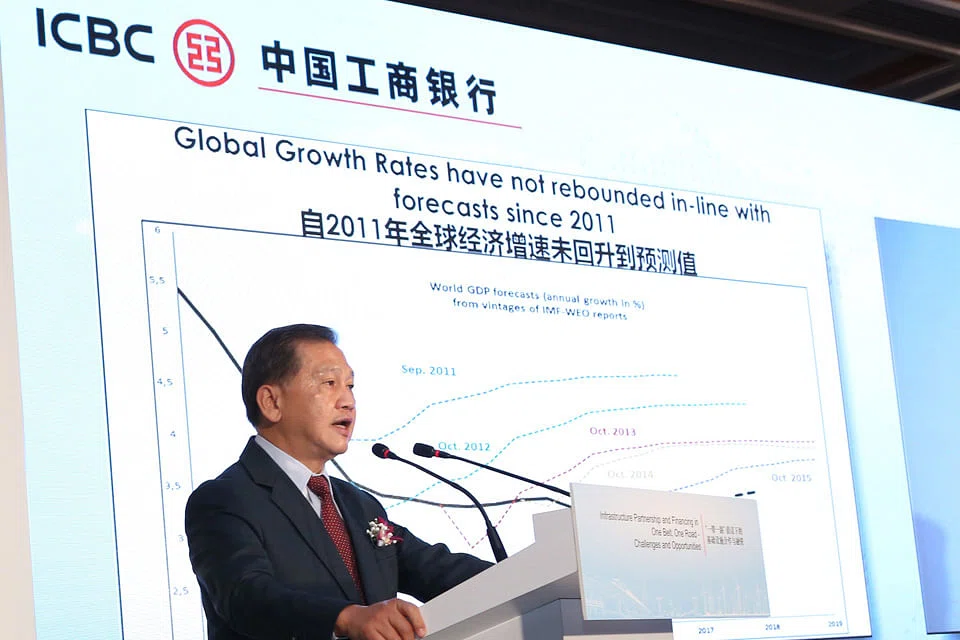
He said this at a forum hosted by the Industrial and Commercial Bank of China (ICBC) and Surbana Jurong on Monday. His views were echoed by others. "We are all acutely aware that the global economy is again slowing down after the relatively few good years of recovery from the global financial crisis (GFC). The International Monetary Fund had in July downgraded the world economic outlook for 2016 from 3.2 per cent to 3.1 per cent. Globally, investment is weak, with world trade slackening behind global income. Uncertainty abounds in the sudden awakening that Britain will leave Europe. We now live in a world of heightened fears of global terrorism and increased security problems.
"As many developed countries are experiencing income stagnation, inequality of incomes have created backlashes to capitalism in general and globalisation in specific. Migration is now facing a pushback as countries start to review their immigration policies. Political malaise in the Middle East and the US election are certainly not helping to shore up confidence in the global economy."
Mr Liew believes that amid such "doom and gloom", the two major stimuli that may reignite global growth are the Trans-Pacific Partnership (TPP) and the One Belt, One Road (OBOR) programme. The OBOR, he believes, can help facilitate trade between China and potentially the 64 other participating countries, thus powering growth among the world's economies. It is widely agreed that infrastructure spending has a multiplier effect on economic growth.
McKinsey estimates that the OBOR initiative could cost as much as US$2 trillion to US$3 trillion a year. Mr Liew said that people often ask him why is China, which is itself facing an economic slowdown at home, promoting such an enormous overseas investment programme. "My response is simply that the economic slowdown is precisely the reason why China is promoting this trade expansion programme," he said.
This probably stemmed from the country's success in 2009 when it injected four trillion yuan (S$800 billion) to fuel its domestic economy with more infrastructure projects. This in turn improved the global commodity trade with emerging countries, especially in basic construction materials, and hence averted a free fall in their economies.
"My view is that if an infrastructure project is correctly conceived, well-planned, properly managed and sufficiently financed, it can be expected to generate stronger returns than many traditional investment projects."
An infrastructure programme also helps boost a country's development industry, from technical service providers such as planners, architects, engineers, project managers, contractors, to associated professional services such as accountants, lawyers, bankers and insurers.
Echoing Mr Liew's sentiment on the potential of infrastructure development, Yaseen Anwar, senior adviser at ICBC Singapore, when speaking on the unabated post-GFC economic tremors, said: "What flicker of hope do we have that could trigger the reforms and stabilise the economy going forward? While collective action from all major economies is essential, one of the key initiatives . . . is the OBOR initiative."
Other volatility indicators he listed were the US$2.2 trillion of capital destruction in global stock markets in January this year, negative interest rates, Europe's sovereign debt crisis and austerity measures, sluggish US growth, and the continuing commodity crisis.
Ambassador of China to Singapore Chen Xiaodong also reminded that President Xi Jinping had stressed at the G-20 Hangzhou Summit two weeks ago that the benefits of infrastructure connectivity should be used to improve the standing of developing countries and small and medium-sized enterprises in the global value chain.
Lim Hng Kiang, Singapore's Minister for Trade and Industry (Trade), also took the opportunity to encourage more partnerships between Singapore and China entities, such as the one between Singapore engineering firm ISDN and power-cum-industrial player China Huadian Engineering to develop mini-hydropower projects across Indonesia since 2014.
At the event, five cooperation agreements were signed between ICBC and Singapore Press Holdings, Singapore Business Federation, Singapore Exchange, Sinochem International and Surbana Jurong on a range of projects and initiatives.
READ MORE: Creativity around infra financing not yet exhausted: AIIB