Pandemic prompts manufacturers to rejig supply chains, operations
Many will likely diversify supply chains, operations by choosing suppliers closer to home in the short term, while setting up facilities in more places
Singapore
AS BUSINESS gradually resumes in the recovery phase of Singapore's pandemic response, manufacturers here are making major changes to their supply chains and operations in facilities both locally and abroad. This is both to comply with regulations and to ensure they are well-prepared for similar crises in future, they told The Business Times.
Consultants said most companies will likely diversify their supply chains and operations by choosing suppliers closer to home in the short term, while setting up facilities in more countries.
"The risks of outsourcing production are seen when supply chains do not have the resilience to cope with disruptions. In the short term, we may see the shift to restructure and localise supply chains and move production and sourcing closer to home," said Graham Conlon, head of digital supply chain at SAP Asia Pacific and Japan.
He added that in the longer term, manufacturers will need to design better supply chains, using digital tools and creating "parallel supply chains" that will allow them to predict and respond rapidly to new developments.
Kuntha Chelvanathan, global procurement capability leader and partner, supply chain and operations at Ernst & Young Advisory, said companies are reducing the number of nodes in their supply chains while diversifying sources to reduce potential points of failure. However, she noted that this cannot be done for every product, and manufacturers will have to analyse and prioritise the changes based on impact to demand, cost and efficiency.
Sudhan Sundaram, managing director, supply chain and operations lead (consulting), Singapore at Accenture, said expanding or relocating manufacturing operations will involve many factors beyond cost.
"(Organisations) will need to consider the ease of doing business, speed of operations, quality of the labour pool and availability of technology and platforms. Improved infrastructure that facilitates the inflow and outflow of goods and a connected and agile ecosystem will also help organisations to set up efficiently and give them an opportunity to scale and be best in class," Mr Sundaram said.
Companies said they will actively lower their risks by changing common practices such as picking suppliers based on cost rather than proximity and operating on a "just-in-time" basis with minimal inventory. If they have factories in more than one country, they will also look to create localised supply chains for each location.
Berne Chung, CEO and managing director of Component Technology, which manufactures machinery for the semiconductor industry, said: "If our factory is in Suzhou, our suppliers should also be from Suzhou. The whole problem now is that if your location is not locked down but your suppliers from other regions are, you can't get your supply.
"This is a major change in our mindset, but it also means costs will be higher because we can't just go for the cheapest supplier."
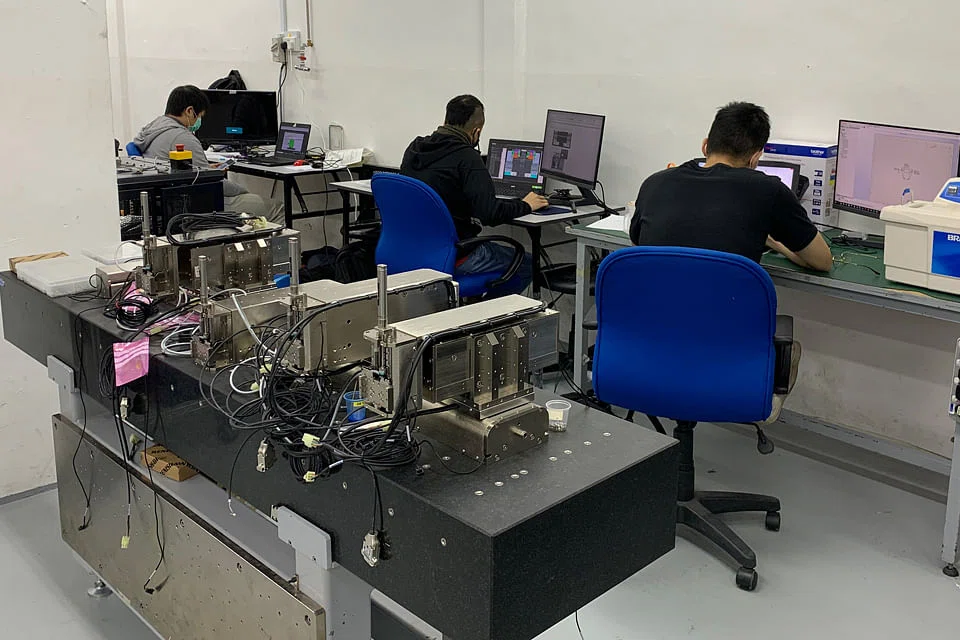
Having full-fledged factories in more locations will help cushion the impact of global crises, as it did for Akribis Systems, which produces drive motors, stages and precision systems. CEO and managing director Leow Yong Peng said its factory in Singapore fulfilled the majority of Akribis' orders while its Chinese factories were under lockdown, and vice versa during Singapore's circuit breaker.
Said Mr Leow: "It looks like centralising all functions in each factory is essential to reduce the risk at the expense of efficiency, versus having each factory focusing on just a specific operation for efficiency and the sake of sustainability."
Mei Reading, global marketing director at Griffin Group International, which manufactures air filtration systems and components, said the company will strengthen its supply of downstream materials by adding a production line for melt-blown fabric. The fabric is used in surgical masks as well as Griffin's air conditioner filters, and the company found itself paying nearly six times the usual price for it at the height of the pandemic in China.
In some areas, the Singapore government may need to step in to localise capabilities that are out of reach financially for individual companies. For instance, some companies in the biomedical field have been sending their products to be sterilised in Malaysia because Singapore does not have a facility for the gamma sterilisation process they need.
Goh Khoon Seng, CEO of bioresorbable implant manufacturer Osteopore, said Malaysia's movement control order has restricted access to the steriliser facilities there, and his output has been erratic as a result. Osteopore recently started validating sterilisers in countries where its customers are based.
"Being a small company, we can't afford to build our own sterilisation facility here," said Mr Goh. "But there are requests being made to EDB (the Economic Development Board) and MTI (the Ministry of Trade and Industry) to set up a gamma sterilisation facility in Singapore, to cater to the biomedical technology space."
He believes such facilities will be crucial especially in health crises, because the sterilisation methods available here either do not work well for all medical products or require an aeration period to eliminate the toxic gases used in the process. "In a crisis like this pandemic, we need high volume production and we need to sterilise things like masks. We cannot be waiting seven days for the gas to dissipate before we can use them."
Manufacturers will be making major changes to their workflows and physical operations as well. Mr Chung of Component Technology said his first priority is to reshuffle assignments and switch to a modular assembly format for his staff, rather than having them work together to assemble machines. He is also considering replicating some of Singapore's safe distancing measures in his Malaysia factory, such as spreading workers out over two shifts instead of one.
Theo10, which manufactures and retails natural skincare products, anticipated the need for more physical separation between workers and added an additional level to its work space when it renovated its premises in February.
Akribis' Mr Leow said redesigning his shop floors to accommodate the new safety distance requirements will be high on his list of priorities. He foresees needing to make "major renovations" to his factory layout to ensure the new work flows are efficient.
He added: "Accelerating the digital transformation of the factory into a smart factory has to be moved up the priority list. Deploying robots into the work space is no longer just a feasibility study. Instead, it has become a necessity."
Mr Goh of Osteopore said manpower has been an issue for some time, with high costs and few willing to take up the jobs available. "We have been already looking at going towards automation, so we can upgrade our products and technicians and they can do more value-added jobs."
The impact of these changes on communication and employee assessment will need to be addressed too, said Mr Leow of Akribis. "In order to prevent different groups working in silos, new collaborative work habits and mindsets need to be adopted and perfected fast. We will see more staff who do not need to operate machineries or lab equipment start working from home.
"This indirectly allows staff to better achieve a flexible work arrangement. However, a new scheme to ensure a good level of contribution despite working from home, creative goal setting and results measurement, benefit and compensation will have to be overhauled to address this new norm."