



Abandoned ‘Titanic’, failing ‘ancient towns’: Why China’s tourism boom leaves white elephants behind
Many ambitious megaprojects across the country have stalled or failed to attract visitors
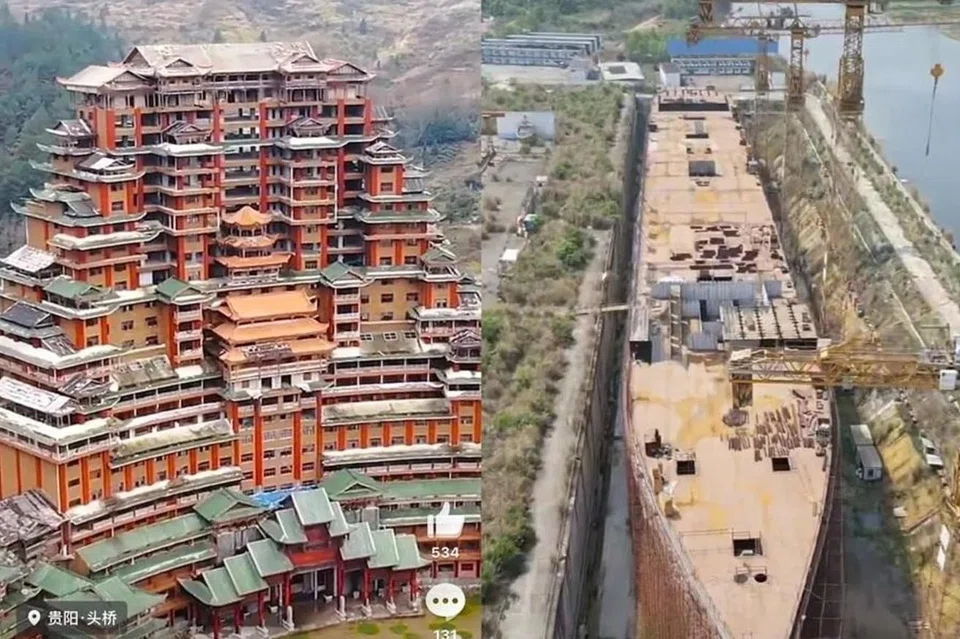
A full-scale Titanic replica, a colossal Water Commissioner’s Mansion and sprawling reconstructed ancient towns. Across China, a wave of ambitious tourism projects is running aground on a simple truth: building an attraction is easier than attracting visitors.
Abandoned ‘Titanic’
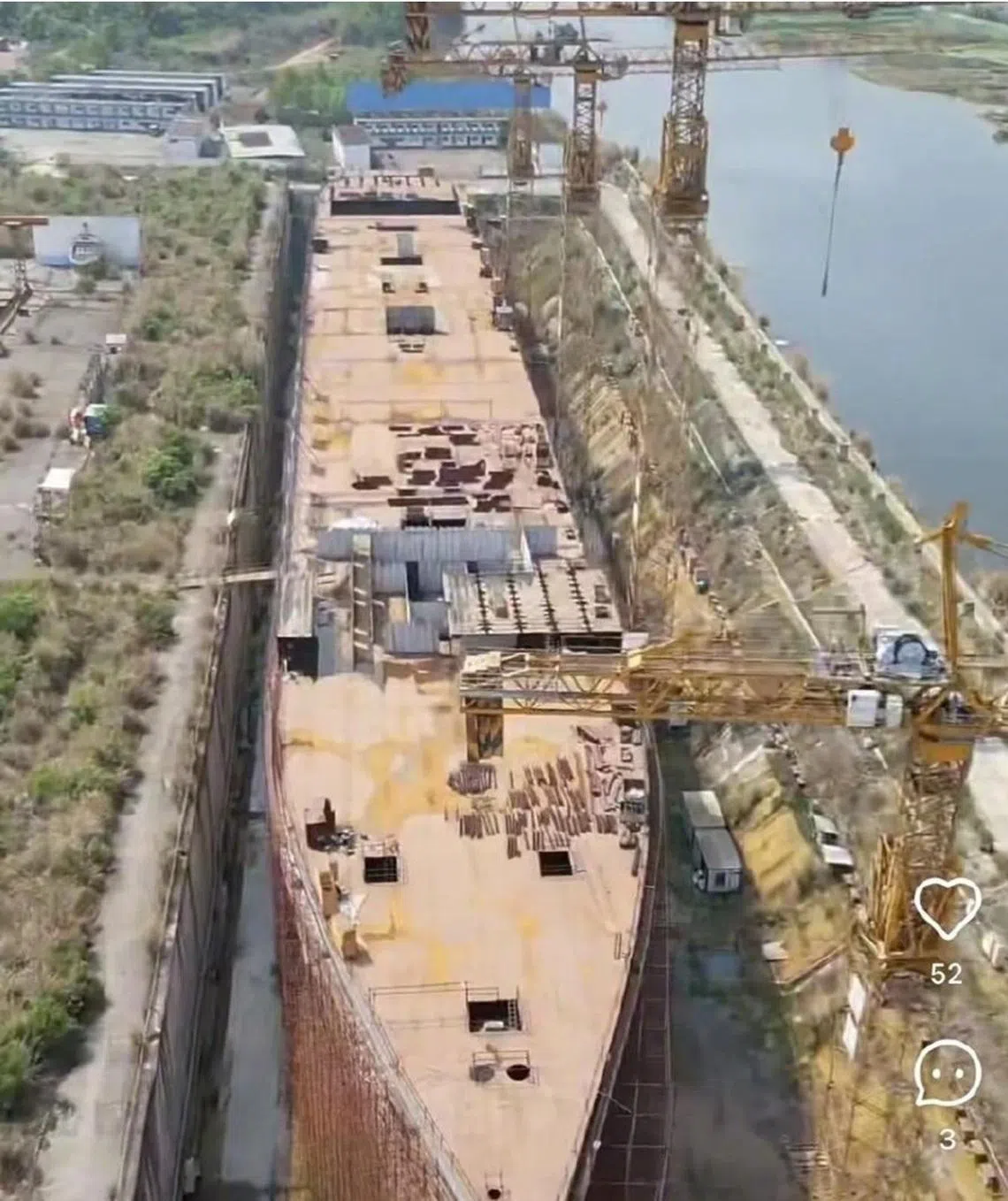
Videos circulating on Chinese social media show a giant unfinished cruise ship sitting abandoned in a dockyard on the banks of the Qi River in Sichuan’s hilly Daying county. Scaffolding and cranes still surround the vessel, but its exterior is now weathered and streaked with rust. Some bloggers have begun treating it as a modern ruin, venturing inside to film videos of its decay.
According to China Newsweek, construction of the full-scale replica Titanic began in 2014, with a planned investment of one billion yuan (S$189 million) and an originally scheduled maiden voyage in 2017. However, the ship is currently only about 90 per cent complete in terms of its steel exterior, and interior outfitting has yet to begin.
Responding to online queries in 2024 about whether the Titanic project would be left unfinished, the Daying county government acknowledged that the project had been suspended after the investor encountered financial difficulties.
Daying county, which invested heavily in the Titanic project only to see it stall, has a permanent resident population of about 370,000. In 2025, its GDP was around 22.1 billion yuan, ranking last among the districts and counties under Suining’s jurisdiction.
Stranded ambition
Daying county is not alone. About 600 km away in Dushan county, under the administration of Qiannan Buyi and Miao Autonomous Prefecture in Guizhou, local authorities began construction of the so-called “World’s First Shuisi Building” in 2016 for 200 million yuan, despite the county’s annual GDP amounting to only about 7.3 billion yuan in 2016. The project later ran into financial difficulties and was forced to suspend construction for a period.
Both Daying and Dushan are remote, economically underdeveloped regions that pinned their hopes on spectacular cultural tourism projects as engines of economic revival. In the end, neither generated the expected boost to local growth, leaving behind unfinished developments and lingering questions about the costs of chasing headline-grabbing attractions.
Tang Renwu, a professor at the Academy of Government at Beijing Normal University, told Lianhe Zaobao that in some counties and remote areas, there is little scope to develop manufacturing, semiconductors, or other heavy industrial projects. Cultural tourism, as a more flexible “soft” sector, offers local officials a greater opportunity to deliver visible achievements.
The problem, however, is that officials are often more concerned with delivering visible achievements during their tenure than with rigorously evaluating whether such projects are economically sustainable.



He said, “What benefits will the project generate? Is it worth the investment? What impact will it have? None of these questions were properly considered.”
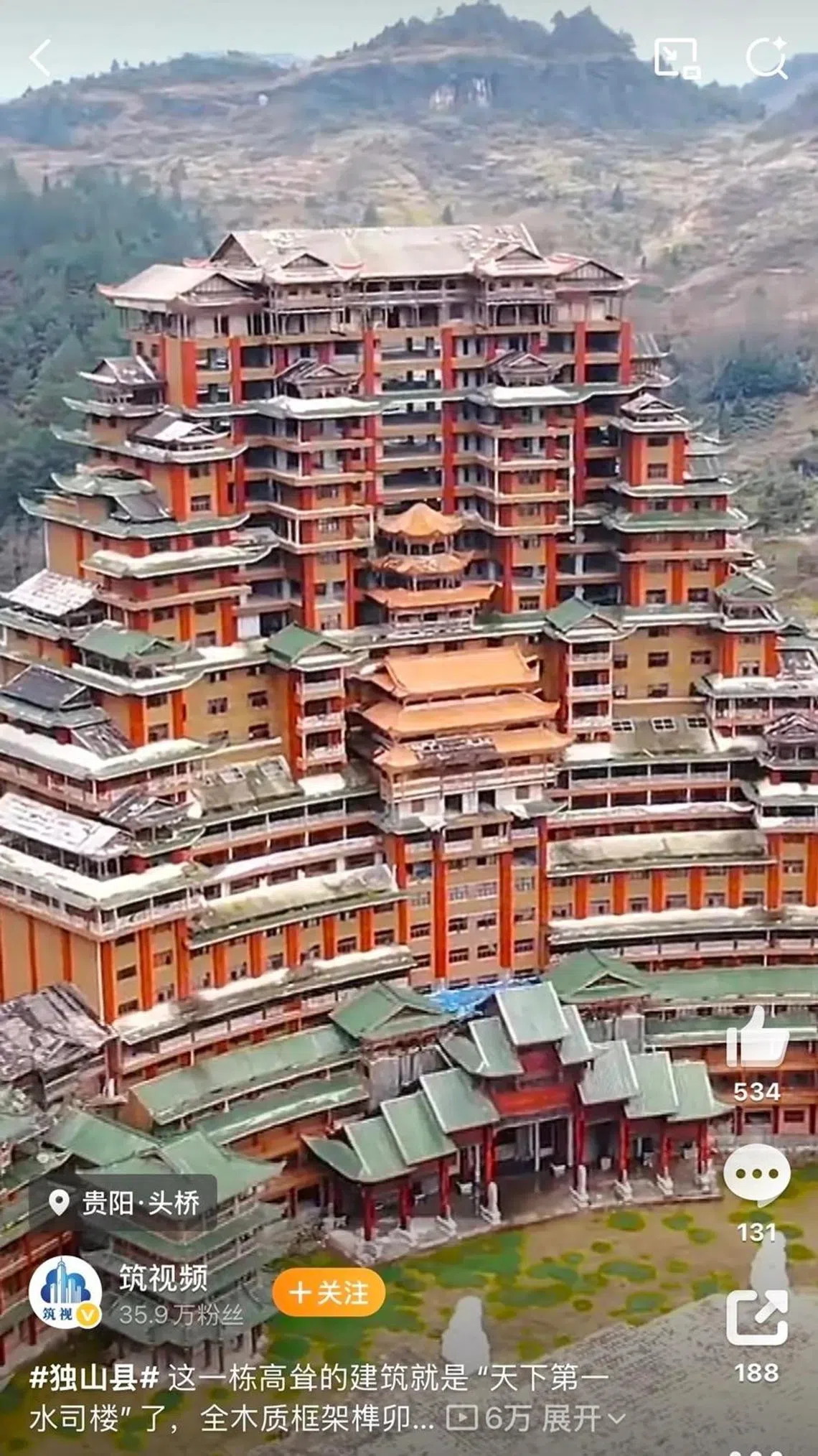
Although Dushan county’s Shuisi Building project was taken over in 2024 and redeveloped into a hotel by the Gemei Group and the Guizhou Tourism Industry Development Group—under the provincial State-Owned Assets Supervision and Administration Commission—the county is still dealing with the fallout, having only emerged from poverty in 2020.
Vanity projects and rising debt
In 2019, China Discipline Inspection and Supervision News, the official newspaper of the Central Commission for Discipline Inspection (CCDI) and the National Supervisory Commission, reported that then-Dushan Party Secretary Pan Zhili had recklessly amassed local debt to finance a series of career-enhancing vanity projects, including the Shuisi Building and what was billed as the “world’s tallest glazed ceramic structure”.
By the time Pan was expelled from the Chinese Communist Party (CCP) and removed from public office, Dushan’s debt had ballooned to more than 40 billion yuan, much of it borrowed at annual financing costs exceeding 10 per cent.
Over the past two years, Dushan’s official assessment of debt risks has shifted from “generally under control” to “effectively contained”. The 2026 government work report highlighted continued efforts to resolve debts accumulated under previous administrations and to take advantage of central government support measures. This suggests that while debt risks in Dushan county have eased, fully resolving them will still take considerable time.
Why officials build big
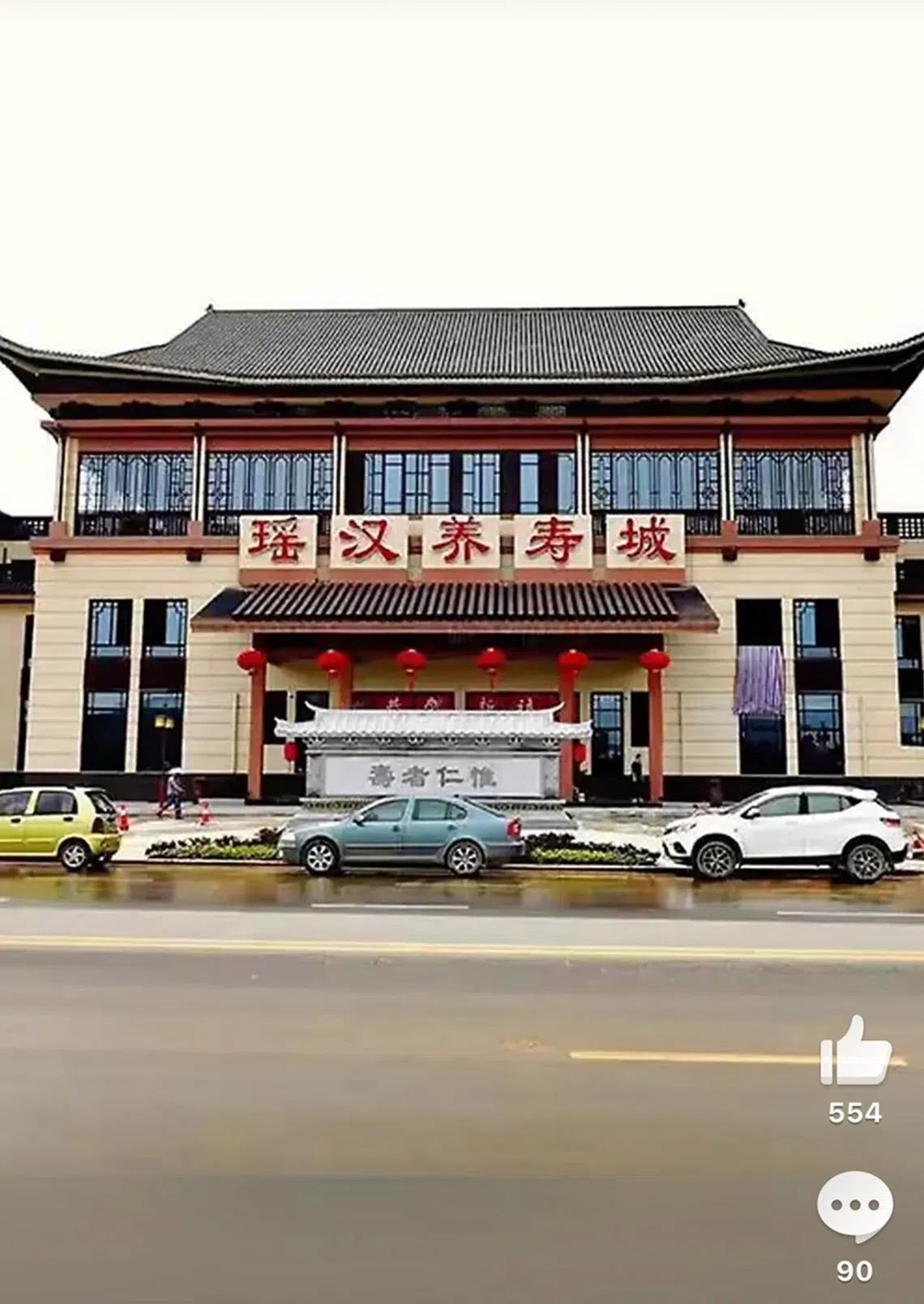
Dushan county and Pan’s case are far from unique. The “Yaohan Longevity City” project, launched in 2018 in Gongcheng Yao Autonomous County, has likewise been left unfinished. Deng Xiaoqiang, who served as the county’s party secretary at the time, was expelled from the CCP and removed from public office in 2022. In 2024, he was sentenced to 19 years’ imprisonment.
In 2026, the CCP launched a party-wide education campaign on “establishing and practising a correct understanding of governance performance”. The move comes amid persistent criticism that some local governments have chased high-profile vanity projects in pursuit of political achievements, often without adequately considering whether local finances and resources could support them.
In a notice issued on Apr 12, the CCDI disclosed that the impoverished Zhaojue county had spent a combined 1.49 million yuan commissioning and promoting three tourism promotional songs. The watchdog also criticised the Hubei provincial department of culture and tourism for directing its affiliated Hubei College of the Arts to commission and market a tourism promotional song for three million yuan.
Tang argued that lavish spending on tourism promotion and large-scale investment in tourism projects share the same underlying problem: decisions driven by the desire to showcase political achievements rather than by rigorous evaluation, a tendency closely tied to the current cadre evaluation system.
Professor Chang Chih-chung of the School of Humanities and Social Sciences at Taiwan’s Kainan University said in an interview that the root of the problem lies in officials’ pursuit of advancement up the political ladder.
He argued that despite repeated calls from Beijing to adopt a correct view of governance performance, the metrics used to evaluate local officials have changed little, leaving their incentives largely intact. Officials are still expected to deliver visible achievements within a limited timeframe, and economic growth and infrastructure projects tend to become primary targets in the pursuit of political performance.
Chang added that such projects are often large, capital-intensive undertakings that proceed without adequate feasibility studies or rigorous evaluation. As a result, they are particularly vulnerable to funding shortfalls and can easily be left unfinished when outcomes fall short of expectations.
From ancient town to ghost town
According to a 2021 analysis by NetEase Datablog, 63 cities in China have developed “Little Santorini”-style attractions, while 62 have launched “Little Kyoto”-style replicas, highlighting the severity of homogenisation in tourism and cultural development projects. In recent years, the boom in “ancient town” developments has become a particularly striking example of this trend.
The 2024 China Ancient Town Tourism Development Report published by the China Tourism Academy found that over 50 per cent of respondents believe there is a degree of similarity between ancient towns, while 38.5 per cent feel that ancient towns lack uniqueness.

Xu Jian, a professor with the School of Media and Communication at Shanghai Jiao Tong University, thinks that the high degree of homogenisation in the commercial development of ancient towns stems from the fact that, for local governments, replicating existing models, rather than developing their own cultural intellectual property (IP), is the lowest-cost and most readily implementable option.
He said, “This kind of format may be attractive at first, but it often lacks sustained consumption momentum. A local tourism and cultural IP cannot be created out of thin air; it must be rooted in local life.”
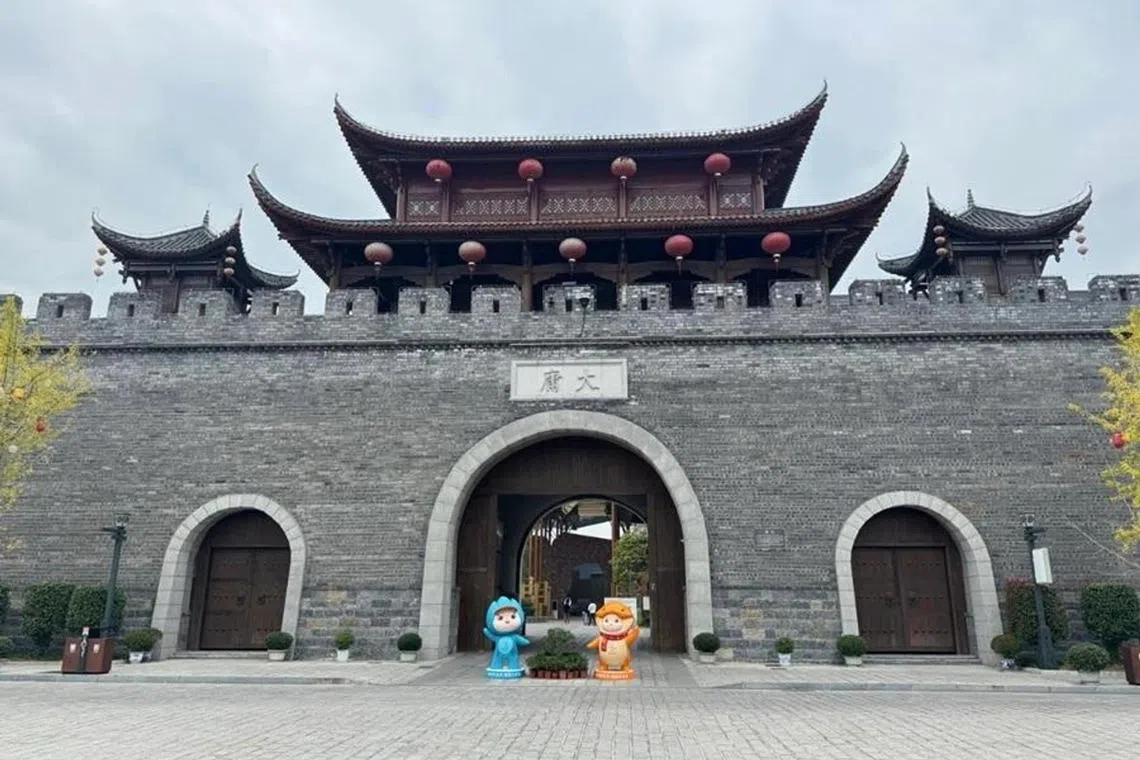
According to statistics from the research institute for China’s ancient cities and culture, there are more than 2,800 ancient towns across China, many of which have already become “ghost towns”.
Data from information platforms such as Qichacha and Tianyancha show that, of over 27,000 ancient town-related tourism enterprises, nearly 40 per cent are in abnormal operating states, including liquidation, closure or suspension of business.
Among them, the Dayong Ancient Town in Zhangjiajie, which cost 2.4 billion yuan to build, recorded cumulative losses of more than 1 billion yuan during four years of trial operations and is now on the verge of bankruptcy.
Zhang Jianchi, party secretary and chairman of Zhangjiajie Tourism Group, told CCTV’s Focus Report in June 2025 that the problem could be summed up as blindly “following trends”. He said: “they see other ancient towns doing well and think they can just build one too.”
Tang noted that this is also a classic example of a distorted view of political achievement. “They are essentially prioritising short-term results more, hoping to stand out quickly through a single project,” he said.
Property-led tourism boom
During China’s property boom, local governments frequently brought in deep-pocketed developers to spearhead large tourism and cultural projects, a model commonly described as “tourism setting the stage, with property development as the main act”.
Cheng Wei (pseudonym), an engineer at an urban planning and consultancy firm, said the tourism-town boom that swept China around 2016 was essentially driven by local governments seeking to tie tourism development to property projects in order to accelerate land sales and boost fiscal revenues.
According to the 2019 investment and financing report of China’s cultural tourism industry, the country’s cultural tourism investment market was worth 1.78 trillion yuan, with tourism complexes and tourism towns accounting for 90.34 per cent of total investment. The average project attracted 8 billion yuan in funding.
Many of the projects that later unravelled were tourism complexes and tourism towns. A widely circulated 2021 article on the Chinese internet, The Death List of Characteristic Towns, estimated that at least 100 tourism towns had been abandoned or gone bust—a figure industry insiders say may have since doubled.
Cheng said that, in this type of partnership, both local governments and developers often have their own agendas. The former aims to lure developers with minimal infrastructure in place, while the latter depends on government-led improvements to surrounding facilities to lift land values. “Both sides are seeking one-off gains from land and property sales, but neither may ultimately get what they want.”
However, Zhang Xiaoduan, deputy dean of the Cushman & Wakefield Research Institute, does not fully agree. “In a good project, real estate and tourism operations should complement each other, and there is value in combining the two. But operations require a certain level of expertise and should be handled by more professional teams,” she said.
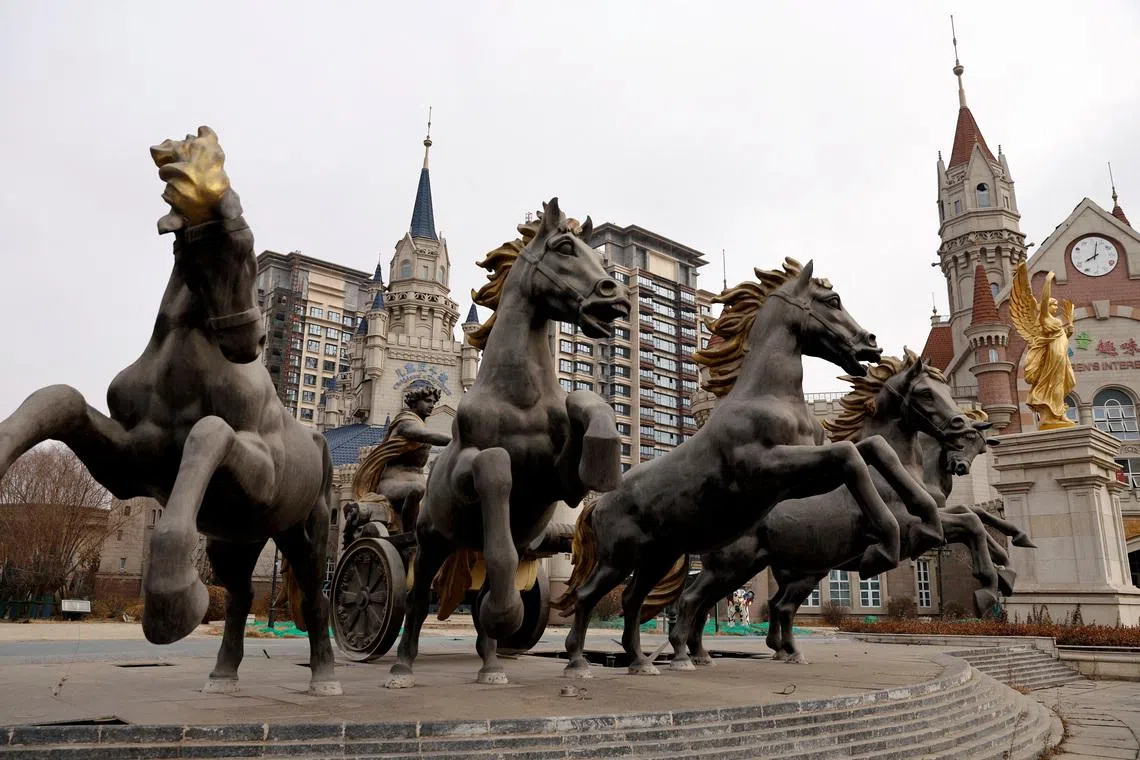
China Evergrande Group’s tourism arm once developed a series of large-scale projects, including Evergrande Fairyland and Evergrande Cultural Tourism Towns. Its sales surged from about 28 billion yuan in 2017 to over 100 billion yuan in 2020 in just three years, briefly making it a major player in the cultural tourism sector. However, following Evergrande’s debt crisis, nearly all of its projects under construction have since stalled.
Zhang said China’s consumption recovery has been sluggish amid a broader macroeconomic slowdown, even as demand for holiday travel remains strong. While opportunities remain for well-designed cultural tourism projects, investors are becoming more cautious, and operations will need to be increasingly professional.
This article, translated by Grace Chong, was first published on ThinkChina, an English-language digital magazine under Lianhe Zaobao.
Decoding Asia newsletter: your guide to navigating Asia in a new global order. Sign up here to get Decoding Asia newsletter. Delivered to your inbox. Free.
Share with us your feedback on BT's products and services
TRENDING NOW
US dollar falters after Iran’s offer to reopen Hormuz sends oil lower

He built the Vingroup empire. Now South-east Asia’s richest man is handing some key roles to his sons

Prudential announces regional leadership changes, including for Singapore, Indonesia

Indonesia court cuts Gojek founder Nadiem Makarim’s jail term to nine years

